
Blog
What Experienced Professionals Must Unlearn to Keep Growing
Author:
Premchand Kurup
Reading Time: 8 Minutes
A session at IIM Kozhikode with senior professionals from the defence sector made something clear that extended well beyond their specific situation. The challenges they were preparing to face, losing the authority their rank gave them, adjusting to an environment that runs on influence rather than instruction, and learning to speak a language their careers never required them to learn, are the same challenges that experienced professionals across every field run into when they move into a new environment, take on a broader role, or simply stop being rewarded for the things that made them successful before.
This is about those challenges, and what to actually do about them.
The Point at Which Experience Stops Doing the Work for You
Senior professionals carry something genuinely valuable: years of making decisions under pressure, the ability to manage large and complex operations, a discipline around planning and follow-through that most organizations cannot teach, and a process mindset built through repetition. These are real advantages, and they translate across sectors and roles.
But here is what catches most experienced professionals off guard. The very same traits that built a strong first half of a career can work against someone if applied without adjustment in a new environment.
A senior manager who joins a new organization and immediately leads with the authority they earned in their previous role tends to find the room goes quiet in a way that feels like respect but is actually discomfort. People are not resisting the experience. They are resisting the assumption that experience alone grants authority here.
Authority vs Influence: The Shift Nobody Announces
In structured environments, whether that is a long-tenured role at a large company, a public sector function, or any hierarchy where seniority is well-established, rank does the heavy lifting. Instructions are clear. Execution follows quickly. The system is built for that.
In most corporate environments, and especially in cross-functional or leadership roles at a new organization, the system does not work that way. A job title does not move people. Influence does.
Influence is earned through something different: demonstrating good judgment consistently, building trust with individuals one conversation at a time, and making people feel that their input is considered even when the final decision is yours. A senior professional who walks into a cross-departmental meeting and announces a new direction without having spoken to the relevant stakeholders beforehand will find that the meeting does not go the way they expected, regardless of how correct the direction is.
Seniority earns the initial hearing in a new environment. The rest has to be built through influence, and that process cannot be rushed.
Mission-First vs Margin-First: A Real and Important Gap
Senior professionals coming from mission-driven backgrounds, whether public sector, specialized technical roles, or high-discipline institutions, often carry a very clear sense of purpose that shapes how they make decisions. That clarity is an asset. But it sometimes creates a blind spot around how business decisions actually work.
Every decision in a commercial organization is connected, directly or indirectly, to cost, profitability, customer value, and risk. A recommendation that is operationally correct but commercially difficult will get modified or rejected, not because the organization does not value expertise, but because the business cannot act on expertise alone.
A senior professional who learns to frame recommendations in terms of business outcome, what this costs, what it risks, what it returns, what the customer impact is, tends to find their ideas getting adopted far more often than someone who presents the operational case alone and expects the commercial logic to be inferred. This is not about compromising standards. It is about understanding what the scoreboard tracks.
Three Things That Need Adjusting
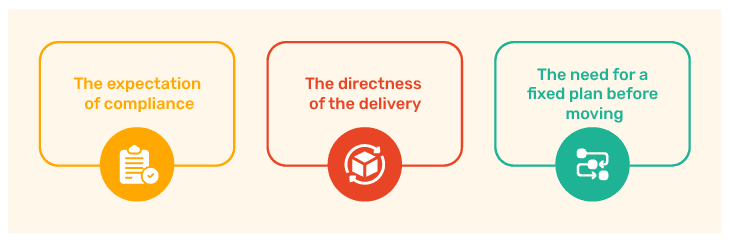
The language around “unlearning” can sound harsh, as if years of good work suddenly become a liability. A better frame is adjustment: taking something that worked well in one context and calibrating it for a different one.
The expectation of compliance
In environments where authority is structural, direction tends to be followed quickly. In corporate environments, people question, push back, and sometimes delay, and this is normal. It is not resistance. It is how professionals in these settings are used to engaging with their work. A leader who responds to this with frustration tends to lose the room. A leader who treats it as an invitation to explain, discuss, and bring people along tends to build a loyal and effective team faster than almost anyone else.
The directness of the delivery
Precision and directness in communication are strengths. But tone calibration matters significantly in civilian environments. A delivery that reads as efficient and clear in one context can read as sharp or dismissive in another. This is not about softening substance. It is about carrying the message across without the delivery getting in the way of it.
The need for a fixed plan before moving
Structured environments reward thorough planning, and the discipline that builds is genuinely useful. But most commercial organizations operate with ambiguity, changing priorities, unclear ownership, and shifting targets. A professional who waits for complete clarity before committing tends to be perceived as slow in a context where the expectation is to make sound decisions with partial information and adjust as more becomes clear.
What the Market Is Actually Looking For
Three things come up consistently when organizations describe what they are looking for at the senior level.
Problem solving that holds up under pressure:
Not the ability to analyze a well-defined problem with sufficient time and data, but the ability to make good decisions when the situation is messy and the timeline is short. Experienced professionals from high-pressure backgrounds often have this in abundance. The gap tends to be in demonstrating it in ways that a corporate audience can recognize and evaluate.
Communication that travels:
Speaking clearly to peers in the same function is necessary but not sufficient. Speaking clearly to people who do not share your background, your technical frame, or your area of expertise, writing a brief that a non-specialist can act on, presenting a risk to a leadership team that does not want granular detail, running a difficult conversation without it becoming a standoff, these are the skills that determine how far a senior professional’s ideas actually travel inside an organization.
Business and financial literacy:
Understanding cost, margin, customer impact, and organizational risk well enough to build those dimensions into recommendations before presenting them, rather than treating them as secondary considerations. This is consistently the area where experienced professionals crossing into new sectors have the most ground to cover, and where deliberate investment pays back the fastest.
How to Make Your Track Record Work for You
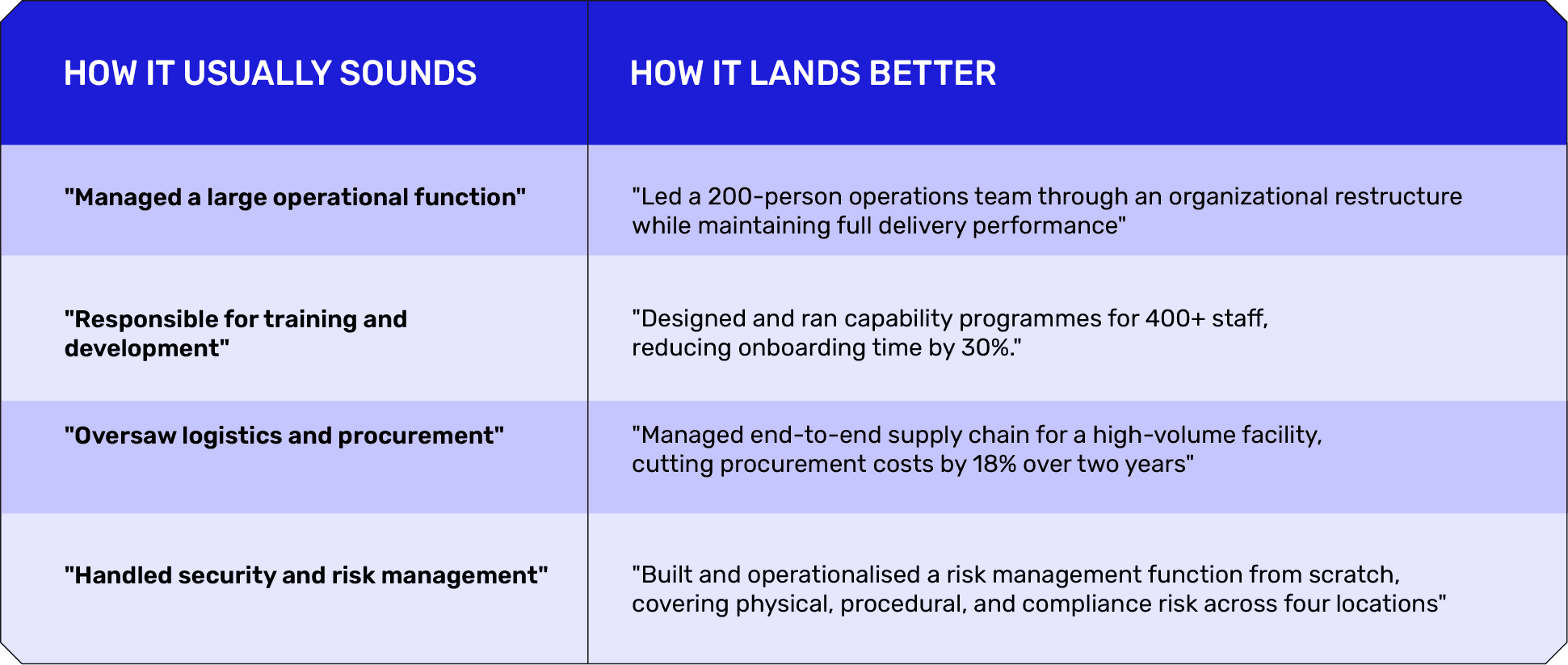
One of the most practical insights from that IIM Kozhikode session was about how experience gets described versus how it needs to be described to land with a new audience.
Most senior professionals describe what they were responsible for. The ones who move faster in new environments describe the outcomes they drove and the scale at which they operated, in language that a new audience can immediately connect to business results.
The experience in both columns is identical. The framing determines whether someone reads it and leans in, or moves on.
What Corporate Life Actually Looks Like from Inside
Three practical realities of corporate environments that tend to catch experienced professionals off guard:
Work moves slower than it looks from outside. Decisions travel through meetings, budget approvals, stakeholder sign-offs, and competing priorities. A change that would take days in a structured organization might take months in a large company. This is not dysfunction. It is how organizations with many competing interests manage alignment and risk. Learning to work with that pace, and sometimes to accelerate it by building the right relationships in advance, is a skill in itself.
Performance is measured in outcomes, not effort. Corporate environments judge people on results, team behaviour, customer impact, and business results. Working extremely hard on the wrong things does not register well on a performance review, regardless of how visible the effort was.
Careers grow through skills, relationships, and reputation, not tenure. Promotions do not follow a fixed timeline. The professionals who move forward consistently tend to be the ones who built skills deliberately, invested in relationships across functions, and are seen as people who make things clearer and easier for the people around them.
The Adjustment Is Narrower Than It Feels
The honest message is this. Experienced professionals coming from structured, demanding backgrounds do not need to start over. The discipline, the composure under pressure, the ability to lead through difficulty, these are rare and genuinely valuable in any organization.
The adjustment is in how authority becomes influence, how operational logic connects to business logic, and how a strong track record gets translated into language that a new audience can understand and act on.
That is real work, and it takes time. But it is not starting from behind. It is adding a sharper layer on top of a foundation that is already solid.
ABOUT AUTHOR

By Premchand Kurup, CEO – Paramount

Premchand Kurup is the Chief Executive Officer at Paramount With over 30 years of leadership experience, Kurup has spearheaded the company’s operations across the Middle East, including UAE, Bahrain, Kuwait, Qatar, Oman, and Saudi Arabia. Premchand Kurup is a visionary leader who pioneered cybersecurity in the Middle East and has been instrumental in positioning Paramount as an industry leader throughout the region. His strong focus on cybersecurity has contributed to the establishment of a robust sector in the Middle East as well as cemented his reputation as a forward-thinking innovator.
Recent Posts
- The Most Critical Cyber Threats Middle East Businesses Face
- History of DNS Abuse Attack Vector & Countermeasure
- Achieving Zero Trust in the Middle East with Endpoint Privilege Management
- Cloud and BYOD – Securely Integrating for Business Growth
- A Step-by-Step Guide to Choosing the Right MSS Provider in the Middle East

Protect your online assets from cyber threats with Paramount
Comprehensive cyber security solutions for individuals and businesses
Significantly reduce the risk of cyber threats and ensure a safer digital environment.
