
Blog
What Is Zero-Trust Security Model and Why GCC Enterprises Are Adopting It Now
Reading Time: 8 Minutes

Across the GCC, cyber threats are gaining momentum. They’re becoming more targeted and deliberate. Saudi Arabia and the UAE, in particular, are seeing a disproportionate share of these attacks, particularly targeting cloud systems, banking platforms, and critical infrastructure.
For many organizations, this is forcing a reset. The old assumptions around security don’t quite hold up anymore.
Zero trust security is increasingly seen as a more realistic way to address how access actually works today.
As cloud adoption accelerates across the Middle East, the attack surface is expanding just as quickly. In this environment, security can no longer be treated as a control layer. It must evolve into a continuous, adaptive function embedded across every access point and workload.
What is a Zero-Trust Security Model
The zero-trust security model is a cybersecurity model that does not trust any user, device, or system at any given time. It verifies every request on the basis of identity, behavior, and context.
If the zero-trust model is integrated with AI, it would be able to perform the following functions:
- Continuously authenticate users
- Detect emerging threats in real-time
- Enforce adaptive policies
The zero trust security model helps enterprises to reduce the dependency on traditional security approaches, enhance zero trust network security, improve visibility, and enhance the ability to detect emerging threats.
Why the Perimeter Based Security Model Falls Short
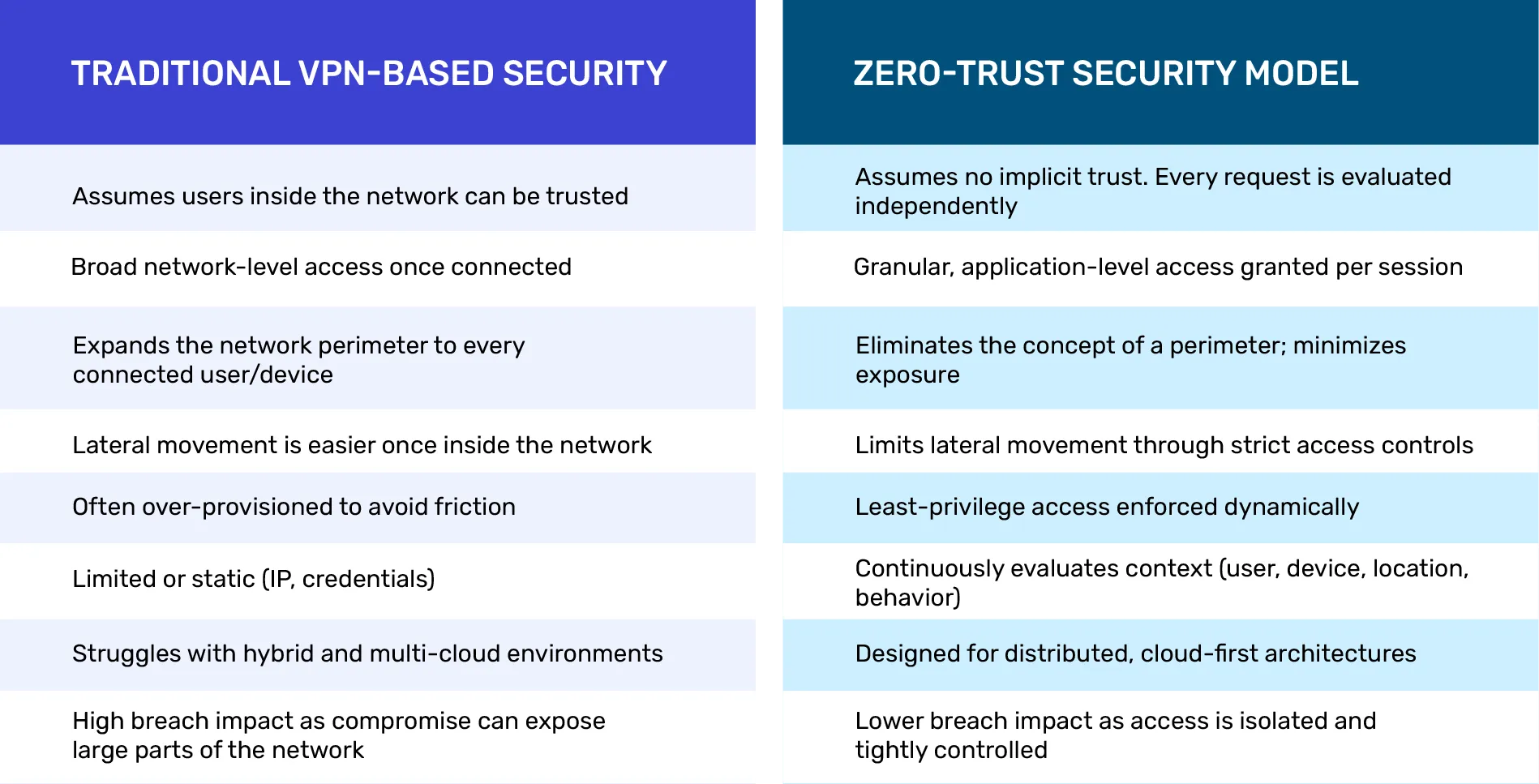
For a long time, the traditional perimeter security model has been used. This model assumes that if users are within the network, they can be trusted. Firewalls, virtual private networks (VPNs), and network boundaries define what is considered “safe.” This is no longer the case.
Cloud computing, work-from-home arrangements, and integrations with third parties have erased the traditional network boundaries. Users access systems from different locations, devices, and networks. This is where zero trust security comes in. It verifies all requests instead of trusting them. Every access decision is considered, dynamic, and constantly changing.

Why the Middle East Is a High-Value Cyber Target
The Middle East is an attractive target for a few obvious reasons. There’s rapid digital growth. Heavy investment in smart infrastructure. Cloud adoption is rising quickly. At the same time, industries like oil and gas, banking, and government still operate with high-value, sensitive systems.
Governments are investing heavily in smart cities, digital banking, and cloud-first strategies. At the same time, sectors such as oil and gas, finance, and government services remain highly sensitive.
This combination creates high-value targets.
In 2024, close to 3,000 cyber incidents were recorded across the region, with over 70% involving disruptive DDoS campaigns. More than a quarter (27.5%) of state-sponsored cyber threats were directed at GCC countries, underscoring the region’s geopolitical significance.
More importantly, these aren’t random attacks anymore. Many are coordinated, persistent, and designed to create real operational impact.
Which is why zero-trust network strategies are gaining traction, not because they’re new, but because they help limit how far damage can spread.
What Are The Principles of Zero-Trust Architecture
A strong zero-trust architecture is built on a few non-negotiable principles:
- Never trust, always verify
- Enforce least-privilege access
- Assume breach at all times
- Continuously monitor and validate access
- Segment networks into micro-perimeters
- Use identity as the primary security boundary
Zero Trust vs. Traditional VPN-Based Security
The Role of AI in Powering Zero-Trust Architecture
AI is becoming a key enabler of zero-trust architecture, especially in large and complex enterprise environments.
It helps organizations:
- Analyze user behavior in real time
- Detect anomalies across networks and endpoints
- Automate access decisions
- Strengthen identity-based controls
- Continuously adapt security policies
Without AI, managing a zero-trust network at scale becomes difficult. With AI, it becomes adaptive and intelligent.
How AI Enables Continuous Authentication in a Zero-Trust Network
In a traditional model, authentication happens once at login. In a zero-trust network, authentication is continuous.
AI analyzes behavioral signals such as login patterns, device usage, location changes, and access frequency. If something changes, access can be restricted or re-verified instantly.
This creates a dynamic security environment where trust is constantly reassessed.
AI-Driven Threat Detection and Automated Policy Enforcement
AI enables organizations to detect threats early by analyzing patterns across large datasets.
It can identify:
- Unusual login behavior
- Lateral movement across systems
- Privilege escalation attempts
- Abnormal data access patterns
Once detected, AI can trigger automated policy enforcement. This ensures that threats are contained quickly without waiting for manual intervention.
This is where zero-trust security becomes truly effective.
Generative AI Risks and Why Zero Trust Is the Answer
Enterprises across the GCC are rapidly adopting generative AI tools such as copilots and large language models.
While these tools improve productivity, they also introduce new risks.
Sensitive data may be exposed, prompts may leak confidential information, and access controls may not be clearly defined.
A zero trust security model helps mitigate these risks by enforcing strict identity verification and access controls.
Agentic AI Attacks: The Threat Zero Trust Was Built For
Agentic AI systems can act autonomously, making decisions and interacting with systems without direct human input.
This introduces a new class of threats.
The zero-trust model ensures continuous verification and strict access control, making it well-suited to handle these emerging risks.
A Closer Look at Zero Trust Regulatory Compliance Across GCC Countries
Across the GCC, cybersecurity regulations are increasingly converging around principles that closely align with zero trust, particularly around identity, access control, and continuous monitoring.
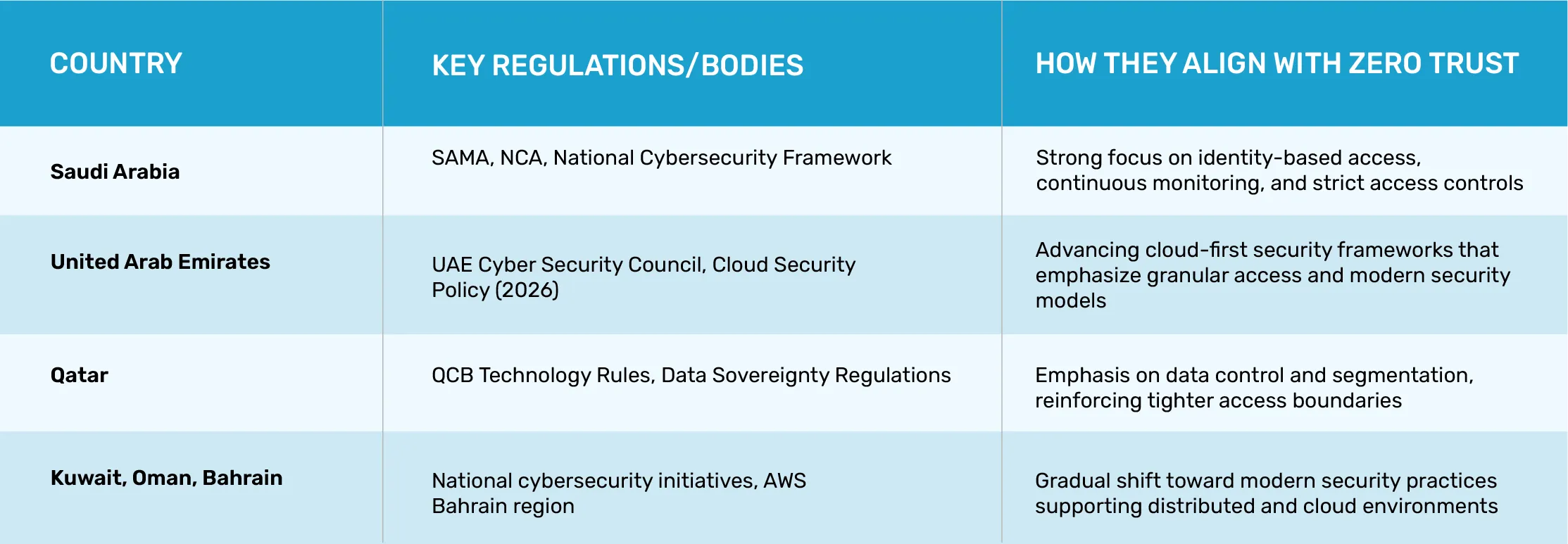
While each country is progressing at its own pace, the broader direction is clear, regulatory frameworks across the GCC are steadily reinforcing the core principles that underpin a zero trust approach.
Key Components of a Zero-Trust Architecture for Middle East Enterprises
In most organizations, a zero-trust architecture develops over time based on user interactions with systems, data flow, and workload placement. Some of the most important capabilities that develop are:
Identity and Access Management (IAM):
Instead of identity being just another step in the login process, it now becomes a primary decision-making step.
Network Segmentation and Micro Perimeters:
Instead of a huge network with open access, we now have segmented networks. This makes it more difficult for a threat to move around if one occurs.
Device Trust and Endpoint Security:
Instead of just relying on the user for security, we now have to consider the device that the user is using to access the network.
Data-Centric Security and Sovereign Cloud Alignment:
With data residency becoming a more rigid requirement for organizations, we are now paying more attention to data access, storage, and security, regardless of where the data is located.
These components combine to provide a multi-layered and adaptive security system that is more likely to meet the needs of today’s complex enterprises.
Measuring Your Zero Trust Readiness
Organizations generally go through these four stages while moving to a zero-trust model:
Initial → Developing → Defined → Optimized
- Initial: The initial state is characterized by perimeter-based security approaches, such as VPNs and implicit trust within the network.
- Developing: Organizations in this phase begin to adopt stronger identity-based controls, multi-factor authentication, as well as basic segmentation approaches. However, there is still a lack of integrated policy approaches.
- Defined: This phase is characterized by stronger zero trust approaches. Access is driven by identity and context; there is segmentation of critical systems, and there is standardization of security policies in cloud as well as on-premise environments.
- Optimized: This is the final phase of the zero trust maturity model. In this phase, a zero trust approach becomes intelligence driven. With continuous monitoring as well as AI-based analytics, there is an evaluation of risks in real-time.
Determining where your organization is in this model is critical in order to ascertain how far you have come as well as what is required to move forward.
Adoption of Zero Trust Across GCC Industries
Zero trust adoption is being pursued most aggressively in sectors where the stakes are highest in terms of regulatory oversight and operational risk.
-
Banking and Financial Services:
With the advent of digital banking and fintech, financial services companies are focusing on zero trust to ensure the security and integrity of customer data and prevent financial frauds, apart from adhering to strict regulatory guidelines on identity and access management and transactional security.
-
Oil and Gas:
Considering that oil and gas is one of the most critical sectors in the region, there is a high degree of convergence of IT and OT risks. Zero trust helps to segment and secure critical infrastructure from targeted attacks.
-
Government and Public Sector:
Governments in all GCC nations are undergoing major digital transformation strategies, including smart cities and e-government services. Zero trust helps governments achieve this in a secure manner without compromising sensitive citizen and national data.
Across these sectors, the shift toward zero-trust security is about ensuring continuity, resilience, and trust in systems that are foundational to national and economic stability.
How Paramount helps transform Cloud Security in the Middle East with AI and Zero-Trust Architecture
Paramount’s approach to transforming cloud security in the Middle East involves leveraging AI and zero-trust architecture to enhance cybersecurity measures. Their AI-native platform provides SecOps teams with panoramic visibility across cloud, SaaS, identity, and AI ecosystems, enabling them to pre-emptively decode and prevent attacks. Paramount’s AI adoption framework and AI cybersecurity framework are designed to equip businesses with the necessary tools to protect critical assets and secure AI-powered operations.
Recent Posts
FAQ
A zero trust security model ensures no entity is trusted by default and requires continuous verification.
Zero trust architecture is a framework that enforces identity-based access, segmentation, and continuous monitoring.
A zero trust network restricts access based on identity and context rather than network location.
Rapid digital transformation and rising threats make zero trust security essential for protecting critical infrastructure.
AI enables real-time authentication, threat detection, and adaptive policy enforcement in a zero trust model.

Protect your online assets from cyber threats with Paramount
Comprehensive cyber security solutions for individuals and businesses
Significantly reduce the risk of cyber threats and ensure a safer digital environment.
