
Blog
How AI Is Transforming the Security Operations Center
Author:
Pradeep Menon
Reading Time: 7 Minutes
Most organizations do not realize their security operations center (SOC) is already outdated until it fails in a high-stakes moment.
Threat actors today are not just faster. They are automated, multilingual, and increasingly capable of mimicking legitimate user behavior at scale. Meanwhile, many enterprises still rely on human-heavy workflows, fragmented tooling, and rule-based detection models inside their SOC cybersecurity environments.
In regions like the GCC, where digital transformation is accelerating across banking, energy, and public infrastructure, the question is no longer whether to invest in a SOC. The real question is whether your SOC can keep up.
To operate at the speed and scale of today’s threats, SOCs need to move beyond manual processes and static rules. This is precisely where AI enters the picture.
AI is not an enhancement to SOC. It is quickly becoming the difference between response and irrelevance.
How do Security Operations Centers Works in Modern Enterprises
A security operations center is the centralized function responsible for monitoring, detecting, investigating, and responding to cyber threats across an organization’s digital ecosystem.
Traditionally, SOCs operate through:
- SIEM platforms
- Rule-based alerts
- Tiered analyst teams
- Manual investigation workflows
This structure was designed for a time when threat volumes were lower, and attack patterns were easier to define. That assumption no longer holds.
As alert volumes increase and attack techniques become less predictable, these same layers begin to create friction instead of control.
This is where AI starts to reshape how a SOC cybersecurity function operates in practice.
With AI in the loop:
- Alerts are prioritized based on risk, not just triggered conditions, reducing noise at the entry point
- Investigations draw on correlated signals across systems instead of isolated event analysis
- Analysts spend less time triaging alerts and more time making decisions that affect business risk
To understand how significant this shift is, it helps to look at how the operating model itself is changing:
Difference between traditional and AI-driven SOCs
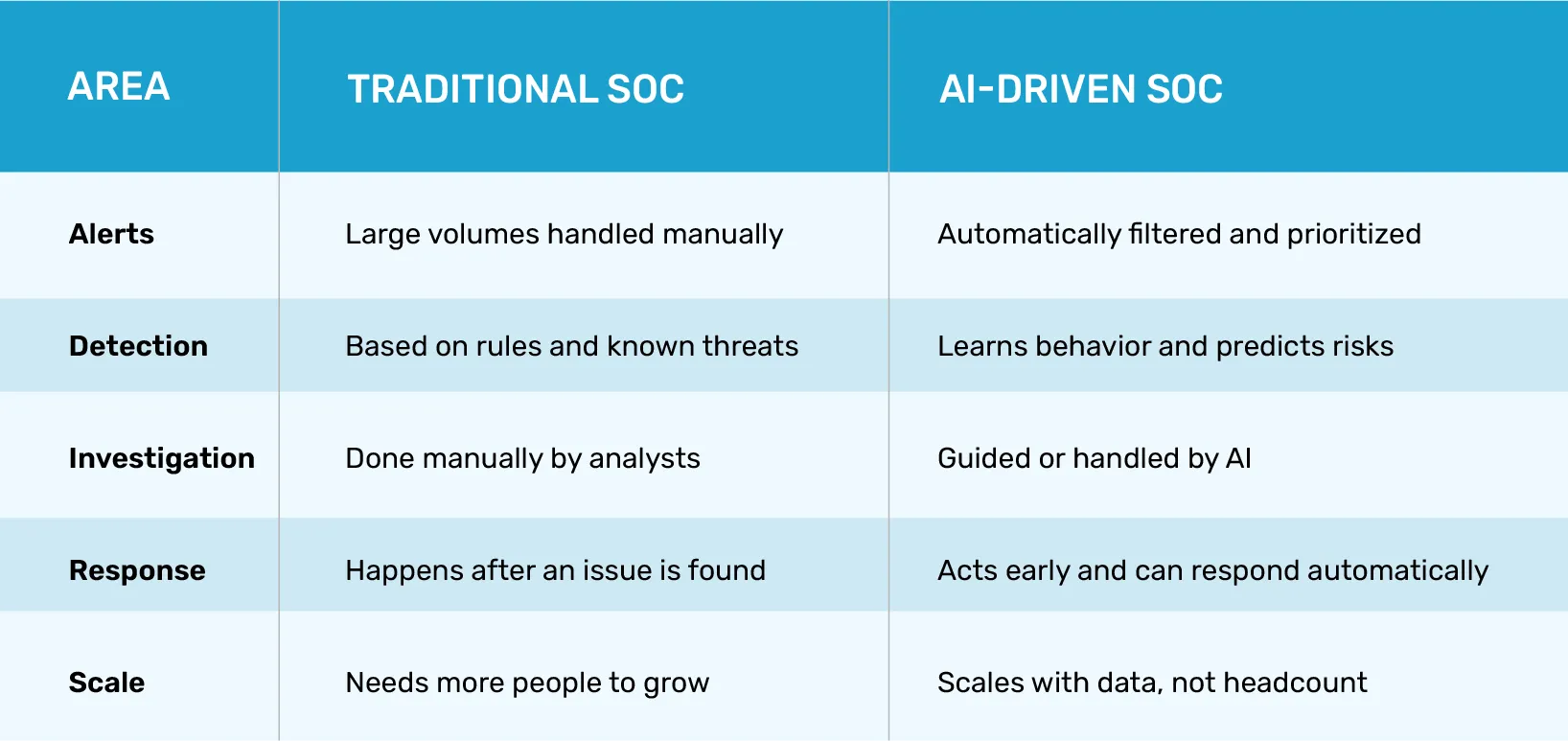
In a traditional model, speed depends on people. In an AI-driven model, speed comes from context. That distinction is what increasingly defines an effective SOC in cybersecurity environments today.
Where traditional SOCs fall short
The challenge lies in the fact that these vulnerabilities may not be perceived as direct operational flaws.
- Identity compromise is viewed as standalone alerts: In the configuration of some SOCs, identity-related abnormalities such as login anomalies, privilege escalation, and session inconsistencies are recorded as individual occurrences. The problem lies in the absence of a holistic analysis of the identity activities across time, devices, and access vectors. The initial signs of an attack may be disregarded as benign signals.
- Disjointed visibility of cloud activities: As organizations continue to leverage public and private cloud environments, data collection becomes disjointed. Legacy SOCs are incapable of integrating and correlating telemetry from these clouds. Thus, organizations suffer from blind spots that fail to link malicious actions from one cloud to the other.
- Missing localized information: Malware detection models are not optimized for linguistic differences. Threat intelligence sources lack information regarding localized threats.
- Slow identification of lateral movement: Attackers do not initiate any action in one attempt. Rather, the process of compromising a network system involves gradual lateral movement through multiple systems. Therefore, traditional rule-based alerting mechanisms cannot identify lateral movement.
- Third party access is loosely governed: Partners and vendors often work outside the purview of the SOC. Even if access was initially properly managed, continuous monitoring is sometimes overlooked. This results in a wider area that is harder to monitor for a traditional SOC.
- Sustained attacks disguise themselves: Stealthy tactics ensure that any action taken does not trigger alerts. Incremental actions seem normal when analyzed on their own. Traditional SOCs tend to miss the larger picture behind these incidents.
Arabic-Language Threat Vectors: The GCC-Specific Challenge
One of the most under-recognized gaps in regional security operations is language. Most global security tools and threat intelligence feeds are trained primarily on English-language data. That creates blind spots in environments where Arabic is widely used across communication, interfaces, and user behavior.
How this shows up in real scenarios
- Phishing emails written in Arabic that bypass standard detection filters
- Domain spoofing using transliteration or visually similar Arabic characters
- Social engineering campaigns tailored to local business and cultural contexts
- Malicious content embedded in Arabic-language documents and messages
Why This Forces a Rethink in SOC Investment
For many organizations, SOC investment has historically been driven by compliance or tooling upgrades.
That approach does not hold in the current GCC threat landscape.
What is needed now is:
- Continuous correlation across identities, devices, and environments
- Detection that adapts to behavior rather than relying on predefined rules
- The ability to prioritize threats based on actual business risk, not alert volume
This is where AI-driven SOC models start to matter in a very practical way.
They do not just process more data. They connect signals that would otherwise remain isolated inside a traditional SOC setup.

Why AI SOC Investment Is Urgent in 2026 in the GCC
Cloud adoption, national digital programs, and connected infrastructure have expanded the attack surface in a way that traditional security operations centers were not designed to handle.
The current factors that drive risk in the GCC include the following:
- Key industries like oil and gas, financial institutions, and government infrastructures are heavily digitalized and well-connected. Any single intrusion will not remain localized.
- Intruders use alternative paths into the network by leveraging credentials, tokens, and privileged access. Such tactics make them difficult to detect by SOC security technologies based on rule sets.
- Fast-paced adoption of hybrid and multicloud infrastructures has created blind spots in visibility. Not all SOC teams have consistent telemetry capabilities in multiple cloud environments yet.
- Providers, vendors, and partners of the organizations belong to the attack surface. However, traditional SOC frameworks usually do not consider the extended perimeter adequately.
- The GCC businesses are often participants in geopolitical struggles; hence, intrusions become more persistent and sophisticated.
The Regulatory Case for AI SOC Investment Across the GCC
In the GCC, SOC investment is increasingly shaped by regulation. Across the region, cybersecurity frameworks are becoming more prescriptive about how monitoring and response should function.
What regulators are expecting
- Continuous monitoring across systems and environments
- Timely detection and reporting of incidents
- Integration of threat intelligence into operations
- Documented and auditable response processes
Frameworks such as:
- Saudi Arabia’s NCA Essential Cybersecurity Controls
- UAE Information Assurance Standards
- Qatar National Information Assurance Framework
all point in the same direction. Security operations must be continuous, measurable, and accountable.
Where traditional SOCs struggle
- Monitoring is not truly continuous due to alert overload
- Incident timelines are difficult to reconstruct
- Reporting depends on manual aggregation of data
- Response processes vary across teams
These are not just operational issues. They are compliance risks.
Why AI-driven SOC aligns better with regulatory expectations
- Automated logging and traceability: Every action, alert, and response is recorded in a structured way
- Faster incident detection and escalation: Helps meet reporting timelines defined by regulators
- Standardized response workflows: Reduces variability and improves audit readiness
- Integrated threat intelligence usage: Moves organizations closer to proactive defense models expected by regulators
AI SOC Investment for GCC Critical Sectors
Not all sectors in the GCC face the same risks. But they share one common constraint.
The cost of delayed response is high.
Where impact is most visible
Banking and Financial Services
- Identity fraud and account takeover attempts are increasing
- AI helps detect behavioral anomalies across transactions and sessions
Oil and Gas
- Operational technology and IT environments are increasingly connected
- AI-driven correlation helps detect cross-domain threats that traditional SOCs miss
Government and Public Sector
- High exposure to targeted and persistent attacks
- AI improves detection of long-running campaigns that avoid obvious triggers
Healthcare
- Sensitive data combined with limited tolerance for downtime
- AI supports faster containment without disrupting operations
A practical roadmap for adoption
Most organizations do not need to rebuild their SOC from scratch. But they do need to rethink how it operates.
1. Assess current gaps
- Where is visibility incomplete
- Where does response slow down
2. Consolidate data sources
- Bring identity, cloud, and endpoint signals into a unified view
3. Introduce AI where it matters first
- Alert prioritization
- Threat correlation
4. Automate repeatable responses
- Especially for known attack patterns
5. Continuously refine
- Based on real incidents, not theoretical models
How Paramount Supports AI-Driven SOC Transformation
Moving to an AI-driven security operations center requires rethinking how signals, decisions, and response workflows come together.
Paramount helps organizations across the GCC make that transition without disrupting existing SOC operations.
How Paramount helps:
- Integrates identity, cloud, and endpoint signals into a unified SOC view
- Introduces AI at high-impact points such as alert prioritization and threat correlation
- Aligns SOC workflows with GCC regulatory and compliance expectations
- Brings in regional threat context, including language-specific attack patterns
The focus is not on replacing your SOC, but on making it more responsive, context-aware, and aligned with real-world risk.
ABOUT AUTHOR

Pradeep Menon - Chief AI & Information Security Officer

With over two decades of experience advising enterprises and government bodies on cybersecurity strategy and compliance, he has led large-scale security programs across BFSI, Government, and Retail sectors throughout the GCC. His expertise lies in aligning cybersecurity frameworks with complex digital transformation initiatives, ensuring resilience at scale. A recognized thought leader, he is frequently invited by industry forums to share insights on the evolving intersection of Artificial Intelligence, cybersecurity, and regulatory compliance, helping organizations adopt AI-driven security strategies responsibly and effectively.
Recent Posts
- Threat Intelligence Platform
- A Step-by-Step Guide to Choosing the Right MSS Provider in the Middle East
- Top 5 Cyber Security Risks in 2026: What GCC and Saudi Leaders Need to Watch Closely
- Think You’re Safe? Your Cybersecurity Assessment Might Say Otherwise.
- Ransomware attack on Chinese bank’s US subsidiary another warning signal
FAQ
There isn’t a fixed timeline. In most cases, organizations begin to see impact within a few months, especially if they start small and focus on areas like alert prioritization before expanding into deeper automation.
Not necessarily. Most AI capabilities are layered onto existing systems. The idea is to make current tools work better together, rather than starting from scratch.
It matters more than most teams expect. If data is scattered or inconsistent, AI will struggle to deliver meaningful insights. Getting your data in order is often the first real step.
Not anymore. Mid-sized organizations are increasingly adopting AI, often through managed services. In many cases, it helps them bridge gaps where hiring large security teams isn’t practical.
Yes, but not entirely different ones. The shift is more about interpreting insights and understanding patterns, rather than manually digging through logs.

Protect your online assets from cyber threats with Paramount
Comprehensive cyber security solutions for individuals and businesses
Significantly reduce the risk of cyber threats and ensure a safer digital environment.
