
Blog
Top 5 Cyber Security Risks in 2026: What GCC and Saudi Leaders Need to Watch Closely
Reading Time: 8 Minutes

Across the GCC, digital growth, critical infrastructure exposure, and geopolitical factors are creating a more complex risk environment than most organizations are prepared for.
A few years ago, most conversations around cyber security risks were still centered on perimeter defenses and endpoint protection. That’s no longer the case.
Today, the exposure is a lot more in cloud configurations, in third-party ecosystems, in operational technology, and increasingly, in how organizations use AI. What makes 2026 different is not just the volume of threats. It’s the way they connect.
Why the GCC and Saudi Arabia Face a Uniquely Elevated Cyber Risk Profile in 2026
When breaches happen in the GCC, they tend to be more expensive. Not marginally but significantly. Estimates regularly place the average breach cost close to or above $8 million. This number reflects the kind of assets being targeted: energy systems, sovereign wealth infrastructure, financial networks, government platforms.
These are not generic enterprise environments. They are high-value, high-impact systems. That’s why cyber security risks in this region carry a different weight. The consequences are often strategic, not just operational.
Cyber security risks vs. Information security risks
This is a distinction most organizations still blur. Let’s look at some of the major differences:
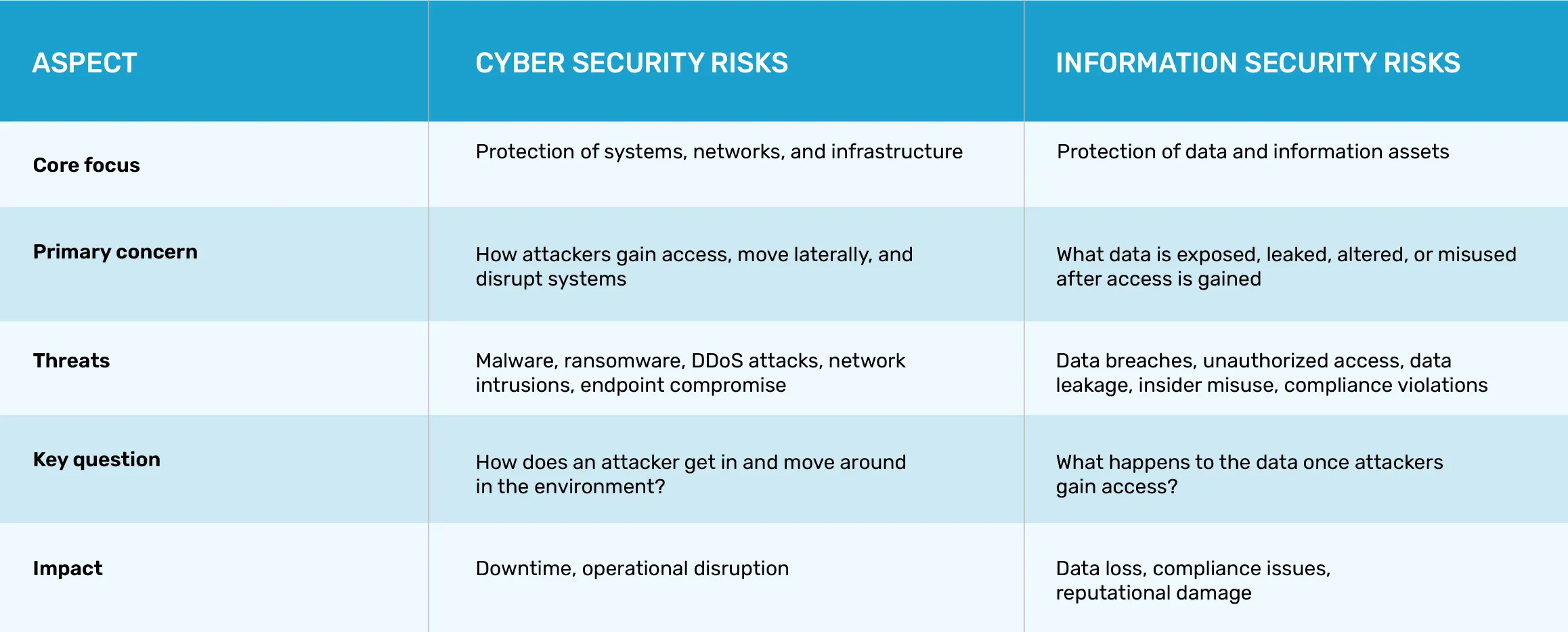
In simple terms, cyber security is about stopping access. Information security is about protecting what matters after access is gained.
With that distinction in mind, let’s look at the most significant risks organizations across the GCC are dealing with today.
Top 5 Risks across the GCC
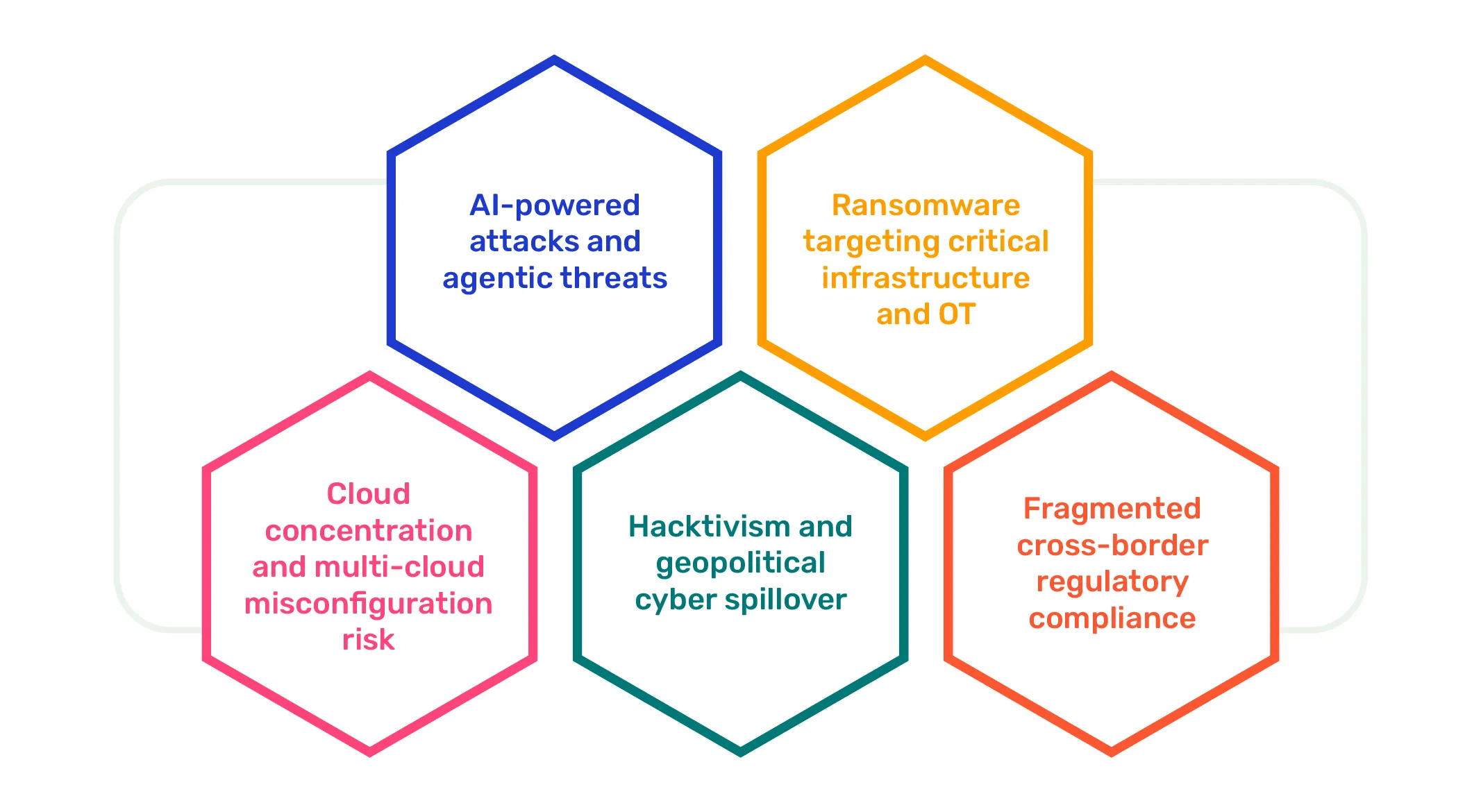
AI-powered attacks and agentic threats
AI is now part of the attack surface. Threat actors are using it to generate phishing content that feels real, automate vulnerability discovery, and adapt attacks mid-execution. This includes:
- AI-generated emails, messages, and even voice deepfakes are making it easier to impersonate trusted individuals at scale.
- Attackers can scan code, systems, and configurations far more efficiently, identifying weaknesses before organizations can patch them.
- AI enables attacks to adjust in real time, changing tactics based on how defenses respond.
Agentic threats take this a step further. These are systems that don’t just assist attackers, but act on their behalf. This shift reduces the need for constant human control and compresses the attack lifecycle, meaning organizations have far less time to detect, respond, and contain threats.
Ransomware targeting critical infrastructure and OT
Ransomware has moved beyond IT systems. Across the GCC, operational technology environments are now firmly in scope especially in sectors like energy, utilities, transport.
When these systems are hit, it’s not about data anymore. It’s about continuity. This is where information security risks and operational risks start to overlap in a way most legacy frameworks don’t fully capture.
Cloud concentration and multi-cloud misconfiguration risk
There’s a quiet dependency forming across the region. Bulk of the infrastructure lies with a handful of hyperscalers. That creates efficiency, but also concentration risk. At the same time, multi-cloud setups are becoming harder to manage. Misconfigurations are common, and often invisible until something breaks. This is one of the fastest-growing cyber security risks right now.
Hacktivism and geopolitical cyber spillover
The GCC is a region where political signals often translate into cyber activity, either directly or through affiliated groups or opportunistic actors. Countries like the UAE, Qatar, and Kuwait see periodic spikes tied to geopolitical events. These attacks are less about financial gain and more about disruption, visibility, and signaling.
Fragmented cross-border regulatory compliance
Operating across the GCC sounds straightforward on paper. In practice, it isn’t. Each country has its own expectations, frameworks, and enforcement approach. What this creates is layered complexity. And with that, increased information security risks, especially when controls are not consistently applied across environments.
These risks become more pronounced in Saudi Arabia, where the concentration of high-value assets makes their impact far more significant.
Top 5 Risks in Saudi Arabia
Ransomware targeting ARAMCO, energy OT, and critical national infrastructure
The energy sector has always been a prime target, but the stakes are different here. When something breaks, it doesn’t stay contained. It spills over into supply chains, markets, and sometimes even politics.
In Saudi Arabia, that exposure is even sharper. With ARAMCO being at the center of global energy supply, attackers aren’t just looking at IT systems anymore. There’s a clear shift toward operational technology (OT), the systems that actually keep production running.
A few things make this particularly difficult to manage:
- OT systems weren’t built for this kind of threat landscape: Many of them are older, harder to update, and not designed with modern security controls in mind.
- The consequences are very different from IT incidents: This isn’t about systems going down for a few hours. It can mean halted production, safety concerns, and real-world disruption.
- The lines between IT and OT are thinner than they used to be As environments become more connected, it’s easier for attackers to move from corporate networks into operational systems.
That’s why, in Saudi Arabia, ransomware isn’t just another IT problem. It sits much closer to questions of national resilience and economic stability.
State-sponsored APT attacks
Saudi Arabia continues to be a named target for advanced persistent threat groups. Campaigns linked to groups like MuddyWater and APT34 are not random. They are persistent, targeted, and strategic. These are long-cycle cyber security risks that require a different level of monitoring and response.
Supply Chain and third-party risk in Vision 2030 projects
Projects like NEOM are large-scale and layered. It includes dealing with hundreds of vendors, contractors, and technology partners, all working across different countries, standards, and timelines. That kind of scale brings a level of complexity most organizations aren’t used to managing.
A serious cyber security risk assessment, in this context, has to look beyond internal systems and treat the entire partner network as part of the attack surface.
How to Conduct a Cyber Security Risk Assessment GCC and Saudi Arabia
A proper cyber security risk assessment is not a checklist exercise.
- It starts with clarity. What are your most critical assets? Not in theory, but in operational terms.
- The next step is mapping threats, vulnerabilities, and dependencies.
- Once all the risks are mapped, the next step is to prioritize. Not everything matters equally but many programs still treat them that way. The goal here is to focus on what can cause the most damage, not just what is easiest to fix.
- The final step is alignment. Controls need to reflect both the threat landscape and the regulatory environment you operate in, whether it’s SAMA, NCA, or other regional frameworks. And this is not static. It needs to evolve continuously.
Organizations operating across the GCC or Saudi Arabia often need a more structured approach to get there. That means identifying blind spots, understanding interdependencies, and building mitigation strategies that reflect real-world complexity, not just theoretical risk models.
How Paramount Helps
Paramount works with enterprises across the region to bring structure and clarity to cyber security risk assessment.
Instead of generic frameworks, the focus is on mapping risks to actual business and operational impact, especially in environments that span cloud, OT, and third-party ecosystems. This includes:
- Identifying critical assets and hidden dependencies
- Assessing both cyber and information security risks together, not in isolation
- Aligning controls with regional regulatory expectations
- Prioritizing actions based on real-world impact, not just severity scores
The outcome is a risk posture that is easier to understand, easier to act on, and better aligned with how organizations in the GCC and Saudi Arabia actually operate.
Recent Posts
- Types of Cybersecurity Threats: Common Risks Every Business Should Know
- Navigating the Landscape of Data Privacy Protection across the GCC
- Everything You Need to Know About Passwordless Authentication
- Protecting Patients in the Digital Age: Why Cybersecurity Must Become the Heart of Healthcare
- Data Classification for GCC Enterprises: A Strategic Guide to Policy, DLP & Governance
FAQ
Cyber security risks are threats that impact systems, infrastructure, or operations, potentially leading to disruption or compromise.
Information security risks relate specifically to data exposure, misuse, or loss.
A cyber security risk assessment identifies and prioritizes threats based on their likelihood and potential impact.
Risk assessment cybersecurity is the process of evaluating vulnerabilities and controls to understand how exposed an organization is to cyber threats.

Protect your online assets from cyber threats with Paramount
Comprehensive cyber security solutions for individuals and businesses
Significantly reduce the risk of cyber threats and ensure a safer digital environment.
