
Blog
Data Classification for GCC Enterprises: A Strategic Guide to Policy, DLP & Governance
Reading Time: 8 Minutes

Data Classification for GCC Enterprises: A Strategic Guide to Policy, DLP & Governance
Your DLP system flagged 847 “Confidential” documents yesterday. Your business teams marked another 1,200 files the same way by default. Meanwhile, your audit team is asking for evidence of a mature data loss prevention strategy across the NCA and DIFC frameworks.
Sound familiar?
If you’re involved with enterprise data security, you know this reality well. Your organization has invested heavily in DLP tools and classification technology, but the policy coverage remains shallow. Business users either over-classify everything or disengage entirely, leaving you with alert fatigue and little visibility into actual data flows.
The problem isn’t your technology stack. It’s the approach.
Most data classification initiatives fail because they’re designed in IT isolation. There is an utter lack of business context, there’s little to no workflow integration, and there is no sustained ownership needed for regulatory compliance. As a result, you’ll see misused labels, overloaded systems, and security teams chasing meaningless alerts while real risks slip through.
For GCC-based multinationals operating under complex regulatory mandates, this isn’t just inefficient, it’s dangerous. Your audit posture depends on demonstrating measurable maturity in data protection, not just having tools deployed.
For GCC-based multinationals operating under complex regulatory mandates, this isn’t just inefficient, it’s dangerous. Your audit posture depends on demonstrating measurable maturity in data protection, not just having tools deployed.
What is Data Classification?
Data classification is the process of identifying, categorizing, and labeling data based on its sensitivity and importance to the organization. For GCC enterprises, this process is the bedrock of a mature data loss prevention strategy, enabling security teams to apply appropriate controls and meet stringent regulatory requirements like the NCA and DIFC frameworks.
The primary purpose of classification is to ensure that security efforts are focused on the most critical assets. By establishing a shared logic between IT and business units, organizations can move beyond mechanical labeling to a strategic model that reduces alert fatigue and prevents unauthorized data movement across cloud and third-party environments.
Why Data Classification is Critical for GCC Enterprises
For most GCC enterprises, data is no longer just a support function, it sits at the centre of decision-making, operations, and customer engagement. From financial records and employee data to intellectual property and customer insights, organisations are dealing with a wide range of information that varies significantly in sensitivity and business impact. Without a clear way to organise and prioritise this data, it becomes difficult to manage risk in a structured manner.
This is where data classification plays a critical role. It gives organisations a clear framework to identify what data they hold, how sensitive it is, and how it should be handled. Instead of applying blanket security controls across everything, which often leads to inefficiencies, classification allows teams to focus protection efforts where they matter most.
For GCC enterprises in particular, the need becomes even more pressing due to the regulatory environment. With data protection laws such as those introduced in the UAE and Saudi Arabia, organisations are expected to demonstrate not just security measures, but also visibility and control over their data. Classification acts as a foundational layer that supports compliance, making it easier to enforce policies, track data usage, and respond to audits with confidence.
Another important factor is the growing complexity of modern workplaces. Data now moves across cloud platforms, collaboration tools, endpoints, and third-party systems. In such an environment, relying solely on perimeter-based security is no longer effective. Classification ensures that wherever the data travels, its sensitivity and handling requirements travel with it.
What Enterprises Get Wrong About Data Classification
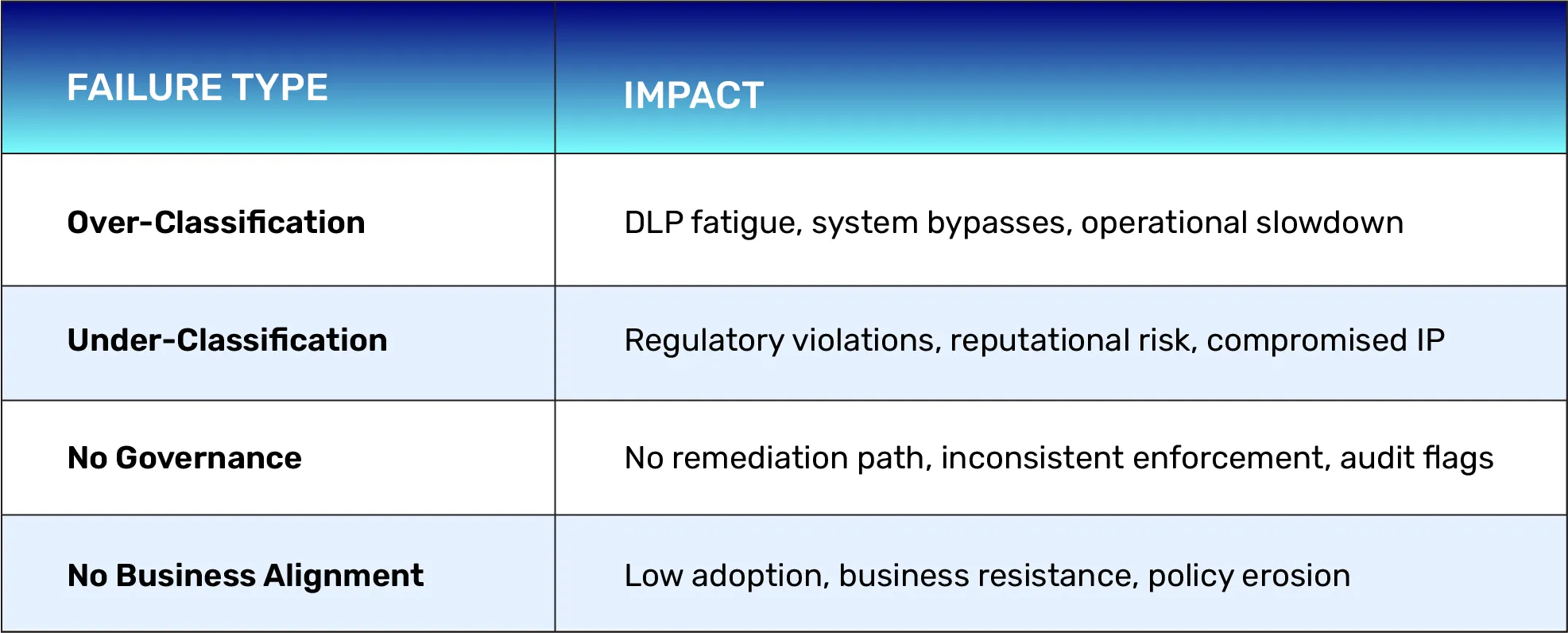
Most classification programs fail not because the enterprise selected the wrong tool, but because the business was never invited to shape the logic behind it.
Enterprises across the GCC continue to invest in dlp data classification and related tooling like CASB and cloud security, only to realise months later that data is still leaking, alerts are still noisy, and audits still raise flags.
These are not technical failures. They’re operational design failures.
Here are the common points of failure enterprises typically notice:
1. Classification models are decoupled from the business
Most frameworks are built by security or IT in isolation, based on assumed risk tiers rather than operational priorities. The result: classification categories that mean little to the people actually using them.
- A marketing team doesn’t know whether its campaign data counts as “Confidential” or “Internal.”
- A finance analyst defaults everything to “Restricted” because they don’t want to be blamed for mislabelling.
- Meanwhile, business-critical IP sits under-classified and unprotected, unflagged by automated DLP.
Without a shared understanding, even the best classification logic can collapse into inconsistency.
2. Labels are applied mechanically, not strategically
When classification becomes a routine checkbox, users disengage. That’s when real exposure begins.
If too much is classified as “Confidential,” DLP tools generate a flood of false positives, diluting attention from real risks.
If too little is classified, sensitive data moves freely between cloud apps, email threads, and third-party environments.
In both cases, the cybersecurity strategy looks complete on paper but is ineffective in practice.
3. Governance is weak or missing entirely
Data classification is not just a policy layer; it’s a governance function. Yet in most deployments, no one owns classification oversight.
- There’s no review of misclassifications
- No escalation path for exceptions
- No accountability for recurring misuse across departments
This void creates two outcomes:
1. Business users become cynical, treating classification as compliance theatre.
2. Security teams burn resources chasing low-priority alerts while real breaches go undetected.
4. Implementation is rushed ahead of readiness
Classification labels are rolled out before any user education, workflow alignment, or role-based guidance is in place.
As a result:
- Business leaders resist enforcement, claiming it slows them down
- Teams invent workarounds, often outside sanctioned channels
- Policy audits flag systemic misuse, despite full deployment of data loss prevention strategy tools.
In every case, the damage is reputational, operational, and regulatory. And it’s avoidable if classification is treated not as a control system, but as an organisational function that spans policy, process, and people.
Types of Data Classification
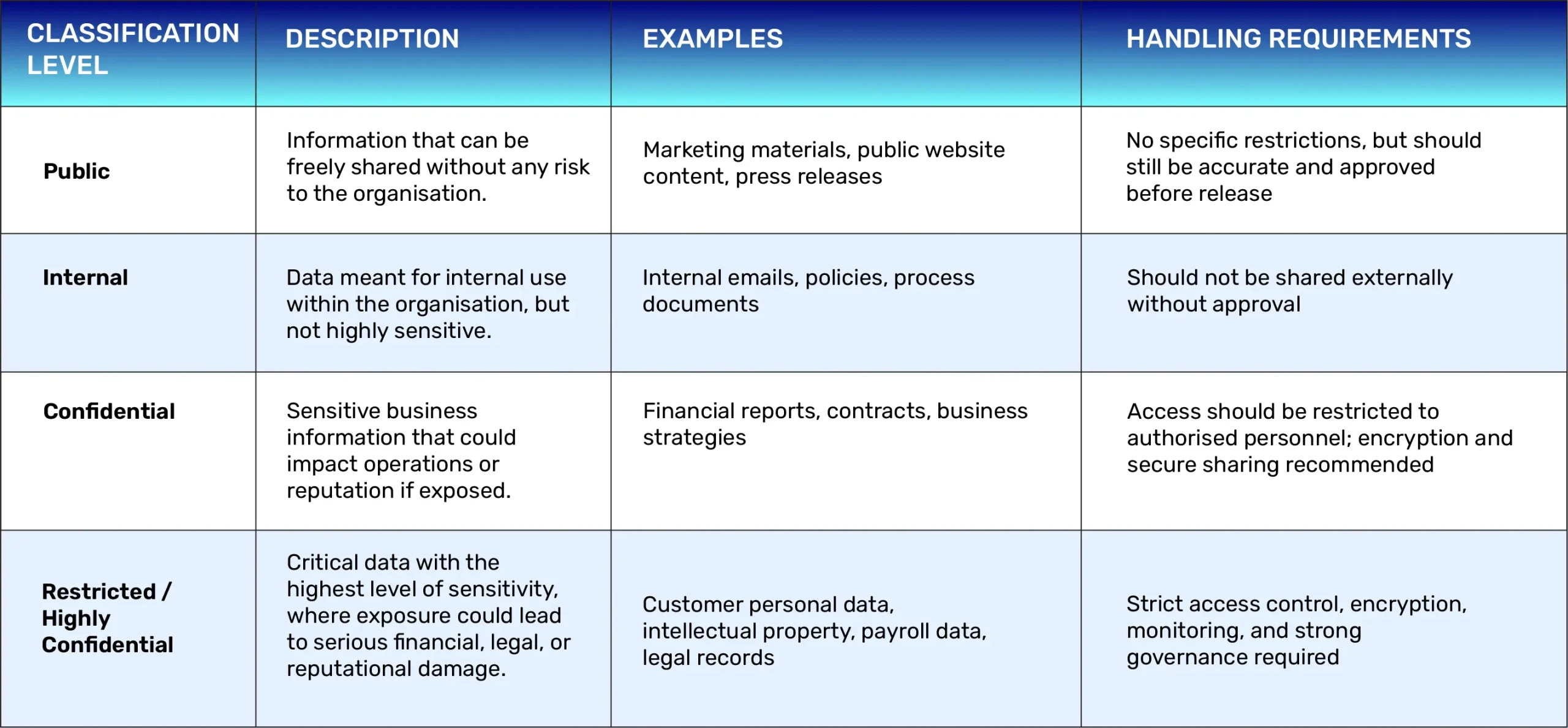
In most GCC enterprises, data classification works best when it is simple, clearly defined, and easy for employees to apply in their day-to-day work. Instead of creating too many categories, organisations typically follow a structured model with a few well-understood levels. This ensures consistency without overwhelming users.
Below is a practical way to look at common data classification types:
Data Classification Policy Framework
What is a Data Classification Policy
A data classification policy is the formal guide that tells an organisation how to identify, label, handle, store, share, and protect its information based on sensitivity and business value. It sets the rules everyone follows, so data is managed consistently across teams, systems, and locations.
For GCC enterprises, this data classification policy is especially important because data often moves across departments, cloud platforms, and external partners. A clear policy removes guesswork and gives employees practical direction on how to treat different types of information.
Key Components of a Policy
- Classification levels: The policy should define each data category clearly, such as public, internal, confidential, and restricted, with simple examples for each.
- Labelling rules: It should explain how data must be marked or tagged so users can quickly understand its sensitivity.
- Access controls: The policy should state who can view, edit, or share each type of data, based on role and business need.
- Handling requirements: It should outline how each category of data must be stored, transferred, encrypted, and disposed of.
- Review and reclassification process: The policy should explain when data must be reviewed and how its classification can be updated if the business context changes.
- Exception management: It should define what happens when a team needs an exception, including who approves it and how it is recorded.
- Compliance alignment: The policy should support legal, regulatory, and contractual requirements that apply to the organisation.
Governance and Ownership
- Business ownership matters: Data classification should not be left to IT alone. Business leaders must help define what data means in practice.
- Security teams guide the control framework: Information security teams should define the protection standards and monitor how the policy is applied.
- Legal and compliance teams ensure alignment: These teams help make sure the policy supports privacy, regulatory, and contractual obligations.
- Data owners are accountable for their information: Each business area should have clear responsibility for the data it creates, uses, or manages.
- Employees need simple guidance: The policy should be easy to understand so users can apply it correctly in daily work.
- Regular oversight is essential: Governance should include periodic reviews, approvals, and updates to keep the policy relevant and effective.
DLP Data Classification – How It Works
Role of Classification in DLP
Data classification gives DLP the context it needs to work properly. Instead of treating every file, email, or upload in the same way, DLP can use classification labels to understand what is sensitive, what is routine, and what needs stronger protection. This makes the controls far more targeted, practical, and effective for everyday business use.
DLP Workflow
- Data is created or received: A user creates a document, receives an email, or stores a new file in a system.
- The data is classified: Based on its content, source, or user input, the information is tagged as public, internal, confidential, or restricted.
- DLP checks the label and content: The system reviews the classification level and looks for policy conditions linked to that type of data.
- Controls are applied: If the data is sensitive, DLP may block, warn, encrypt, quarantine, or restrict sharing.
- Activity is monitored and logged: Any action taken on the data is recorded so security teams can review it later if needed.
- Exceptions and alerts are handled: If something unusual happens, the system raises an alert or routes it for approval and investigation.
Common Failures in DLP Data Classification
A common issue is inconsistent classification across teams, where the same type of data is labelled differently depending on who handles it. Another frequent problem is over-classification, which creates unnecessary friction and causes users to ignore the labels altogether. In many cases, organisations also rely too heavily on manual tagging, which leads to mistakes, delays, and uneven adoption. When classification is not tied clearly to DLP rules, the controls become vague and the programme loses much of its value.
A Business-Aligned Approach to Data Classification
Fixing classification doesn’t start with labels. It starts with context.
When data is classified in isolation, every enforcement mechanism downstream becomes unreliable. DLP alerts become noise. Cloud protections are misaligned. And regulatory audits become defensive exercises.
Here’s how to rebuild classification from the ground up, anchored in the business, not the tooling.
Phase 1: Engage the business early
Most classification models fail because they’re built in IT conference rooms and then enforced on people who were never consulted.
Start with a structured workshop involving risk, IT, legal, and departmental leaders. Your task is to identify:
- What kinds of data are being created and handled daily
- Where that data moves (e.g. between systems, across regions)
- What teams believe is “sensitive,” and why.
These conversations are often the first time the business realises that classification isn’t just about security, it’s about enabling safe, compliant productivity.
Phase 2: Build a fit-for-purpose framework
A classification model should be as simple as it is enforceable. Most enterprises don’t need seven tiers. In GCC markets, a three- or four-tier model often provides the best balance of precision and usability:
- Public – No restrictions, approved for external distribution
- Internal – For internal use only, low sensitivity
- Confidential – Business-sensitive; misuse can impact operations or brand
- Restricted / Regulated – Subject to legal, regulatory, or contractual obligations
Tiers should map directly to enforcement logic in your data loss prevention strategy, access control policies, and cloud computing security services.
Phase 3: Map data to business processes
Classification isn’t about documents. It’s about workflows.
For example:
- An HR document containing salary data may be “Internal” when stored on the intranet, but “Confidential” once sent for external benchmarking.
- Marketing campaign files may be “Internal” pre-launch, and “Public” once cleared for release.
Identify how classification changes across the data lifecycle at rest and in motion. This also helps define what should trigger alerts or block actions.
Phase 4: Establish governance and accountability
You can’t secure what no one owns. Classification requires operational governance:
- Data owners must review and validate classifications
- Security teams must define enforcement rules and reporting protocols
- Business leaders must be accountable for misuse within their teams
This structure prevents misclassifications from becoming systemic and enables course correction before audits or breaches expose the gap.
Phase 5: Automate smartly, not hastily
Once context, logic, and ownership are in place, only then should you apply automation. Integrate automation with:
- DLP and CASB systems
- Cloud platform-native controls (e.g., Azure Information Protection)
- SIEM correlation rules
- Role-based access policies
Automating too early locks in the wrong logic at scale. Doing it at the right point ensures that automation enforces intent, not errors.
Data Classification Best Practices
- Keep the classification model simple: Most organisations benefit from using three to four clear categories. When there are too many labels, employees struggle to choose the right one, which leads to inconsistency and low adoption.
- Define categories with real business examples: Avoid vague definitions. Instead, link each classification level to actual data used within the organisation so employees can quickly relate and apply it correctly.
- Align classification with business processes: Data classification should fit naturally into how teams already work. If it feels like an extra task, people are more likely to skip or ignore it.
- Make labelling easy and intuitive: Whether manual or automated, the process should be simple. Clear prompts, default labels, and minimal steps improve accuracy and usage.
- Combine manual and automated classification: Automation helps at scale, but users still understand context best. A balanced approach ensures better accuracy and coverage.
- Link classification directly to security controls: Labels should not just exist for visibility. They must trigger real actions such as access restrictions, encryption, or sharing limits.
- Train employees with practical scenarios: Instead of generic training, use examples from daily work. This helps employees understand how classification applies in real situations.
- Assign clear data ownership: Each dataset or business area should have a defined owner responsible for maintaining correct classification and handling.
- Review and update classifications regularly: Data sensitivity can change over time. Regular reviews ensure that labels remain accurate and relevant.
- Monitor usage and improve continuously: Track how classification is being used across teams. Identify gaps, common errors, and areas for improvement to refine the programme over time.
- Avoid over-classification: Not everything needs to be marked as highly sensitive. Overuse of strict labels can slow down operations and reduce trust in the system.
- Ensure alignment with compliance requirements: The classification framework should support regulatory and legal obligations, making audits and reporting more straightforward.
These best practices help create a classification programme that is not only effective on paper but also practical and sustainable in everyday operations.
Tools for Data Classification in Cloud & DLP
In cloud and DLP environments, the most useful tools are the ones that do three things well: discover sensitive data, classify it consistently, and apply the right protections without creating unnecessary friction for users. In practice, that usually means a mix of data governance, sensitivity labelling, and DLP policy enforcement across cloud storage, endpoints, and collaboration platforms.
Common examples include Microsoft Purview, Google Cloud Sensitive Data Protection, and Amazon Macie. Microsoft Purview supports data classification, sensitivity labels, and encryption, and its Data Map can automatically label content across supported assets. Google Cloud’s Sensitive Data Protection is designed to discover, classify, and de-identify sensitive data inside and outside Google Cloud. Amazon Macie automates discovery, logging, and reporting of sensitive data in Amazon S3, and also supports custom data identifiers for organisation-specific detection rules.
For GCC enterprises, the real value of these tools is not just visibility. It is the ability to connect classification to action, so sensitive information can be labelled, monitored, restricted, redacted, or protected according to policy. When that link is in place, classification stops being a static tag and becomes part of everyday data protection.
Common Challenges in Data Classification
- Lack of clear ownership: When no one is clearly responsible for classification, the process becomes inconsistent and easy to ignore.
- Too many classification levels: A complicated model with too many labels confuses users and makes adoption harder.
- Inconsistent tagging across teams: Different departments may classify the same type of data in different ways, which creates confusion and weakens control.
- Heavy reliance on manual effort: Manual classification is time-consuming and often leads to mistakes, delays, or incomplete coverage.
- Poor employee understanding: If users do not understand the difference between categories, they may label data incorrectly or not at all.
- Weak alignment with business processes: Classification works poorly when it is treated as a separate compliance task instead of part of daily work.
- Over-classification or under-classification: Marking too much data as sensitive can slow operations, while marking too little can increase risk.
- Limited integration with security tools: When classification is not linked to DLP, access control, or encryption, the labels add little practical value.
- No regular review process: Data changes over time, and classifications that are not reviewed quickly become outdated.
- Low user adoption: If the process feels complicated or disruptive, employees are less likely to follow it consistently.
How Paramount Enables Sustainable Data Classification Programs
Most classification programs fail because they’re either too vague or too rigid. At Paramount, we help GCC enterprises design and implement business-aligned, scalable frameworks that integrate seamlessly with cybersecurity strategy. We start with cross-functional workshops to uncover risks, co-design relevant classification tiers, and embed them into tools like DLP platforms and endpoint policies.
Our team supports governance activation, policy enforcement, and ongoing maturity—so your program stays resilient under audit, during incidents, and as your business grows.
Key Takeaway
The strongest data loss prevention strategy doesn’t begin with encryption. It begins with knowing what’s worth protecting and ensuring your entire business understands how to handle that data.
Classification is the foundation. But without shared logic, real governance, and consistent usage, it becomes cosmetic. So, if your current framework isn’t producing clarity, confidence, or measurable control, it’s time to revisit the model.
If your DLP strategy isn’t reducing risk, it’s time for a rethink. Let’s design a classification approach that’s built to last. Talk to us.
Recent Posts
- From Cybersecurity to Career Security: How Women Can Gift Knowledge to Broaden the Tech Pipeline
- Essentials To Achieve Information Security Compliance
- 10 Tips to examine while developing Cybersecurity Awareness Program
- How to Define Policies and Usage Guidelines for Business Users
- Cloud cost optimization strategies for the Middle East| Paramount
FAQs on Data Classification
Data classification is the process of organising information based on its sensitivity, value, or importance. It helps an organisation decide how data should be stored, shared, and protected.
It helps GCC enterprises manage risk, support compliance, and apply the right level of protection to different types of data. It also improves visibility and makes governance easier across teams and systems.
In most cases, three to four levels are enough. A simple model is easier for employees to understand and use consistently.
No. IT and security teams support the process, but business leaders, legal, compliance, and data owners also need to be involved. Classification works best when ownership is shared.
Data classification identifies how sensitive data is, while DLP uses that information to help prevent misuse, leakage, or unauthorised sharing. Classification gives DLP the context it needs to enforce the right controls.
Yes, to a large extent. Many organisations use automated tools to detect sensitive content, apply labels, and support policy enforcement. In practice, the strongest results usually come from combining automation with human oversight.
They should be reviewed regularly, especially when data changes in value, sensitivity, or business use. A fixed review cycle helps keep the classification model accurate and reliable.
Incorrect classification can lead to poor access decisions, weak protection, compliance issues, or unnecessary restrictions. That is why clear policy, training, and governance are so important.
The four most common types, or levels, of data classification used by enterprises in the GCC are: Public, Internal, Confidential, and Restricted / Highly Confidential. These levels guide the specific security controls applied to the data.
Most GCC enterprises use three to four clear classification levels (Public, Internal, Confidential, and Restricted) for simplicity and consistency. A simpler model prevents users from becoming confused by too many labels.
Effective classification is a multi-phased process that involves: engaging the business to define what is sensitive; building a simple framework; mapping data to business workflows; establishing data governance; and smartly automating the labeling and enforcement through tools like DLP.
Classification is achieved through three methods: Manual Classification (users apply labels), Automated Classification (systems like DLP detect content and apply labels), and a Combined Approach (integrating automation for speed with human oversight for accuracy).

Protect your online assets from cyber threats with Paramount
Comprehensive cyber security solutions for individuals and businesses
Significantly reduce the risk of cyber threats and ensure a safer digital environment.
