
Blog
Threat Intelligence Platform
Reading Time: 8 Minutes
How to Build a Threat Intelligence Platform That Works for You
Advanced Persistent Threats (APTs) involve stealthy, persistent adversaries who don’t seek quick attacks. Instead, they linger in the background, learning your network’s every move, waiting for the right moment to strike. Traditional defenses may not be sufficient to fend off these threats.
In regions like the Middle East, where countries such as Saudi Arabia and the UAE rank among the top cyberattack targets, the question is not “if” but “when” your organization will be attacked. APT groups, like Tropic Trooper, continuously expand their attack scopes, targeting sensitive government and private sector data. The financial and reputational losses from these breaches often exceed millions of dollars.
What is a Threat Intelligence Platform?
In cybersecurity, we are currently drowning in data but starving for information. Every day, security teams are bombarded by thousands of alerts, “blacklists,” and news reports about the latest malware. A Threat Intelligence Platform (TIP) is essentially the filter that turns all that chaotic noise into a clear, actionable signal.
Think of a TIP as the “central brain” of your security operations. It is a specialized tool designed to collect data about potential threats from dozens of different sources, internal logs, commercial feeds, and open-source intelligence, and bring them all under one roof.
But it doesn’t just “store” this data. The real value of a TIP lies in its ability to:
- Correlate: It looks for patterns. If a specific IP address is mentioned in a dark web forum and is also showing up in your firewall logs, the TIP flags that connection.
- Enrich: It adds context. It’s one thing to know an IP is “bad”; it’s another to know it belongs to a known state-sponsored hacking group targeting the financial sector.
- Prioritize: It helps teams stop playing “whack-a-mole.” Scoring threats based on their relevance to your specific industry and infrastructure, it tells your analysts what to fix first.
What is Threat Intelligence?
While the terms “threat data” and “threat intelligence” are often used interchangeably, there is a massive difference between them. Threat data is raw and unorganized, a list of a million malicious IP addresses or file hashes. Threat intelligence is what happens when you take that data, analyze it, and add context. It tells you not just what is happening, but who is doing it, how they are operating, and why they might be targeting you.
In a professional setting, we look at cyber threat intelligence as the difference between being a “firefighter” (reacting after the smoke is already in the air) and being a “fire marshal” (understanding the risks and preventing the spark from happening in the first place). It’s about empowering your security team to make informed, data-driven decisions that actually move the needle on risk.
To be truly effective, threat intelligence is usually categorized into four distinct levels, each serving a different part of the organization:
- Strategic Intelligence: This is high-level and non-technical. It focuses on broad trends, geopolitical risks, and the overall threat landscape. It’s designed for the C-suite and the Board to help them decide where to invest their security budget over the next year.
- Tactical Intelligence: This is the most immediate and “technical” level. It involves Indicators of Compromise (IOCs) like malicious IPs, URLs, and file signatures. This is what feeds your automated tools (like firewalls and EDRs) to block active attacks in real-time.
- Operational Intelligence: This dives into the “how” and “why.” It focuses on the specific Tactics, Techniques, and Procedures (TTPs) of threat actors. It helps your SOC managers and threat hunters understand the adversary’s playbook so they can anticipate their next move.
- Technical Intelligence: This provides granular details on specific software vulnerabilities (like CVEs) and the specialized tools used by attackers. It’s critical for your security engineers who are responsible for patching systems and refining defensive policies.
Essentially, threat intelligence turns the “unknown unknowns” into “known risks.” It’s the foundational knowledge that allows an enterprise to build a defense that is as sophisticated as the threats it faces.
How a Threat Intelligence Platform Works
A Threat Intelligence Platform (TIP) doesn’t just store information; it functions as a highly automated, high-speed translator. It takes millions of disparate, messy data points from across the globe and turns them into a cohesive story that your security team can actually use. In 2026, this process has evolved from simple data collection into an AI-driven lifecycle that connects global threats directly to your specific business context.
To understand how a TIP functions, it’s best to look at Threat Intelligence Lifecycle:
Threat Intelligence Lifecycle
The threat intelligence lifecycle is the process of turning raw, chaotic data into a finished product that a human can actually use to make a decision. It isn’t a one-time project; it’s a continuous loop that ensures your security strategy evolves as fast as the attackers do.
- Direction and Planning: This is where we set the strategy. Before you start collecting data, you need to know what you’re trying to protect and who is likely to come after it. Are you focused on protecting customer payment data, or are you more concerned about state-sponsored intellectual property theft? Setting clear “intelligence requirements” here prevents your team from getting lost in irrelevant data later on.
- Collection: Once the goals are set, we start gathering the raw materials. This involves pulling data from a wide variety of sources, everything from technical “Indicators of Compromise” (like malicious URLs) to human-led intelligence found in dark web forums or industry-sharing groups (like ISACs).
- Processing: Raw data is rarely ready for human eyes. In this stage, we clean and organize the information. This might involve translating a report from another language, converting different data formats into a standardized one, or removing duplicate entries so the analysts aren’t looking at the same threat twice.
- Analysis and Production: This is the most critical stage, it’s where we “connect the dots.” Analysts look at the processed data to find patterns and assess the “so what?” factor. Instead of just seeing an IP address, they identify it as part of a coordinated campaign targeting financial institutions in the Middle East. The goal is to produce a report that is clear, timely, and actionable.
- Dissemination and Integration: Intelligence is worthless if it stays in a silo. In this stage, the “finished” intelligence is sent to the people and systems that need it. This could mean a high-level briefing for the C-suite or an automated feed that tells your firewall to block a specific set of malicious domains instantly.
- Feedback: The lifecycle is a circle, not a line. After the intelligence has been used, we ask: “Did this help us?” and “What was missing?” This feedback goes right back into the Planning stage, ensuring that the next cycle is even more accurate and relevant than the last.
Types of Threat Intelligence
Not all intelligence is used for the same purpose. To build a truly resilient defense, an enterprise needs a mix of insights that serve different parts of the organization, from the engineers in the server room to the executives in the boardroom.
The following table breaks down the four primary categories of threat intelligence and how they help secure your business:
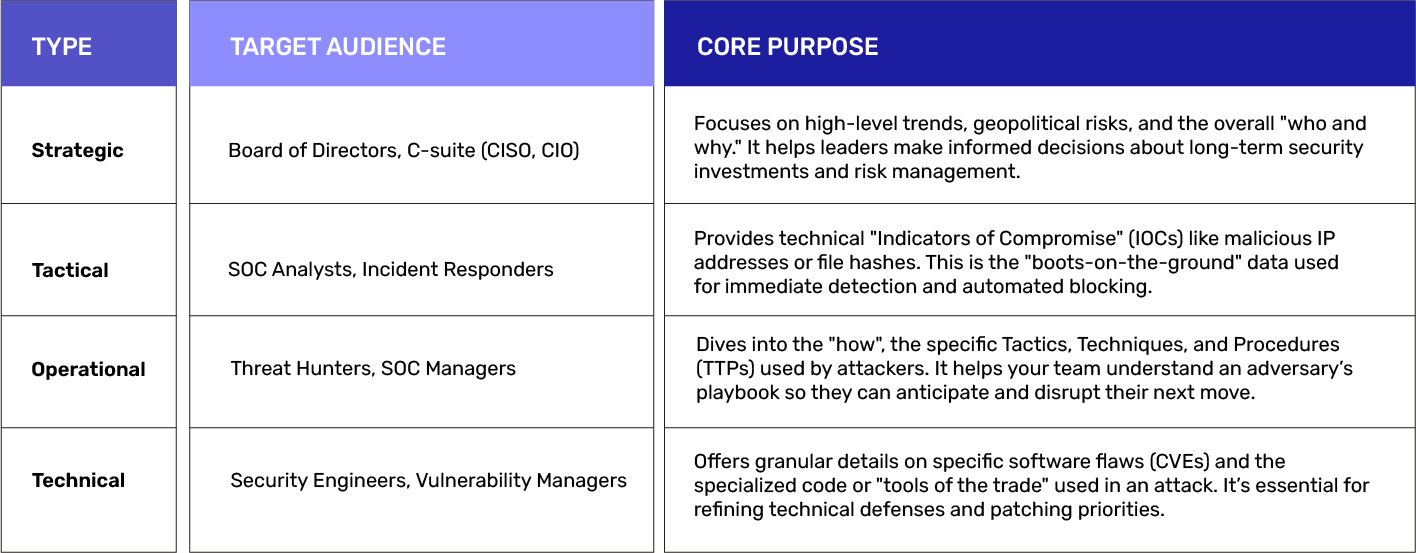
By integrating all four types into a single platform, you ensure that every level of your organization is moving in sync. You aren’t just blocking individual attacks (Tactical); you are understanding the landscape (Strategic), outthinking the opponent (Operational), and hardening your systems (Technical).
Key Features of a Threat Intelligence Platform
Selecting a cyber Threat Intelligence Platform isn’t just about finding a tool with the most “feeds.” It’s about finding a system that fits into your team’s workflow and actually makes their lives easier. A high-performing TIP should act as a force multiplier, automating the tedious parts of security so your human experts can focus on high-level strategy.
Here are the non-negotiable features that define a modern, effective TIP:
- Centralized Data Aggregation: A TIP should be a “data vacuum,” capable of pulling in information from every available source, commercial feeds, open-source intelligence (OSINT), dark web monitors, and your own internal network logs. The goal is to have one single source of truth rather than ten different browser tabs.
- Automated Normalization: Threat data is messy and comes in dozens of different formats. A key feature of any TIP is its ability to “translate” all that data into a standardized language (like STIX or TAXII) automatically. This ensures that your different security tools can actually talk to each other without manual intervention.
- Smart Correlation and Context: It’s not enough to know an IP is “bad.” A good platform “connects the dots,” showing you that a specific malicious file is linked to a known threat actor who has been targeting your specific industry. This context is what turns raw data into actionable intelligence.
- Risk-Based Prioritization: Not all threats are created equal. An essential feature is a “scoring engine” that evaluates threats based on their relevance to your business. If a piece of malware only targets an operating system you don’t use, your TIP should deprioritize it so your team can focus on the fires that are actually burning in your backyard.
- Seamless Integration: A TIP shouldn’t be an island. It needs to “play well with others,” pushing refined intelligence directly into your existing security stack, your SIEM, firewalls, and EDR tools. This allows for “automated blocking,” where the system identifies a threat and updates your defenses before a human even has to step in.
- Collaborative Workspaces: Security is a team sport. A TIP should provide a shared environment where analysts can document their findings, share notes on a specific investigation, and even securely share intelligence with trusted industry peers or government bodies.
- History and Trend Analysis: A great platform doesn’t just show you what’s happening now; it tracks how threats evolve over time. By looking at historical data, you can identify long-term patterns in an attacker’s behavior, helping you move from “stopping the current attack” to “preventing the next one.”
The Impact of Advanced Persistent Threats (APTs) on Your Organization
1. Financial Loss
APT attacks often cause financial harm through:
- Direct theft of money or assets.
- Regulatory fines for data breaches, especially in sectors like finance or healthcare.
- Recovery costs from forensic investigations and remediation efforts.
- Business disruption from downtime, leading to lost revenue.
2. Fact
The average data breach costs over $3.8 million.
3. Data Theft
APTs often target:
- Intellectual property like product designs and trade secrets.
- Customer information, including personal and financial data.
- Business plans and strategic information, potentially affecting market position.
4. Operational Disruption
APTs target critical systems to disrupt:
- Industrial control systems in energy, manufacturing, or transportation.
- Healthcare systems, endangering lives through service interruptions.
- Supply chains, leading to logistical slowdowns and unfulfilled orders.
5. Reputational Damage
A significant attack can result in:
- Customer churn: Loss of customers who doubt your data security.
- Broken partnerships: Business partners may terminate contracts due to risk concerns.
6. Regulatory Penalties
- Fines from GDPR or HIPAA violations.
- Increased compliance scrutiny through audits and investigations.
7. Long-Term Espionage
APTs maintain access for prolonged periods to:
- Gather intelligence on networks and vulnerabilities.
- Plan future attacks for maximum impact.
- Discover hidden weaknesses for later exploitation.
Building an Effective Threat Intelligence Platform (TIP)
1. Data Collection & Aggregation
Collect data from:
- Internal sources: Firewalls, intrusion detection systems (IDS), and endpoint detection tools.
- External sources: Open-source intelligence (OSINT), industry alerts, and government advisories.

2. Correlating Threat Data with Context
Your TIP must map threat data to the organization’s risk profile to filter out noise and focus on relevant threats.
3. Automating Threat Response
Automate responses to reduce attacker dwell time:
- Isolate compromised systems to prevent lateral movement.
- Trigger alerts to notify the Security Operations Center (SOC).
- Block malicious IPs and quarantine suspicious files automatically.
Steps to Build a Threat Intelligence Process
1. Define Your Organization’s Needs
Identify key assets, likely adversaries, and industry-specific risks to develop a customized TIP.
2. Select the Right Tools
Ensure tools integrate with SIEM, endpoint detection, and incident response platforms.

3. Automate & Configure Responses
Pre-define actions for specific threat levels to ensure rapid, consistent responses.
4. Continuous Monitoring & Threat Hunting
Use SIEM and endpoint tools to maintain real-time visibility across your IT environment.
5. Integrate TIP with Security Infrastructure
Ensure seamless integration with SOC processes and security tools to streamline workflows.
6. Train Your Team
Invest in scenario-based training for SOC teams to ensure readiness against advanced threats.
Continuous Improvement through Feedback Loops
1. Post-Incident Reviews:
Analyze security incidents to refine TIP settings and response playbooks.
2. Stay Informed:
Keep up with peer incidents and evolving threats in your industry.
3. Evolve with Threat Actor Tactics:
Regularly update detection rules to keep pace with new vulnerabilities.

Why You Need a Threat Intelligence Platform (TIP)
-
Stay Ahead of Threats:
Real-time insights help preempt cyberattacks.
-
Reduce Human Error:
Automation minimizes manual processes and enhances response times.
-
Accelerate Incident Response:
Correlating threat data with contextual insights ensures faster mitigation.
The Time to Act is Now
With 58% of organizations in the Middle East expecting APT attacks in the coming year, the threat landscape is evolving rapidly. Contact a cybersecurity provider to integrate a TIP with cutting-edge technologies, real-time monitoring, and automation.
Threat Intelligence Platform vs SIEM vs SOAR
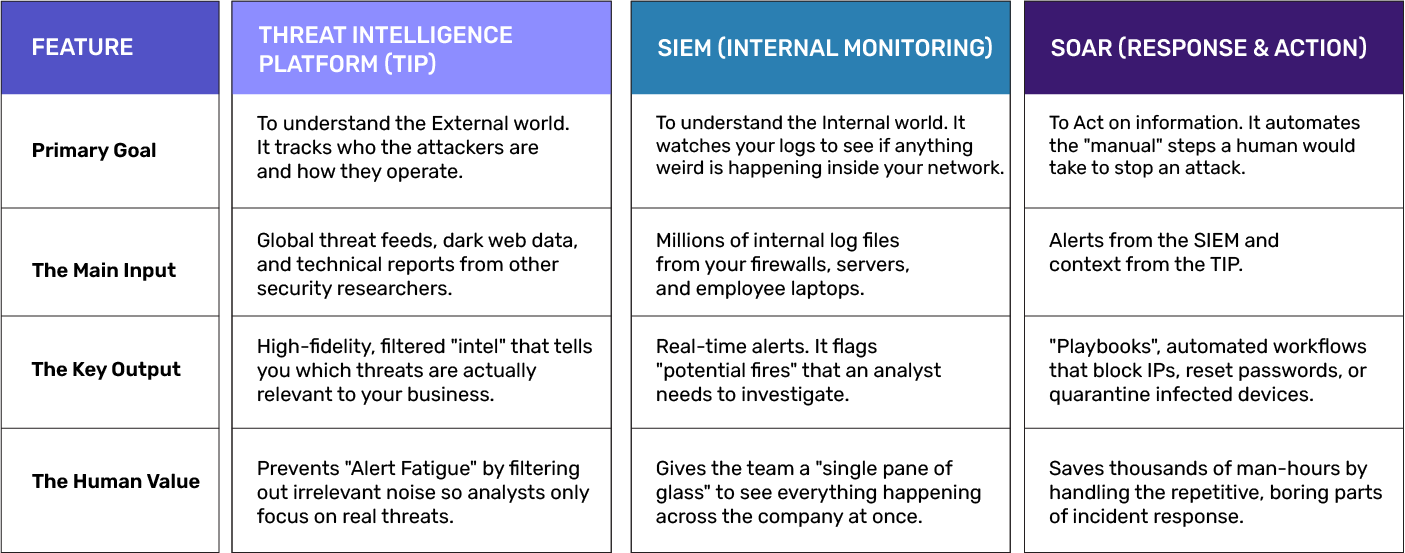
While these three tools often live in the same Security Operations Center (SOC), they each play a very different role. You can think of them as the “Three Musketeers” of security: they work together, but they have distinct personalities and jobs.
If the SIEM is the smoke detector, the TIP is the intelligence report on who is starting fires, and the SOAR is the automated sprinkler system that puts them out.
How they work together in the real world:
- The TIP identifies that a specific group is using a new type of malware to target companies in the Middle East. It sends these “Indicators of Compromise” to your other tools.
- The SIEM notices that an employee’s laptop just downloaded a file that matches the “fingerprint” the TIP warned about. It creates an urgent alert.
- The SOAR platform sees the alert, automatically checks the TIPfor more context, and then immediately disconnects the laptop from the internet and locks the user’s account to prevent the malware from spreading.
By integrating all three, a security team moves from manual, slow reactions to a high-speed, intelligence-driven defense.
Threat Intelligence in Middle East Enterprises
In the Middle East, cybersecurity isn’t just an IT concern, it’s a matter of national and economic resilience. As the region continues its rapid digital transformation through initiatives like Saudi Vision 2030 and the UAE’s “We the UAE 2031,” the stakes for protecting our digital infrastructure have never been higher. For enterprises operating here, cybersecurity threat intelligence has shifted from a “nice-to-have” luxury to the essential foundation of a secure business.
The threat landscape in our region is unique, and a one-size-fits-all global approach often misses the mark. Here is why localized threat intelligence is a game-changer for Middle Eastern organizations:
- A High-Value Target: Because the GCC is a global hub for energy, finance, and logistics, we naturally attract some of the world’s most sophisticated threat actors. Whether it’s state-sponsored groups or high-stakes ransomware gangs, the adversaries targeting our region are often highly motivated and well-funded. Strategic threat intelligence helps local leaders understand these specific “neighborhood” threats before they arrive at the digital doorstep.
- The Geopolitical Factor: In the Middle East, what happens in the physical world often ripples into the digital one. Regional tensions frequently manifest as “hacktivism” or targeted cyber-espionage. Having a cybersecurity Threat Intelligence Platform that tracks these regional geopolitical shifts allows security teams to anticipate waves of attacks linked to specific events, allowing them to harden defenses in advance.
- Navigating Local Regulations: Organizations in the UAE and Saudi Arabia are now operating under strict new frameworks like the SDAIA (Saudi Data & AI Authority) guidelines and the UAE PDPL. These regulations don’t just demand that you have security; they increasingly demand that you are proactive. Threat intelligence provides the evidence-based approach that regulators look for during audits.
- The Talent Multiplier: We know that there is a global shortage of cybersecurity professionals, and the Middle East is no exception. A TIP acts as a force multiplier for our local teams. By automating the collection and filtering of data, it allows our home-grown talent to focus on high-level strategy and hunting rather than spending their days manually sorting through thousands of irrelevant alerts.
- Building a “Sharing Culture”: We are seeing a fantastic rise in regional collaboration. Organizations are moving away from the old “siloed” approach and are starting to share threat data through national cybersecurity centers. A TIP makes this collaboration seamless, allowing a bank in Riyadh to learn from a threat detected by a logistics firm in Dubai, creating a “herd immunity” for the entire regional economy.
Challenges in Threat Intelligence Implementation
While the benefits of a Threat Intelligence Platform are clear, getting one up and running isn’t without its growing pains. It’s rarely a “plug-and-play” situation; rather, it’s a strategic shift that requires a good deal of coordination across different teams.
- Drowning in the “Data Deluge”: The biggest hurdle is often the sheer volume of information. If you plug in every available feed without a clear strategy, your team will quickly be overwhelmed by noise. The challenge isn’t just getting data, it’s filtering out the 99% that doesn’t matter to your specific business so you can find the 1% that does.
- The Integration “Jigsaw Puzzle”: For a TIP to be effective, it needs to talk to your existing tools, your firewalls, your email security, and your cloud monitors. In many organizations, these systems live in silos or run on legacy software that doesn’t easily “hand off” information. Bridging these technical gaps often requires more custom engineering than people initially expect.
- The Skills Gap: A TIP is a powerful engine, but it still needs a driver. Many enterprises find that they have plenty of “general” IT staff but lack specialized threat analysts who know how to interpret complex indicators or hunt for adversaries. Without the right people to verify the intelligence, even the best platform is just a very expensive dashboard.
- Proving ROI to the Board: Cybersecurity is often seen as a “cost center” until something goes wrong. Explaining the value of a TIP to non-technical executives can be tough. It’s hard to put a dollar value on a “prevented” attack, so teams often struggle to secure the long-term budget needed for high-end commercial feeds and platform maintenance.
- Dealing with “Stale” Intelligence: The shelf-life of threat data is incredibly short. An IP address that was malicious this morning might be perfectly safe by the afternoon. Maintaining a “clean” database and ensuring that your automated blocks aren’t accidentally stopping legitimate business traffic is a constant, high-stakes balancing act.
- Actionability vs. Curiosity: There is a temptation to collect intelligence just because it’s interesting. Organizations often fall into the trap of tracking “cool” hacker groups that have zero intention or capability of targeting their industry. The challenge is keeping the focus strictly on intelligence that leads to a specific, defensive action.
- Standardization Headaches: Even though the industry is moving toward standards like STIX and TAXII, different vendors still have their own ways of describing threats. Reconciling these different “languages” so your systems can act on them in real-time remains a significant technical bottleneck for many implementation teams.
Best Practices for Threat Intelligence Platforms
Implementing a Threat Intelligence Platform (TIP) is a major step toward a mature security posture, but the tool is only as good as the strategy behind it. To move from “collecting data” to “preventing breaches,” your team should focus on these industry-proven best practices:
- Start with a Clear Mission: Don’t just turn the platform on and hope for the best. Define your Priority Intelligence Requirements (PIRs) first. Are you most worried about financial fraud, intellectual property theft, or ransomware? By telling the platform what you care about most, you ensure the alerts you get are actually relevant to your business.
- Prioritize Quality Over Quantity: There is a common temptation to plug in every free and commercial feed available. This is a recipe for “alert fatigue.” Instead, curate your sources. Focus on high-fidelity feeds that have a proven track record of accuracy and, more importantly, relevance to your specific industry and geographic region.
- Demand “Actionability”: Every piece of intelligence the platform highlights should answer one simple question: “So what?” If a report doesn’t lead to a specific action, like blocking an IP, patching a server, or updating a firewall rule, it’s just interesting news, not intelligence. Focus your workflows on data that allows your team to do something.
- Automate the “Boring Stuff”: Use your TIP to handle the repetitive, high-volume tasks. Automate the ingestion, normalization, and basic blocking of known “commodity” threats. This frees up your expensive human analysts to focus on the high-level “hunting” and complex investigations that a machine can’t handle.
- Integrate, Don’t Isolate: A TIP shouldn’t be a silo. Its real value is unlocked when it “talks” to the rest of your security stack. Ensure it is seamlessly integrated with your SIEM for better internal monitoring and your SOAR for faster automated response. Intelligence is only powerful if it’s where the action is happening.
- Keep the “Human in the Loop”: While automation is great, context is king. A machine might see a connection, but a human analyst understands the nuance of a business relationship or a geopolitical shift. Ensure your team has the time and training to dig into the “why” behind the data the platform provides.
- Clean Your Data Regularly: Threat intelligence has a short shelf life. An IP that was used by a hacker yesterday might be assigned to a legitimate coffee shop tomorrow. Establish a regular “pruning” process to remove stale indicators so you aren’t accidentally blocking legitimate traffic and creating headaches for your users.
- Measure and Refine: You can’t manage what you don’t measure. Track metrics like Time to Detect (TTD) and the percentage of alerts that turned out to be “false positives.” Use this data to refine your feeds and rules, making the platform smarter and more efficient every month.
By treating your TIP as a living, breathing part of your security ecosystem rather than a “set-and-forget” software purchase, you can turn raw global data into a shield that truly protects your organization’s future.
Recent Posts
- AI Governance in Practice: Why Speed Needs Guardrails, Not Hype
- Top 5 Cyber Security Risks in 2026: What GCC and Saudi Leaders Need to Watch Closely
- Value-Driven Cybersecurity
- The 3W’s of Cybersecurity Frameworks – What, Why, and When
- Types of Network Access Control (NAC): Methods, Models, and Best Practices
FAQs
Not all intelligence is created for the same audience. To be effective, an organization usually balances these four categories:
- Strategic: High-level insights for executives about broad trends and geopolitical risks.
- Tactical: Technical details like malicious IP addresses or file signatures used for immediate blocking.
- Operational: Deep dives into “how” attackers work (their playbooks and techniques) so your team can anticipate their next move.
- Technical: Granular data on specific software vulnerabilities and the specialized tools hackers use.
While the “best” platform depends on your specific infrastructure and budget, a few names consistently lead the industry in 2026:
- Recorded Future: Known for its massive data collection and excellent visualization of the “threat landscape.”
- Anomali (ThreatStream): A heavy hitter for enterprises that need to integrate dozens of different feeds into one place.
- ThreatConnect: Often praised for its ability to link intelligence directly to incident response workflows.
- CrowdStrike Falcon Intelligence: A go-to for teams that want high-fidelity intelligence baked directly into their endpoint security.
- Palo Alto Networks (Cortex TIM): Ideal for organizations already using the Palo Alto ecosystem who want a seamless, automated defense.
Intelligence isn’t a single event; it’s a continuous loop known as the “Intelligence Lifecycle.” It follows these six steps:
- Direction: Setting your goals and identifying what you need to protect.
- Collection: Gathering raw data from internal and external sources.
- Processing: Cleaning and organizing that data so it’s easy to read.
- Analysis: Connecting the dots to figure out what the data actually means for your business.
- Dissemination: Getting that “finished” intelligence to the people who can act on it.
- Feedback: Reviewing the results to make the next cycle even more accurate.
In the world of enterprise security, successful intelligence is often distilled into the “Golden Triangle” of People, Process, and Platforms:
- People: The skilled analysts who have the intuition to understand an attacker’s motive.
- Process: The repeatable workflows that ensure data is handled consistently and quickly.
- Platforms: The technical tools (like a TIP) that automate the “grunt work” so the people can focus on the strategy.
When these three work in harmony, threat intelligence stops being a “cost” and starts being a strategic shield.
The Time to Act is Now
With 58% of organizations in the Middle East expecting APT attacks in the coming year, the threat landscape is evolving rapidly. Contact a cybersecurity provider to integrate a TIP with cutting-edge technologies, real-time monitoring, and automation.

Protect your online assets from cyber threats with Paramount
Comprehensive cyber security solutions for individuals and businesses
Significantly reduce the risk of cyber threats and ensure a safer digital environment.
