
Blog
The Career Questions Most Young Professionals Are Not Asking Yet
Author:
Premchand Kurup
Reading Time: 8 Minutes
A business leadership talk at IIM Kozhikode put something into focus that most early-career advice tends to miss. The conversation was built around real numbers from a real business, two people who joined as fresh graduates and ended up running a third of the company’s revenue between them. Not because they followed the conventional career playbook, but largely because they did not.
The lessons from that session apply to anyone early in a career trying to figure out how to build something that actually grows stronger with time, rather than just moving quickly through a series of roles.
The Implicit Career Model That Nobody Questions
Most early career advice, whether it comes from peers, campus placement prep, or online content, optimises for speed. Get promoted fast. Build a varied CV. Move to the better-known company. Take the role with the bigger title. On the surface, none of this is bad advice. But it tends to produce careers that look impressive on paper for the first five years and then flatline in a way that is genuinely hard to explain.
The reason, when you look closely, is almost always the same. The person was optimising for the wrong metric.
Depth Compounds. Switching Just Accumulates.
There is an implicit model of career building that gets passed around widely, and it goes like this: stay in a role for two years, take what you can, move for a better title or more pay, repeat. Each individual move looks like progress. The CV gets longer. The brand names get bigger. But progress measured by moves is not the same thing as progress measured by depth.
In most fields worth being in, the things that make someone genuinely valuable cannot be built in two-year increments. Client trust is one example. It does not just mean that a client likes you. It means they call you first when something goes wrong, that your judgment is trusted without needing to be justified each time, and that your continuity in a relationship is itself a business asset. That kind of trust takes years to earn and cannot be fast-tracked.
The same applies to institutional knowledge. A professional who has been in one domain long enough to see how decisions made three years ago actually played out, to understand why the current approach replaced the old one, to know the patterns that only become visible over time, has something that a more varied CV structurally cannot produce. The market pays for this depth. It just does not always signal that clearly in the early years, which is why so many people leave before the compounding starts.
Scope Beats Title, & Scope Comes in More Than One Shape
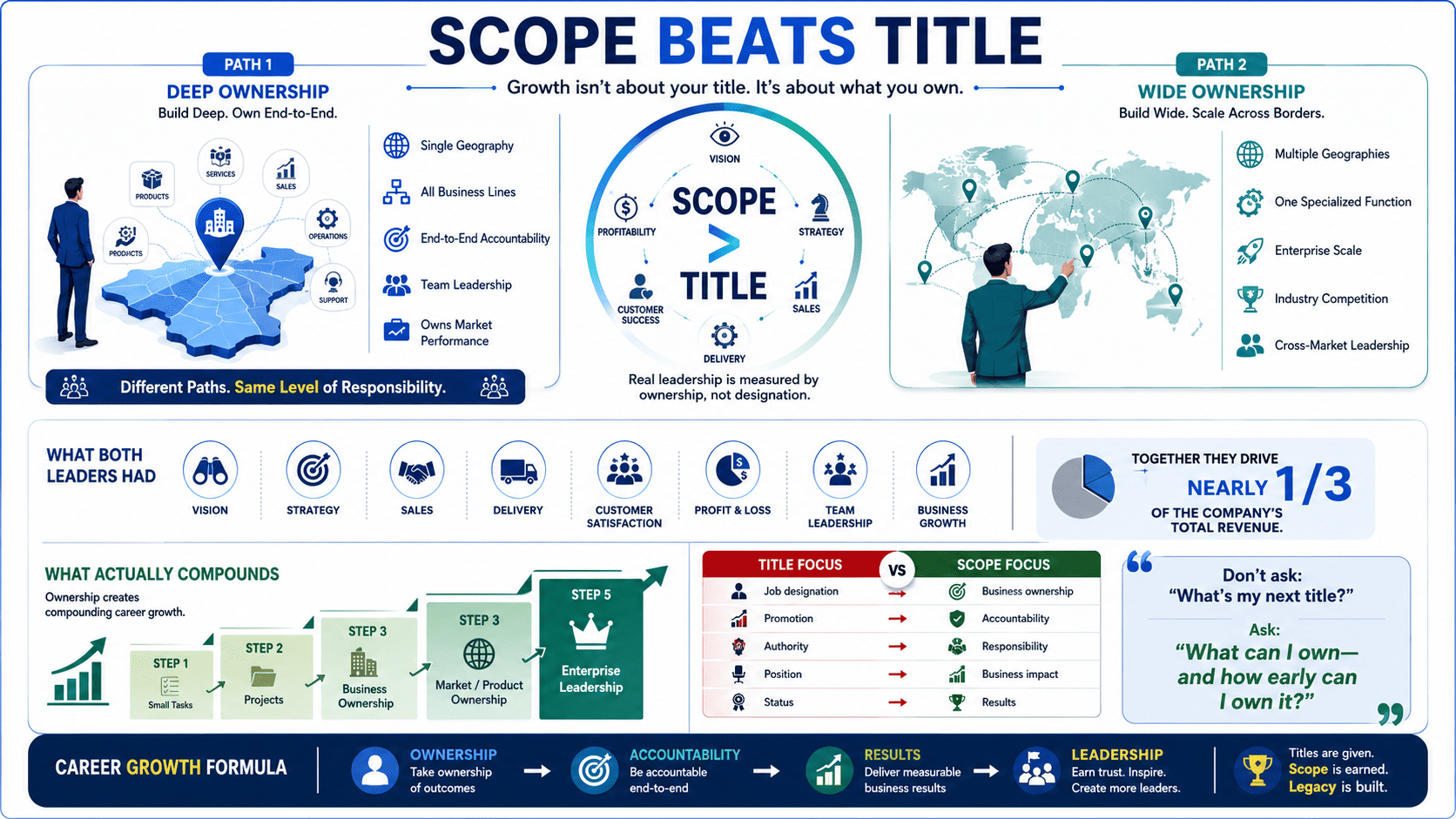
One of the clearest points from the Kozhikode session was about how two professionals can build equally strong careers on completely different paths, and why neither is more senior than the other.
One person built deep within a single geography, owning all business lines end-to-end in that market. The other went wide across a function, taking it across multiple geographies and competing with the biggest names in the industry. Both carried full accountability for outcomes: vision, strategy, sales, delivery, customer satisfaction, and the bottom line. Both led teams of similar size. And together they drive a third of the company’s total revenue.
The lesson is not “go deep” or “go wide.” The lesson is to stop measuring growth by what the title says and start measuring it by how much of the business you actually own end-to-end. A title without real accountability behind it is not a career milestone. A role where someone owns a market, a product line, a customer segment, or a full function and is held responsible for the result, that is where compounding starts.
The more useful question for any early-career professional to ask when evaluating a role is not “what is the next title” but “what can I actually own here, and how early can I start owning it?”
Leaving Is Not Failure. Coming Back Is Not Weakness.
This one goes against most conventional career thinking, and it is worth sitting with.
The second person featured in the Kozhikode session did not spend fifteen years in a straight line at one company. In the middle of it, they left for four years to build their own venture. Then they came back and went on to build a business unit that now contributes significantly to the company’s overall revenue and competes directly with industry giants.
That sequence, staying, leaving, testing yourself, returning with something new, matters more than the tenure number alone. It proves that the years inside the organization were not about playing it safe or lacking other options. They were a choice, re-examined and re-made after real information was gathered about what the person was capable of on their own.
The message this sends is not “stay loyal to one organization for a long time.” It is closer to: go find out what you are capable of when no one is protecting you. Test yourself in conditions where your performance is the only thing keeping you going. Then decide, with actual evidence rather than assumption, where you want to build depth and for how long.
Staying has value. But staying as a habit rather than a deliberate, re-examined choice is just avoidance with a long tenure attached to it.
Ownership Is the Actual Multiplier, Not Time Served
Ten years at a company does not, by itself, create a leader. Neither does fifteen. What creates a leader is ten or fifteen years of owning outcomes the way a founder does, being responsible for the full picture, not just one part of it.
Most early-career professionals do not ask about ownership when they evaluate a role. They ask about compensation, growth trajectory, learning opportunities, and the company’s brand. These are reasonable things to consider. But they leave out the most important one: what will I actually be held accountable for here, and will that accountability grow over time?
A role at a recognizable organization with a strong title but narrow responsibilities, where individual contribution is hard to measure and accountability is shared across many people, tends to produce a polished professional who hits a ceiling earlier than expected. A role that gives someone genuine ownership of a customer, a function, a market, or a product from early on, even if the company name is less well-known, tends to produce someone who builds far more quickly and carries compounding value into every subsequent role.
Tenure with ownership is compounding. Tenure without ownership is just seniority.
Smaller Does Not Mean Weaker
There is a bias in most early-career decision-making toward larger organizations, and it is understandable. Bigger brand, better-known alumni network, more structured learning programmes. But in specialized fields, size and quality are not the same thing.
The Kozhikode session made this point with a direct example. A team of 75 people, within a mid-sized company, competed directly with some of the largest professional services firms in the world in a specific niche. And won enough of that competition to represent a significant share of the company’s revenue. They won not because of scale, but because of focus, depth, and the speed that comes from not having to coordinate across thousands of people before making a decision.
A young professional who goes deep in a specific area, builds genuine expertise, and learns to compete on precision and depth rather than scale tends to be in a very strong position by mid-career. Often stronger than someone who spent the same years collecting experiences at large organizations where their individual contribution was harder to see and their depth harder to build.
The size of the player in the room does not determine the outcome. The quality of the expertise does.
The Question Worth Optimising For
Most people early in their careers are optimising for one question: how fast can I get promoted?
That question is not wrong. But on its own it tends to produce careers that start fast and plateau in the middle in a way that takes years to understand and even longer to reverse.
The question worth adding to it is: how much can I actually own, and how early can I start building something that compounds?
Depth in a domain worth being deep in. Genuine accountability for outcomes. The confidence that only comes from testing yourself outside a safety net at least once. These are the things that make a career keep accelerating ten and fifteen years in, rather than peaking early and levelling off.
The two professionals featured in the session did not know, on the day they joined, that they would one day run a third of the company’s revenue. They just kept choosing depth over breadth, ownership over title, and the courage to test themselves even when it meant stepping away for a while.
That is the version of a career worth building toward, regardless of the field or the organization.
ABOUT AUTHOR

By Premchand Kurup, CEO – Paramount

Premchand Kurup is the Chief Executive Officer at Paramount With over 30 years of leadership experience, Kurup has spearheaded the company’s operations across the Middle East, including UAE, Bahrain, Kuwait, Qatar, Oman, and Saudi Arabia. Premchand Kurup is a visionary leader who pioneered cybersecurity in the Middle East and has been instrumental in positioning Paramount as an industry leader throughout the region. His strong focus on cybersecurity has contributed to the establishment of a robust sector in the Middle East as well as cemented his reputation as a forward-thinking innovator.

Protect your online assets from cyber threats with Paramount
Comprehensive cyber security solutions for individuals and businesses
Significantly reduce the risk of cyber threats and ensure a safer digital environment.
