
Blog
Zero Trust vs VPN: 7 Key Differences and How to Choose
Reading Time: 7 Minutes

Zero Trust Network Access (ZTNA) verifies the user, device and context on every request, then grants access to one named application; a virtual private network (VPN) authenticates the user once and creates a tunnel into the network. If VPN credentials are stolen, an attacker can inherit everything that account can reach; with ZTNA, access is tied to one application. Think of a VPN as a key to the building, and ZTNA as a key to one room, checked again each time the door opens.
What a VPN does
A VPN creates an encrypted tunnel between a device and the corporate network. A tunnel is a protected connection between two points. After authentication, the device is treated much like it is inside the network perimeter, the boundary separating trusted internal systems from outside connections.
- It authenticates the user at connection time.
- It sends traffic through the corporate network.
- It can provide broad access to network resources.
The VPN is doing what it was designed to do. Its model was built around a clear inside and outside.
What zero trust network access does
ZTNA starts with a simple principle: never assume, always check. NIST describes zero trust as an approach where trust is not granted simply because of network location, and access decisions can consider user and device identity. (NIST Computer Security Resource Center).
- Identity verification: The user is checked on each request, not only at login.
- Device posture: The system checks whether the device is patched, managed or encrypted.
- Application-level access: Access is granted to a specific application rather than the wider network.
- Continuous re-evaluation: Access can be reviewed during the session as context changes.
Least privilege means giving a user only the access needed for a task. Device posture means the current security state of the device making the request.
7 key differences between ZTNA and VPN
The Zero Trust Network Access vs VPN comparison becomes clearer side by side.
The 7 differences, side by side
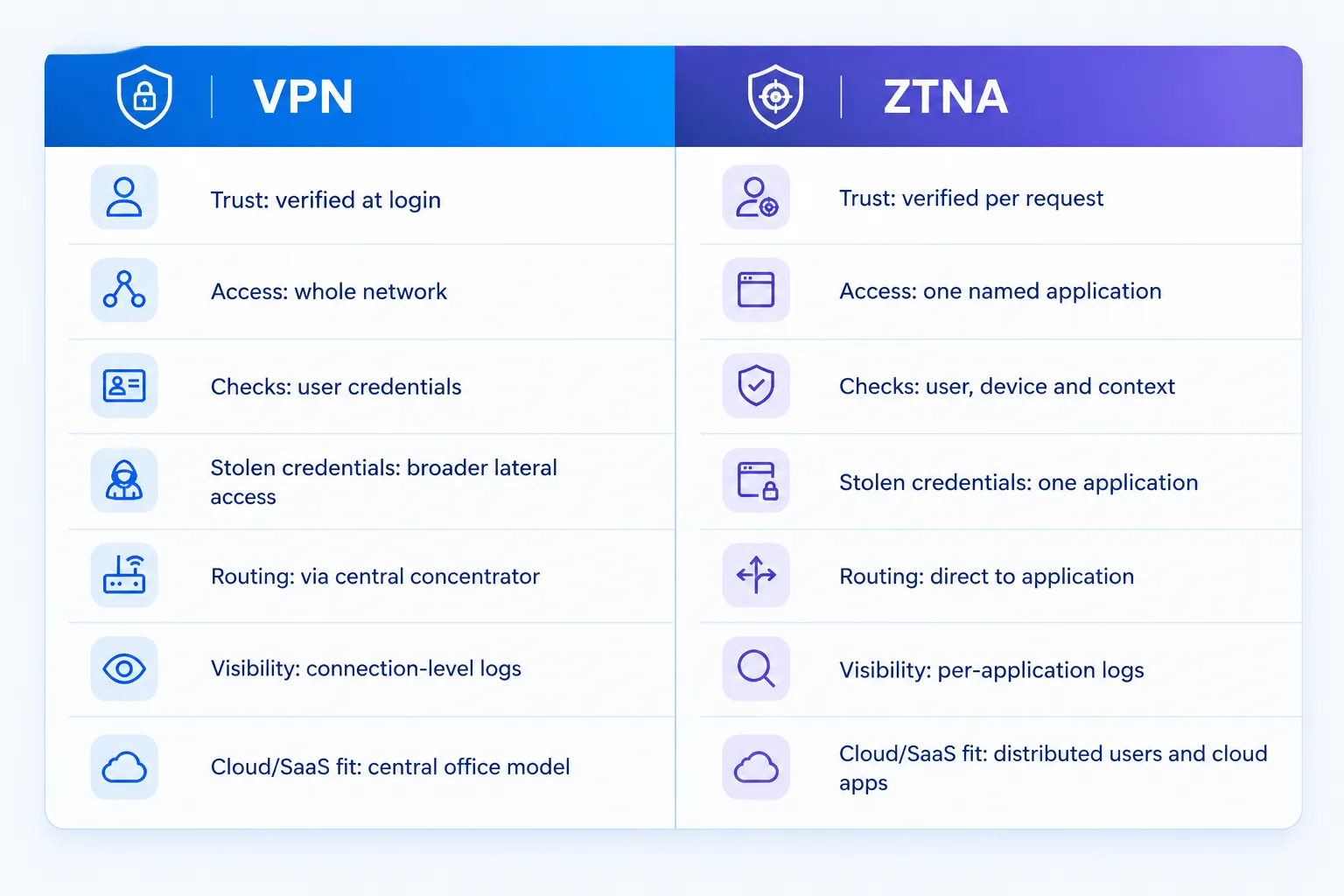
What these differences mean in practice
- A contractor needing one finance application may receive access to the wider network through a VPN.
- A laptop that missed recent patches can still connect through a VPN because its condition may not be checked.
- A user in Riyadh accessing a cloud application may send traffic through a head-office concentrator, adding latency.
When a VPN is still the right choice
ZTNA is not a universal replacement for VPNs. Some environments still have practical reasons to keep them.
- Site-to-site connections between offices or data centres.
- Legacy applications that cannot sit behind a modern access broker.
- Administrative access to network infrastructure itself.
- Smaller organisations with one location and little cloud use, where changing the access model may cost more than the operational gain.
A staged migration may leave VPN and ZTNA running together for a period.
Moving from VPN to ZTNA
Start with a simple question: what is the VPN actually being used to reach?
- Inventory: List every application reached through the VPN and who uses it.
- Prioritise: Start with the highest-risk, lowest-complexity group, often contractors and third parties.
- Run both: Move application groups across in stages instead of one large cutover.
- Decommission: Remove VPN access for each application as it moves.
The inventory step is where many projects stall because teams lack a reliable picture of what the VPN is carrying.
Recent Posts
- Best Practices for Cloud Risk Management in the Middle East | Paramount
- Never Trust, Always Verify: Why Zero Trust is the Key to Modern Cyber Defense
- Data Classification for GCC Enterprises: A Strategic Guide to Policy, DLP & Governance
- Generative AI adoption risks you should address to safeguard your enterprise
- PAM Applications: How Privileged Access Management Enhances Cybersecurity
Frequently Asked Questions
For remote user access to applications, usually yes. For site-to-site links and network device administration, usually no.
Yes. Organisations can run both during migration while application groups move across in stages.
No. ZTNA is one component of SASE, which can also include SD-WAN, secure web gateway and CASB in a cloud-delivered service.
Not technically. But identity is the control point, so ZTNA without strong authentication gives up much of its intended security value.
Usually, ZTNA has higher per-user licensing costs, while VPN estates may carry hardware, bandwidth and support overhead. Actual cost depends on the existing setup.

Protect your online assets from cyber threats with Paramount
Comprehensive cyber security solutions for individuals and businesses
Significantly reduce the risk of cyber threats and ensure a safer digital environment.
