
Blog
NESA Compliance and DESC Compliance in the Age of AI Cyber Security
Author:
Pradeep Menon
Reading Time: 8 Minutes

The UAE’s cybersecurity framework is built on two key pillars: NESA (National Electronic Security Authority) compliance at the national level and DESC (Dubai Electronic Security Center) compliance within Dubai. Both define how organizations secure systems, manage risk, and prove that controls are working.
AI is already embedded in that system. It classifies alerts, scores risk, and shapes response decisions. As a result, many security controls, especially those related to monitoring, detection, and incident response, no longer operate in a purely manual way.
This is where many organizations struggle. Monitoring, detection, and incident response controls may be in place, but the evidence needed to show how these controls operate, and to prove they are effective is often missing.
Understanding the UAE’s Cybersecurity Compliance Landscape
The UAE compliance picture is easier to manage once you separate national controls from Dubai-specific controls. The national NESA compliance track now lies under the UAE Information Assurance framework managed through the Cyber Security Council. It is designed to protect critical information and communication systems that support national infrastructure. Dubai’s DESC compliance track lies under the Information Security Regulation issued for government entities in Dubai and is supported by sector-specific standards and certifications from the Dubai Electronic Security Center.
That distinction matters because many organizations in the UAE operate across both environments. A government-linked entity in Dubai may need to satisfy Dubai controls for local operations while also aligning to national assurance expectations if it supports critical national services, regulated sectors, or shared government infrastructure. The overlap is operational, not theoretical.
AI changes the compliance conversation because it affects the controls regulators already care about. Logging, access control, risk assessment, incident response, evidence quality, and ongoing monitoring all become faster with AI. They also become harder to govern if teams deploy AI into detection, triage, scoring, or automated response without setting rules for accountability and auditability first.
The UAE Cyber Security Council’s National Information Assurance Platform (NIAP) makes that direction explicit. It describes AI-driven monitoring, scoring, and assessments as part of continuous compliance.
NESA compliance vs DESC compliance
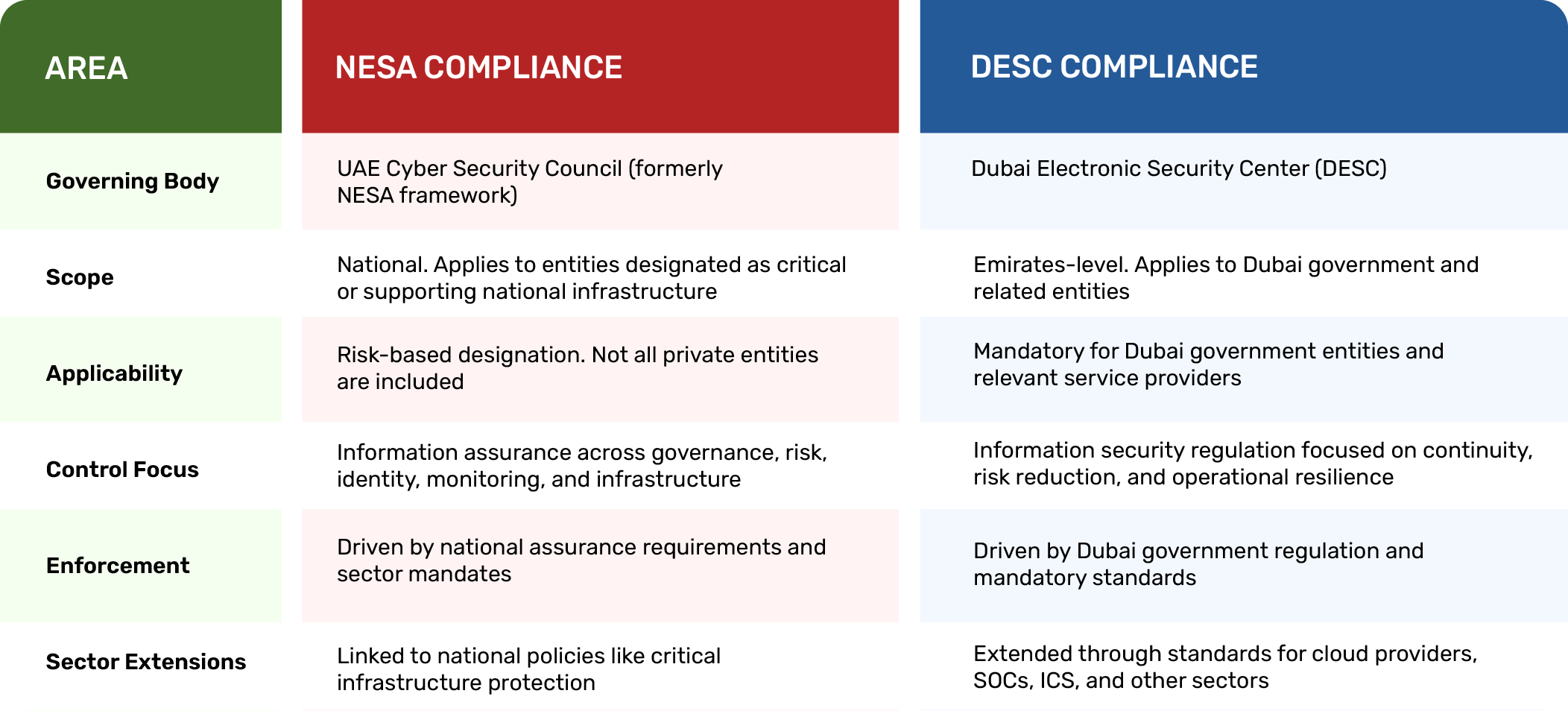
NESA compliance applies to entities designated under the UAE Information Assurance regime, especially critical entities identified under the UAE critical infrastructure protection model. The UAE IA Regulation says the competent authority designates critical entities mandated to implement the controls. That makes the national framework risk-based and sector-sensitive. It is not a blanket rule for every private company operating in the country.
DESC compliance applies to Dubai government entities under the Information Security Regulation (ISR), and DESC also issues additional standards that become mandatory in defined cases, such as cloud service providers and SOC providers that want to serve Dubai government and semi-government entities.
An entity can lie inside Dubai’s public sector environment, and support services considered critical at a national or emirate level. In practice, that means security leaders should not build two separate compliance programs. They should build one control architecture, then map it to both frameworks.
Access control, risk management, vulnerability management, logging, incident response, supplier governance, and assurance are common ground. Evidence collection, scope, reporting lines, and sector obligations are where differences appear.
Inside NESA Compliance: What Security Teams Need to Implement
The current UAE Information Assurance framework gives NESA compliance its practical shape. It provides management and technical security controls for entities to establish, implement, maintain, and continuously improve information assurance. It also links those controls to related national policies, including critical infrastructure protection, cyber risk management, and information sharing.
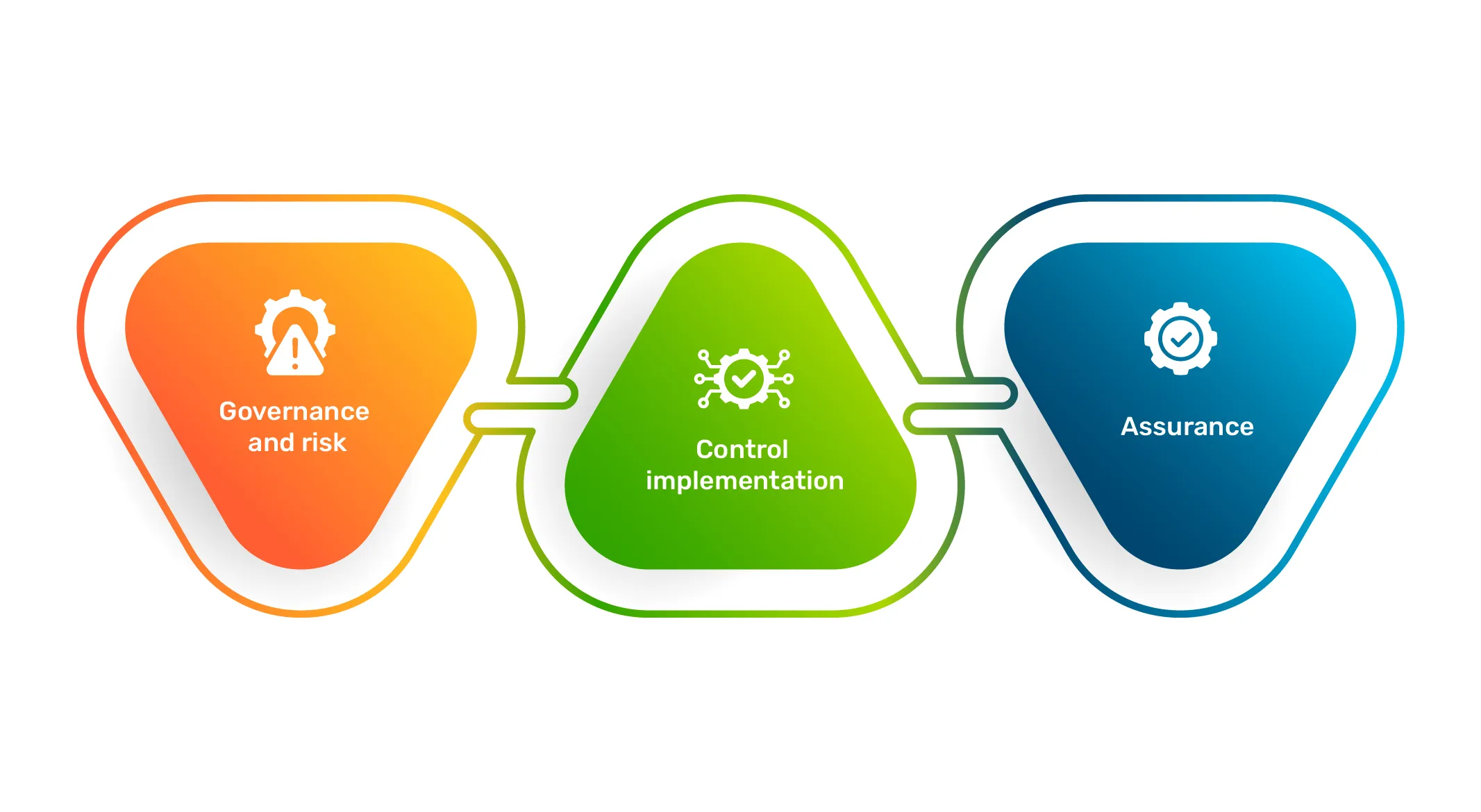
That structure matters because NESA compliance is not a document-checking exercise. It expects a working operating model. Three areas usually decide whether an organization is ready.
- Governance and risk – The framework expects entities to understand which controls apply, how priorities are set, and how compliance will be measured and enforced. A company that cannot explain its risk logic will usually struggle during assessment even if it owns the right tools.
- Control implementation – The national framework is built around management and technical controls, then phased by priority. That means teams need a sequence. Security architecture, asset visibility, identity control, monitoring, and third-party oversight cannot all be treated equally. Some controls are foundations. Others depend on them.
- Assurance – The framework does not stop at implementation. It expects measurement, feedback, and refinement. That has a direct impact on AI use. If AI is used to score risk, monitor anomalies, or automate evidence collection, the organization still needs to explain the method, validate the output, and show who owns decisions taken on that basis.
A weak NESA compliance program typically treats the framework as a checklist of controls to be completed. In contrast, a strong program treats it as a structured management system, backed by solid technical evidence that proves those controls are working.
What DESC Compliance Demands from Security Teams in Dubai
DESC compliance starts with the Dubai Government Information Security Regulation, which is listed under Executive Council Resolution No. 13 of 2012. DESC describes the purpose of the regulation clearly. It is meant to ensure continuity of critical business processes, reduce information security risks and damages, and maintain confidentiality, integrity, and availability for information handled by Dubai government entities.
That wording has two practical consequences. One is scope. DESC compliance is built for government operating reality in Dubai. The other is operational emphasis. It is closely tied to continuity, service resilience, and risk reduction, not only to baseline policy hygiene.
DESC’s own material also shows how the framework has expanded around the ISR. There are supporting standards for cloud service providers, SOC providers, industrial control systems, web security, connected vehicles, and other environments.
The CSP and SOC security standards are mandatory for providers that want to offer those services to Dubai government and semi-government entities. That turns DESC compliance into a market access issue for vendors, not only an internal government requirement.
For security leaders, three design choices matter most under DESC compliance.
- Applicability – DESC states that Dubai government entities must conduct an applicability review of the ISR domains and controls to determine which are relevant. That means control selection cannot be copied from another entity’s scope.
- Sector fit – If an entity is related to cloud, SOC, or critical infrastructure contexts, following basic ISRs may not be enough, and additional standards can apply.
- Audit posture – DESC has built an ecosystem around standards, certifications, providers, and cyber risk oversight. Organizations that wait until assessment season to clean evidence usually create unnecessary work for themselves.
How can AI in cybersecurity accelerate NESA and DESC Compliance?
AI delivers the most value when it is applied to specific control challenges. Its impact is far more limited when used broadly as a general efficiency layer. Here are the areas where AI has the strongest compliance value for NESA compliance and DESC compliance:
- Continuous monitoring and control validation – The UAE Cyber Security Council’s NIAP (National Information Assurance Policy) already frames using AI to provide real-time monitoring, continuous validation, and standardized reporting. That matches a common pain point in both frameworks: controls are often implemented once and checked too slowly. AI can shorten that gap.
- Log analysis and anomaly detection – Security teams drown in telemetry long before they fail compliance. AI can reduce review time by correlating events, spotting patterns, and escalating unusual activity faster. That supports core obligations around monitoring, incident detection, and quality of evidence.
- Evidence collection for audits – One of the most expensive parts of compliance is proving that controls operate consistently. AI can help classify evidence, link it to controls, and flag missing artefacts before an audit window closes. That matters more in organizations trying to serve both national and Dubai-specific control sets.
- Risk scoring and remediation prioritization – Both frameworks are risk-led. AI can help rank weaknesses by likelihood, exposure, and control dependency, so teams fix the issues that affect compliance posture first. Done well, this speeds decisions. Done badly, it turns risk scoring into opaque automation.
- Third-party and cloud oversight – Dubai’s mandatory CSP and SOC standards show how important supplier assurance is in the DESC environment. AI can help watch provider performance, configuration drift, and control exceptions across outsourced environments.
The useful test is simple. If an AI use case cannot be tied to a control family, an audit pain point, or a decision bottleneck, it does not belong in the compliance stack.
Why is AI Governance now a part of NESA and DESC Compliance?
Once AI is placed inside security operations, compliance evidence, detection logic, or risk scoring, AI itself becomes part of the control environment. That creates obligations under both NESA compliance and DESC compliance, even if neither framework was written as an “AI law.”
This is because both frameworks care about governance, risk, accountability, and control effectiveness. If a model influences alerts, suppresses noise, recommends remediation, or drafts audit evidence, the organization needs to know four things:
- What data the model uses
- How outputs are reviewed
- Who approves actions
- How errors are corrected
These are governance questions first. They become compliance questions the moment an assessor asks how the control works in practice.
In the UAE’s national model, compliance is tied to continuous improvement, measurement, and enforcement. In Dubai’s model, it is tied to continuity, risk reduction, and practical control adoption across government operations. AI can support all of that. It can also break it if teams cannot explain decisions or prove oversight.
A workable AI governance baseline for this region should include human review for high-impact actions, documented model purpose, input data controls, testing for false positives and false negatives, change management, and a clear audit trail for automated or semi-automated decisions.
NESA and DESC Compliance in Practice Across UAE Sectors
NESA compliance and DESC compliance define control requirements at a framework level. Sector context determines where those controls break first.
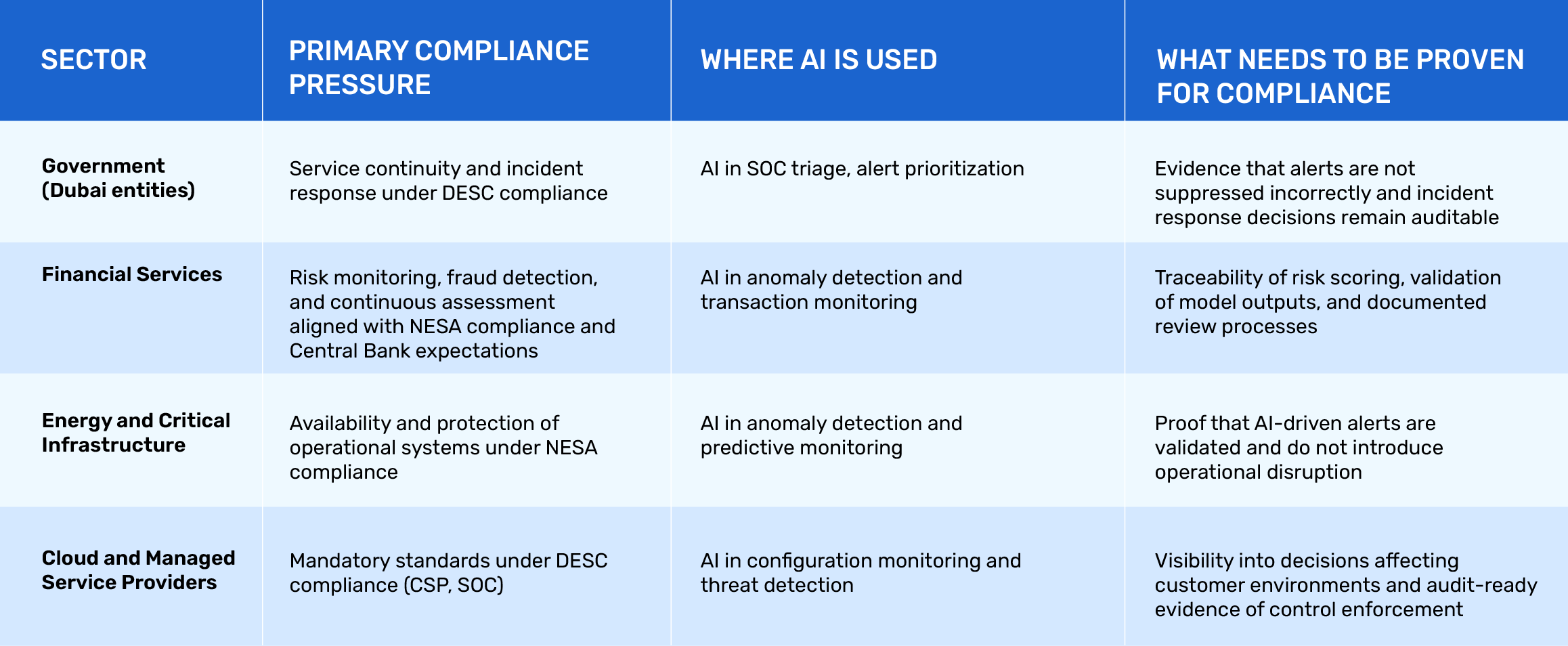
The regulatory expectation stays consistent across sectors.
Both frameworks require:
- Monitoring that can be explained
- Decisions that can be traced
- Controls that can be evidenced
AI changes how these are executed.
The failure pattern is consistent. Teams deploy AI into detection or monitoring but cannot explain how outputs are validated or how decisions are reviewed. That creates a compliance gap even if the underlying control exists.
How to Achieve NESA and DESC Compliance Using AI?
Meeting NESA compliance and DESC compliance with AI starts with control mapping. This means:
- Map each control family to a measurable outcome: Identity, monitoring, incident response, and risk management should define where AI is introduced. Without that mapping, AI becomes noise.
- Use AI where control execution fails at scale: Log analysis, anomaly detection, and evidence collection are common pressure points. AI can reduce manual effort and improve coverage, but only if outputs are reviewed and validated.
- Tie AI outputs to audit evidence: If a model flags an incident or ranks risk, the decision path must be traceable. Regulators do not assess tools. They assess how decisions are made and recorded.
- Introduce governance before automation: Define model purpose, input data boundaries, and review mechanisms. High-impact actions should not be fully automated without oversight.
- Test for failure instead of accuracy: False positives increase operational load. False negatives create compliance gaps. Both need to be measured and controlled.
Making NESA and DESC Compliance Work in Practice
Paramount helps organizations move from control implementation to control proof. Instead of treating NESA and DESC as static frameworks, Paramount connects controls to real-time evidence across monitoring, detection, and response environments.
By integrating AI into control validation, evidence collection, and audit readiness, Paramount ensures that every control is not only implemented but also measurable, explainable, and continuously verifiable, aligned with both national and Dubai-specific compliance expectations.
ABOUT AUTHOR

Pradeep Menon - Chief AI & Information Security Officer

With over two decades of experience advising enterprises and government bodies on cybersecurity strategy and compliance, he has led large-scale security programs across BFSI, Government, and Retail sectors throughout the GCC. His expertise lies in aligning cybersecurity frameworks with complex digital transformation initiatives, ensuring resilience at scale. A recognized thought leader, he is frequently invited by industry forums to share insights on the evolving intersection of Artificial Intelligence, cybersecurity, and regulatory compliance, helping organizations adopt AI-driven security strategies responsibly and effectively.
Recent Posts
- What Is IAM? A Complete Guide to Identity and Access Management in Cybersecurity
- The 3W’s of Cybersecurity Frameworks – What, Why, and When
- From Cybersecurity to Career Security: How Women Can Gift Knowledge to Broaden the Tech Pipeline
- Best Practices for Implementing Robust OT Security
- Why is choosing the Right Security Operations Center Necessary?
FAQ
AI plays a pivotal role in enhancing cybersecurity measures for DESC and NESA compliance by automating threat detection and response mechanisms. Utilizing machine learning algorithms, AI systems can analyze vast amounts of data in real-time to identify patterns and anomalies indicative of security breaches.
AI assists in continuous monitoring and assessment by employing advanced analytics to sift through network traffic and system behaviors continuously. AI-driven tools can generate real-time alerts for suspicious activities and can autonomously make decisions based on learned behaviors, thus ensuring organizations maintain compliance with DESC and NESA standards.
Several specific features of AI are critical for achieving DESC and NESA compliance, including predictive analytics, threat intelligence integration, and automated response capabilities. Predictive analytics allows organizations to foresee potential cyber threats by analyzing historical data trends, which is crucial for preemptive action. Threat intelligence integration enables AI systems to continuously update their knowledge base with information about emerging threats, enhancing situational awareness.
Organizations can ensure that their AI-driven cybersecurity solutions align with DESC and NESA standards by conducting a thorough gap analysis of their current security posture against the compliance requirements. This involves identifying the specific controls and measures outlined by DESC and NESA and assessing whether their AI tools meet these standards.
Organizations might face several challenges when integrating AI into their cybersecurity strategies for DESC and NESA compliance. One major challenge is the potential for false positives and negatives in AI-driven threat detection, which can lead to unnecessary operational disruptions or overlooked threats. Additionally, integrating AI systems with existing security infrastructures may require significant investment in technology and training

Protect your online assets from cyber threats with Paramount
Comprehensive cyber security solutions for individuals and businesses
Significantly reduce the risk of cyber threats and ensure a safer digital environment.
