
Blog
Best Practices for Implementing Robust OT Security
Reading Time: 8 Minutes

Best Practices for Implementing Robust OT Security
Introduction
In a world where operational technology (OT) powers everything from energy grids to manufacturing plants, the stakes for OT security have never been higher. Every networked device, every interconnected system, and every control mechanism is a potential gateway for threats that could disrupt entire industries. With cyber threats targeting critical infrastructures on the rise, implementing robust OT security is no longer optional—it’s a business imperative.
This blog dives into OT security best practices, giving you a clear path to safeguarding your systems and ensuring resilience in today’s dynamic threat landscape. Discover the strategies that can transform your OT security from a vulnerability into a competitive advantage.
What is OT Security?
At its heart, Operational Technology (OT) Security is about protecting the physical world. While IT security focuses on the “virtual” world of emails, databases, and spreadsheets, OT security is the guardian of the machines that keep our society running, the turbines in a power plant, the pumps in a water treatment facility, and the robotic arms on a factory floor.
If IT is the “digital brain” of an organization, OT is its “mechanical muscle.” In 2026, the lines between the two have blurred, but the mission of OT security remains distinct: to ensure that physical processes are safe, reliable, and never stop.
To understand OT security, it helps to look at the three core pillars that define it:
- Process Over Data: In the IT world, if a system is infected, we might shut it down to protect the “confidentiality” of the data. In the OT world, shutting down a system could be catastrophic. Imagine a cooling pump in a chemical plant stopping, it doesn’t just mean a “data loss”; it could lead to physical damage, environmental hazards, or a threat to life. OT security prioritizes Availability and Safety above all else.
- The “Invisible” Infrastructure: Most of us never see the hardware that OT security protects. It’s made up of specialized devices like PLCs (the “mini-computers” that control a machine’s logic) and SCADA systems (the high-level software that lets operators monitor a whole factory). These devices often have lifecycles of 20 or 30 years, meaning OT security experts are often protecting legacy technology that was built long before the modern internet existed.
- The End of the “Air Gap”: For decades, industrial systems were “air-gapped”, meaning they weren’t connected to the internet. Today, that isolation is a myth. In our drive for “Smart Factories” and real-time analytics, we’ve connected our machines to our corporate networks. OT security is the discipline of managing this “Convergence,” ensuring that a phishing email in the HR department doesn’t accidentally shut down a production line.
What is OT Cyber Security?
If “OT Security” is the broad practice of keeping industrial systems running, then OT Cyber Security is the digital armor we wrap around them. It is the specific discipline of protecting our physical machinery from malicious code, remote hackers, and the digital vulnerabilities that come with a connected world.
In 2026, the term “cyber” has taken on a much heavier meaning for industrial leaders in the GCC. We are no longer just worried about a mechanical failure; we are defending against sophisticated digital actors who can cross the globe in a millisecond to manipulate a valve in a refinery or disrupt a power grid in a smart city.
To look at OT Cyber Security through a professional, human-centric lens, we have to recognize three defining shifts:
- The Digital-to-Physical Bridge: In traditional IT, a “cyber attack” usually ends with a stolen password or a locked file. In OT, a cyber attack ends with a physical consequence. OT Cyber Security is the “Safety Officer” of the digital age. It ensures that a piece of malware cannot override an emergency shutdown system or trick a sensor into reporting a safe temperature when a boiler is actually overheating.
- Defending “Digital Debt”: One of our biggest human challenges in the GCC right now is what we call “digital debt.” Many of our most critical industrial systems are running on hardware that is 10 or 20 years old, built at a time when “cybersecurity” wasn’t even a word in the engineering manual. OT Cyber Security is the art of retrofitting these legacy systems with modern protections, like Passive Monitoring and Micro-segmentation, without ever touching the “fragile” machines themselves.
- The Rise of Autonomous Threats: With time, we are seeing the emergence of “AI-driven” attacks that can probe a network’s defenses far faster than a human could. Modern OT Cyber Security has responded by using AI as a shield. We now use behavioral analytics to learn the “normal heartbeat” of a factory. If a machine suddenly starts receiving commands in a sequence it has never seen before, the security system can flag it instantly, not because it’s a “known virus,” but because it simply doesn’t “feel” right for that process.
Why OT Security is Critical for Middle East Enterprises
In the Middle East, the conversation around OT security has moved past “best practices” and entered the realm of national survival. As we proceed into 2026, our region is at the center of a historic digital change. Whether it’s the sprawling smart cities of NEOM, the expansion of the Barakah Nuclear Plant, or the massive hydrogen projects in Oman, our future is built on connected machinery.
However, this rapid growth has created a unique set of pressures for Middle Eastern enterprises. Today, protecting our industrial floors is critical for three fundamental reasons:
- The stakes of the “Hybrid” Landscape: As we’ve seen earlier, regional geopolitical tensions now manifest in cyberspace just as quickly as they do on the ground. For a GCC enterprise, an OT breach isn’t just a technical glitch; it can be a target of strategic disruption. When a water desalination plant or a regional power grid is targeted, it’s not just about losing revenue, it’s about the safety and stability of the community.
- A “Year of Reckoning” for Regulations: We have officially moved from “voluntary compliance” to “mandatory resilience.” With the latest 2026 updates from Saudi Arabia’s NCA (ECC 2-2024) and the UAE’s National Cyber Security Strategy, the grace periods are over. In many jurisdictions, cybersecurity is no longer just for government entities; every private sector company is now legally accountable for its industrial security. Failing to protect these assets now carries heavy legal and financial consequences.
- Managing “Digital Debt”: The Middle East is home to some of the world’s most advanced new infrastructure, but it also relies on veteran industrial systems that have been running for decades. In 2026, we are facing a “digital debt”, older machines that were never meant to be online are now connected to the cloud for AI-driven analytics. Protecting these legacy systems requires a humane, careful touch that respects the engineering of the past while securing it for the future.
- The AI-Enabled Threat: We are now seeing the first waves of AI-powered industrial malware that can “learn” a factory’s heartbeat and wait for the perfect moment to strike. For regional leaders, OT security is the only way to ensure that our leap into Industry 4.0 doesn’t leave us vulnerable to autonomous threats that move faster than any human operator can react.
OT Security vs IT Security
The fundamental tension between these two worlds comes down to their “non-negotiables.” In the IT world, if a laptop is infected with a virus, the standard professional response is to disconnect it, wipe it, and restore the data. We prioritize Confidentiality, making sure the wrong person doesn’t see the data.
In the OT world, we don’t have that luxury. If you “wipe and restart” a controller that is managing a high-pressure steam valve in a refinery, you aren’t just losing data, you are creating a massive safety risk for the people on the floor. In OT, the absolute priority is Availability and Safety. The machines must keep running, and they must keep the humans around them safe.
Another human factor is the “lifecycle” of the technology. Your IT team likely expects to replace their servers and software every 3 to 5 years. However, your plant engineers are likely managing machines that were installed 20 years ago. These machines were built for durability, not for cybersecurity. Managing OT security is the art of protecting these “digital veterans” in a world of modern threats without accidentally causing a shutdown during a security scan.
Key Differences at a Glance
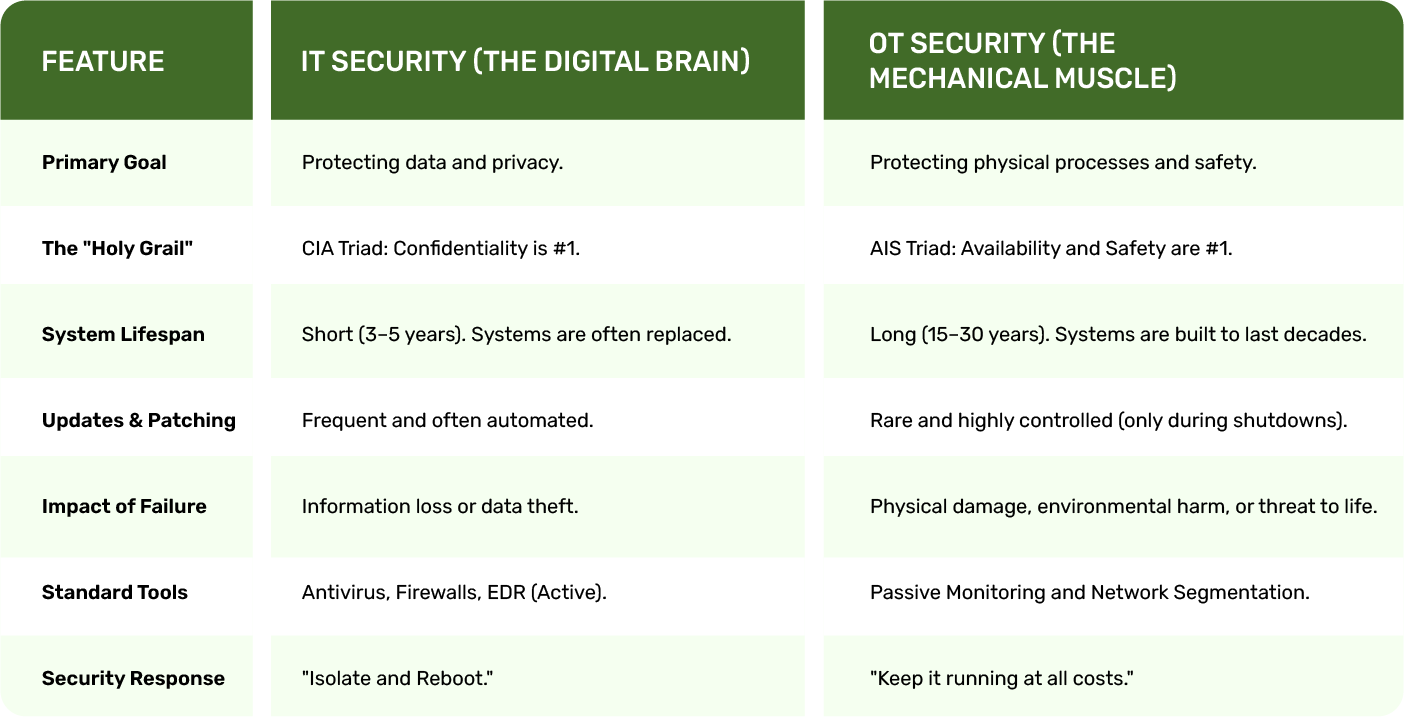
As we move toward a more “converged” world where our factory floors are connected to our corporate clouds, the challenge now is no longer about choosing one over the other. It’s about building a unified team where the IT specialists understand the “fragility” of a production line, and the OT engineers understand the “visibility” needed to stop a digital threat before it becomes a physical disaster.
Key Components of an OT Security Framework
Building a security framework for an industrial environment is less like installing software and more like designing a safety system for a skyscraper. It requires a layered approach where every component is built to support the weight of the others. Now, a truly “robust” framework isn’t just about blocking hackers; it’s about ensuring that your engineers and operators can work with confidence, knowing the system has their back.
A professional OT security framework generally rests on five foundational building blocks:
- Asset Visibility (The “Know Your Floor” Rule): You cannot protect what you cannot see. The first component is a live, automated inventory of every device on your network, from the massive turbines down to the smallest temperature sensor. In 2026, we will use passive discovery tools that “listen” to network traffic without touching the machines, ensuring we never accidentally disrupt a sensitive process just by trying to count it.
- Zones and Conduits (The “Firebreak” Strategy): This is the core of network segmentation. We group assets into “Zones” based on their function and risk, for example, putting all your safety systems in one high-security zone. We then control the “Conduits” (the communication paths) between them. This ensures that if a single workstation is compromised, the threat is physically contained and cannot “jump” to the rest of the plant.
- Identity-Based Access Control: The days of shared passwords on the factory floor are over. A modern framework uses Multi-Factor Authentication (MFA) and Just-In-Time (JIT) Access. This is especially critical for third-party vendors. Instead of giving a technician a permanent VPN key, you give them access that only works for the specific four-hour window they need to perform maintenance.
- Continuous Threat Detection: Because industrial systems follow very predictable patterns, we use Behavioral Monitoring to spot trouble. If a PLC (Programmable Logic Controller) suddenly starts receiving “stop” commands at 3:00 AM when the plant is supposed to be at full capacity, the framework flags it immediately. It’s about detecting the anomaly in the process, not just looking for a “virus.”
- Incident Response & Resilience Playbooks: Every second counts when a physical process is at risk. A key component of the framework is having OT-specific playbooks that tell your team exactly what to do. These aren’t generic IT guides; they include physical steps, like when to switch to manual control and how to restore “known good” configurations to your machines from secure, offline backups.
Common Threats in OT Cyber Security
In the past, we often spoke about OT threats in the “future tense”, as hypothetical scenarios that might happen one day. But as we move through 2026, those threats have become a daily reality for industrial operators across the GCC. We’ve seen a shift from “nuisance” attacks to highly targeted, strategic campaigns designed to disrupt national infrastructure or steal the “digital blueprints” of our industries.
Here are the most common threats that professional teams are currently defending against on the factory floor:
- Extortion-Focused Ransomware (The “Data Theft” Shift): While early ransomware simply locked your files, today’s attackers have become more devious. They now prioritize Industrial Data Theft. Instead of just encrypting your SCADA system, they steal your proprietary formulas, process logs, and network maps. They then use this data as leverage, threatening to leak it to competitors or use it to train their own AI attack models. In our region’s high-stakes sectors like Oil & Gas, the pressure to pay is immense because the downtime costs are so high.
- The “Trojan Horse” (Supply Chain & Vendor Attacks): We are seeing a massive surge in attacks that don’t target your perimeter directly, but rather the vendors you trust. Whether it’s a compromised software update from a trusted provider or a “backdoor” in a third-party remote access tool (like the notable 2026 Cisco zero-day), attackers are riding the coattails of your legitimate partners. For many Middle East enterprises, the “back door” left open by a maintenance contractor is now a bigger risk than the front door guarded by the firewall.
- AI-Augmented Stealth: Attackers are now using AI to do the “grunt work” of hacking. We are seeing automated tools that can probe an OT network for vulnerabilities at lightning speed, finding that one unpatched PLC (Programmable Logic Controller) in a sea of thousands. Even more concerning is Polymorphic Malware, malicious code that slightly changes its own “DNA” to evade traditional signature-based security tools, making it nearly invisible to older defenses.
- Identity Hijacking & “Living off the Land”: Hackers have realized that it’s easier to “log in” than to “break in.” By stealing valid credentials from employees or contractors, often through sophisticated, AI-driven phishing, they can enter your network as a “trusted user.” Once inside, they use your own administrative tools to move around (a technique called “Living off the Land”), making it incredibly difficult for security teams to distinguish between a legitimate maintenance task and a malicious intrusion.
- Physical Disruption & Spoofing: Recently, we’ve seen a disturbing rise in attacks that target the “senses” of our machines. GPS Spoofing, particularly in the maritime and logistics sectors of the Gulf, has caused real-world navigation errors and operational chaos. By feeding false data to a ship’s sensors or a factory’s timing systems, attackers can cause physical accidents or shutdowns without ever “breaking” a piece of software.
- The “Shadow IT” Leak: As industrial teams rush to adopt AI for predictive maintenance, many are inadvertently creating new risks. Engineers may use unvetted AI chatbots to analyze “log files” or “optimization data,” unknowingly uploading sensitive operational details to public clouds. This “Shadow AI” creates a persistent leak of corporate intelligence that is hard to track and even harder to plug.
OT Security Architecture & Zones
To build this “watertight” architecture, we rely on established frameworks that help us map out the digital layout of a plant. The most recognizable of these is the Purdue Model, which organizes technology into logical levels, from the physical sensors on the floor (Level 0) up to the corporate office (Level 4/5).
The Concept of Zones and Conduits
While the Purdue Model gives us the map, the ISA/IEC 62443 standard gives us the building strategy through “Zones and Conduits.”
- Zones (The Rooms): We group assets together based on their function, their risk level, and their communication needs. For example, your emergency shutdown systems (SIS) should be in their own highly restricted zone, separate from the general assembly line controllers. By grouping them, you can apply specific security rules to that “room” without affecting the rest of the house.
- Conduits (The Hallways): A zone is useless if you don’t control the doors. Conduits are the controlled communication paths between zones. In 2026, we use Industrial Firewalls and Unidirectional Gateways (Data Diodes) to act as the “security guards” in these hallways. They ensure that only the exact data needed for the job is allowed through, and nothing else.
The Critical Role of the Industrial DMZ (iDMZ)
One of the most important architectural features in a modern GCC enterprise is the Industrial DMZ (iDMZ). This is a “buffer zone” that sits between your corporate IT network and your sensitive OT floor.
In a professional architecture, the IT network never talks directly to the OT network. Instead, they both talk to the iDMZ. If an executive wants to see production data, they access a mirror of that data in the DMZ. This “air-lock” system is what prevents a ransomware infection in the corporate email system from migrating down into the factory’s control logic.
Moving Toward Micro-Segmentation
With time, we are seeing a shift from “big zones” to Micro-segmentation. Using software-defined networking, we can now create “mini-zones” around individual machines. This is particularly useful for protecting legacy equipment that can’t be patched. By wrapping it in its own digital “bubble,” we can keep it isolated and safe even in a converged environment.
By designing your architecture with these zones and conduits, you aren’t just “plugging holes”, you are building a predictable, resilient environment where a single point of failure never becomes a total operational shutdown.
Implementing Robust OT Security
According to a report by ABI Research and Palo Alto Networks, 70% of industrial organizations faced cyberattacks in the past year, with a troubling 26% experiencing attacks on a weekly, or even more frequent, basis. These incidents not only led to immediate losses in data and revenue but also severely disrupted ongoing business operations, with a fourth of these organizations having to shut down due to the attacks.
Building a resilient OT security framework starts with a well-rounded operational technology strategy. An effective OT security strategy must focus on several foundational elements, each working to bolster the system’s defenses. By setting the groundwork for robust OT security, organizations can address unique vulnerabilities and challenges within OT environments and tailor their security approach to meet specific operational needs.
Step-by-Step Approach
Step 1: Align Your Teams (The Cultural Bridge)
Before touching a single machine, you must bring your IT and OT leaders into the same room. Security in 2026 is a team sport. Establish a common language where the IT team understands that “uptime is king,” and the OT team understands that “visibility is safety.” Without this cultural alignment, even the best tools will fail.
Step 2: Shine a Light on the “Dark Corners” (Asset Discovery)
You cannot protect what you can’t see. Use automated, passive discovery tools to create a live inventory of every PLC, HMI, and sensor on your network. This step is about moving away from outdated Excel sheets and toward a real-time “Source of Truth” for your industrial assets.
Step 3: Measure Real-World Risk (Vulnerability Assessment)
Not every “critical” vulnerability on a dashboard is a priority for your plant. Context is everything. Evaluate your assets based on their Operational Impact. Ask: “If this device fails, does the whole line stop?” Focus your initial efforts on the “crown jewels”, the systems that directly manage safety or core production.
Step 4: Build Your Digital Bulkheads (Network Segmentation)
Adopt the “Zones and Conduits” approach. Physically and logically separate your industrial network from your corporate office using an Industrial DMZ (iDMZ). This ensures that a simple virus in the office doesn’t have a clear path to the machines that run your business.
Step 5: Modernize Your Access (Identity Management)
Phased out shared passwords and “always-on” remote access. Implement Multi-Factor Authentication (MFA) for all users, including third-party contractors. We lean heavily on Just-In-Time (JIT) Access, where a technician is only given the “keys” to a machine for the specific window of time they are performing maintenance.
Step 6: Listen for the “Heartbeat” (Behavioral Monitoring)
Deploy tools that learn the normal operational patterns of your plant. Instead of just looking for “bad software,” these tools look for “strange behavior”, like a controller trying to change a set-point in the middle of the night. This is your “early warning system” for both cyber attacks and mechanical failures.
Step 7: Harden Your Backup and Recovery (Resilience)
In the world of OT, we plan for the “when,” not the “if.” Ensure you have offline, “immutable” backups of your machine configurations. Test your Incident Response Playbooks regularly with “tabletop” exercises that involve both your security team and your plant operators.
Step 8: Continuous Governance and Compliance
OT security is not a “one and done” project. Regularly audit your systems against regional standards like the Saudi NCA (ECC) or UAE PDPL. Use these regulations not just as a checkbox, but as a framework to continuously improve your maturity.
OT Security Best Practices
For a modern enterprise, security is about finding the sweet spot between absolute protection and operational efficiency. You cannot lock a system down so tightly that it becomes impossible to operate, nor can you leave it so open that a single human error leads to a regional shutdown.
Implementing these practices requires a nuanced, “boots on the ground” perspective that respects the daily realities of the plant floor:
- Prioritize Passive Visibility: In the IT world, we often “ping” or scan devices to see if they are healthy. In the OT world, an active scan can accidentally crash a sensitive, older controller. Best practice today is Passive Monitoring, using tools that silently analyze network traffic to identify assets and threats without ever “touching” the machines themselves.
- Embrace “Windowed” Patching: You cannot patch a turbine in the middle of a production run. Instead of the IT-style “patch now” approach, develop a rigorous Maintenance Window Strategy. Have your updates tested, verified, and staged in a sandbox environment so that the moment the machines go offline for scheduled maintenance, your security team is ready to move with zero guesswork.
- Secure the “Digital Doorway” (Remote Access): Whether it’s a vendor in Europe or an engineer working from home in Dubai, remote access is often the weakest link. Move away from permanent VPNs. Implement Just-In-Time (JIT) access coupled with Multi-Factor Authentication (MFA). Access should be a “temporary key” that expires the moment the maintenance window closes.
- Bridging the Human Gap: Your plant operators are your first line of defense. They know the “sound” and “feel” of a healthy machine better than any sensor. Invest in OT-specific awareness training. When an operator knows that a weird screen flicker or a slightly sluggish HMI response might be a digital intrusion rather than just a “mechanical quirk,” your defense becomes significantly stronger.
- Don’t Forget Physical Security: Sometimes we get so focused on firewalls that we forget about the physical locks. A visitor with a USB stick and 30 seconds of access to an unlocked cabinet can bypass the world’s best encryption. Ensure that your physical security, cameras, badge access, and locked equipment racks are a core part of your cyber strategy.
- Practice for the “Bad Day”: Resilience is a muscle. Conduct regular Tabletop Exercises that simulate a real-world OT event, such as a ransomware attack on the SCADA system. Ensure your IT, OT, and executive leadership teams are all in the room. The goal isn’t just to solve the technical problem, but to manage the communication, safety protocols, and manual recovery steps in a high-pressure environment.
The 2026 Reality: The most effective security teams are those that spend as much time on the factory floor talking to engineers as they do in the SOC looking at screens.
By treating these practices as a continuous commitment rather than a “one-time project,” you build an operation that isn’t just secure, it’s resilient enough to weather the unexpected.
Industry Use Cases of OT Security
In the world of industrial operations, theory only takes you so far. To truly understand the value of OT security, you have to see it in action, protecting the literal lifeblood of our regional economy. In 2026, the most resilient enterprises in the Middle East aren’t just “buying security”; they are embedding it into their specific industrial workflows to prevent a digital glitch from becoming a headline-making disaster.
Here is how OT security is being applied across three of our most critical sectors:
- Oil & Gas: Protecting the “Safety Instrumented Systems” (SIS)
In a modern refinery or offshore platform, the Safety Instrumented System (SIS) is the final line of defense, the “emergency brake” that prevents explosions or environmental leaks.- The Scenario: An attacker gains access to the corporate network via a phishing email and tries to “hop” over to the production floor to disable a pressure-relief valve.
- The OT Security Solution: By using Unidirectional Gateways (Data Diodes) and strict Network Segmentation, the enterprise ensures that data can only flow out of the production line (for monitoring) but never in (for control). The safety systems are “air-locked” in a high-security zone that a corporate-level virus simply cannot reach.
- Utilities: Securing the Water and Power Grid
For a desalination plant or a power utility in the GCC, “uptime” isn’t a metric, it’s a social contract.- The Scenario: A maintenance contractor’s laptop is compromised with malware that attempts to “spoof” sensor data, making a water pump look like it’s failing when it’s actually healthy, or vice versa.
- The OT Security Solution: The utility implements Behavioral Analytics that learn the “heartbeat” of the plant. When the malware tries to send a command that doesn’t match the normal physics of the water flow, the system flags it as an anomaly in real-time. This allows the operators to switch to manual control before the “digital lie” can cause a physical shutdown.
- Manufacturing: Managing the “Smart Factory” Revolution
As regional manufacturers move toward Industry 4.0, they are connecting more robotic arms and assembly lines to the cloud for AI-driven optimization.- The Scenario: To fix a robotic arm, an international vendor requires remote access. In the past, this meant a permanent VPN “backdoor” that was often forgotten and easily hacked.
- The OT Security Solution: The factory uses Just-In-Time (JIT) Access Control. The vendor is granted a one-time digital key that only works for the specific four-hour window of the maintenance task. Every action they take is recorded and monitored, and the “doorway” is automatically slammed shut and locked the moment the work is done.
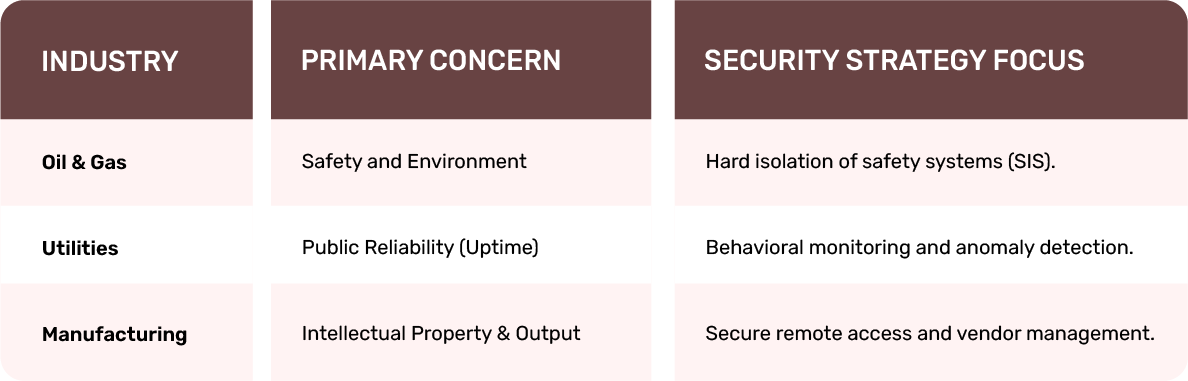
By looking at these use cases, it becomes clear that OT security isn’t about “stopping the internet.” It’s about building a professional environment where the machines do exactly what they are told, and nothing else.
-
Comprehensive Risk Assessment:
The cornerstone of any OT security strategy, risk assessment identifies vulnerabilities specific to OT environments. Conducting thorough assessments allows organizations to pinpoint and mitigate risks unique to industrial systems, forming the first line of defense.
-
Effective Access Control Measures:
Access control is essential in managing who can interact with critical OT systems. Implementing multi-factor authentication, strict access protocols, and role-based permissions can prevent unauthorized access and protect sensitive data.
-
Up-to-date Asset Inventory Management:
Maintaining an accurate and updated inventory of all OT assets is a core security best practice. With a comprehensive inventory, organizations gain visibility into all devices, ensuring that security measures are applied consistently across the entire OT landscape.
-
Strategic Network Segmentation:
The Palo Alto survey revealed that 40% of respondents reported friction between their OT and IT teams, while only 12% indicated these teams were fully aligned. Isolating OT networks from IT networks and other critical components significantly reduces the risk of lateral movement during a cyberattack. Network segmentation helps contain potential threats, making it a valuable component of a robust OT security strategy.
-
Regular Security Audits and Testing:
Frequent security audits and penetration testing help organizations identify weaknesses and stay proactive in addressing vulnerabilities. Regular assessments are essential to any operational technology strategy, as they ensure systems are continuously protected against emerging threats.
Strategies for Achieving Robust OT Security
Organizations must keep in mind strategic OT security practices such as:
-
Incident Response Planning:
Establishing a tailored incident response plan is fundamental for OT security. A well-defined response plan ensures that teams can react quickly and efficiently in the event of a security breach, minimizing potential damage and downtime.
-
Employee Training and Awareness:
Employee training is a powerful tool in any OT security strategy. By fostering a culture of security awareness, organizations can mitigate the human factor, one of the leading causes of security incidents, ensuring that staff can recognize and respond to potential threats.
-
Integration of Advanced Technologies:
Advanced tools, such as AI and machine learning, have become essential in detecting anomalies within OT environments. Leveraging these technologies strengthens the operational technology strategy ensuring a more efficient and robust security system.
-
Collaboration Between IT and OT Teams:
A siloed approach can hinder security efforts, making collaboration between IT and OT teams a crucial OT security best practice. A unified approach allows teams to align their security practices, resulting in a more comprehensive and effective strategy.
-
Adherence to Regulatory Compliance:
Regulatory standards exist to ensure a minimum baseline of security. Over the next two years, 74% of executives across 16 countries anticipate increased regulatory pressures on OT security, reflecting heightened organizational awareness of the need for stronger OT security measures. This shift signals preparation for stricter standards and enhanced resilience across industries. Adhering to these regulations is not only a requirement but also a best practice, as compliance helps ensure that the operational technology strategy remains robust and in line with industry standards.
Overcoming Common Challenges in OT Security Implementation
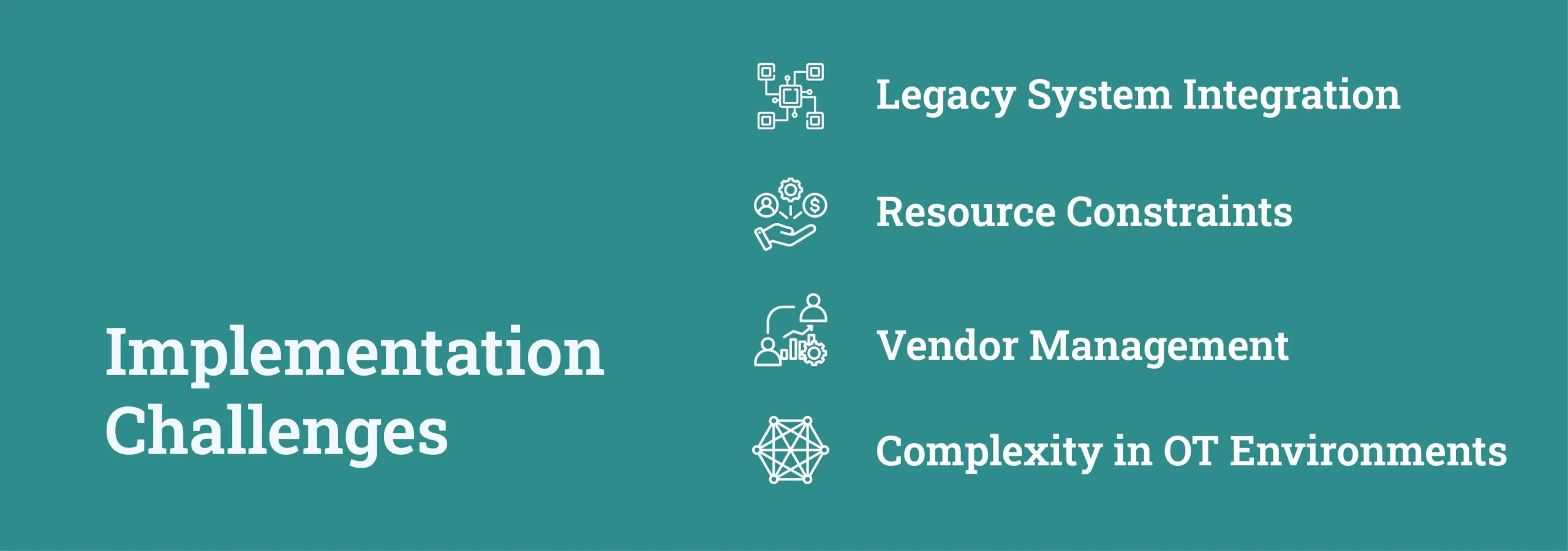
Implementing OT security best practices comes with challenges; here are strategies to address common hurdles organizations may encounter:
-
Legacy System Integration:
Many OT environments rely on legacy systems that lack modern security features. Securing these systems requires specialized strategies, such as network segmentation and regular patching, ensuring that legacy components do not compromise the broader OT security strategy.
-
Resource Constraints:
Budget limitations are a common concern in OT security implementation. Focusing on high-impact OT security practices, such as access control and asset management, can help organizations establish a secure foundation without exceeding resource constraints.
-
Vendor Management:
Ensuring that third-party vendors adhere to OT security best practices is critical. Conducting regular audits and establishing clear security requirements for vendors can help mitigate risks introduced by external parties.
-
Complexity in OT Environments:
OT environments often consist of various systems and devices, adding layers of complexity. In the ABI Research study, over 60% of respondents pointed to the complexity of OT security solutions as a significant challenge when selecting security software and equipment. This finding underscores the demand for simpler, more streamlined security solutions tailored to OT environments. Implementing scalable OT security practices that can adapt to different systems and environments simplifies the overall security management process.
Conclusion
In today’s rapidly evolving threat landscape, robust OT security is a vital component of long-term business resilience. With global OT security spending projected to soar from USD 20.7 billion in 2024 to USD 44.9 billion by 2029, the demand for robust security strategies has never been more urgent. As regulations tighten and cyber risks grow more complex, the need for effective, actionable security strategies becomes essential. By embracing OT security best practices, organizations can not only protect their critical systems but also gain a strategic advantage.
To build a security framework that meets these demands, trust in a partner like Paramount Assure—where expertise in OT security ensures your operations remain secure, compliant, and future-ready.
Explore Paramount for tailored solutions to safeguard your organization.
Recent Posts

Protect your online assets from cyber threats with Paramount
Comprehensive cyber security solutions for individuals and businesses
Significantly reduce the risk of cyber threats and ensure a safer digital environment.
