
Blog
How to Integrate Climate Risk into Your GRC Framework: A Step-by-Step Guide for UAE Banks
Author:
Manisha
Reading Time: 8 Minutes

Banks in the UAE are now expected to treat climate and sustainability risk with the same seriousness they give to credit risk or operational risk. The Central Bank of the UAE (CBUAE) has laid out a clear set of expectations over the past two years, and banks that haven’t started organizing their response are running out of runway. The good news is that most banks don’t need to buy or build a new system to get compliant. If a bank already runs a governance, risk, and compliance (GRC) platform such as Archer, most of the heavy lifting can happen inside modules that are already live: Operational Risk Management, Business Continuity Management, Third-Party Risk Management, and Governance & Compliance.
This blog walks through what CBUAE actually requires, what a bank needs to define internally before touching any software, what a GRC platform can realistically implement, and how a phased rollout might look.
The CBUAE Rules, in Order
CBUAE didn’t publish one big ESG regulation and call it done. Instead, it released three separate pieces of guidance over about 20 months, each building on the last.
November 2023 – Principles for Effective Management of Climate-Related Financial Risks: This is the foundational document. It sets out the basic risk management cycle banks are expected to follow: identify climate risk, assess it, measure it, mitigate it, monitor it, and report on it. It’s principle-based rather than prescriptive, meaning it tells banks what outcome to reach without dictating exactly how to get there.
June 2024 – Principles for Sustainability-Related Disclosures: This one is about transparency. It asks banks to produce decision-useful ESG disclosures that line up with international frameworks like the Task Force on Climate-related Financial Disclosures (TCFD) and the International Sustainability Standards Board (ISSB). In practice, this means governance structures, strategy, and risk exposure all need to be documented and communicated to stakeholders in a consistent way.
July 2025 – Climate-Related Financial Risk Management Regulation: This is the binding one. Unlike the first two documents, which set principles, this is enforceable regulation. It requires banks to build climate risk into governance structures, the Internal Capital Adequacy Assessment Process (ICAAP), solvency assessments, and recovery planning. If a bank has gaps, it needs a documented remediation plan to close them.
One detail worth noting: CBUAE has clearly prioritized the “E” in ESG first. Climate and environmental risk are the focus of these three instruments, while social and governance topics are largely handled through existing corporate governance rules that already apply to banks. So when people talk about “ESG compliance” for UAE banks right now, they mostly mean climate compliance.
What the Bank Has to Define Before Any System Work Starts
Here’s a mistake that trips up a lot of institutions: jumping straight into configuring software before deciding what the bank actually wants to say about its own risk. Regulation expects certain foundations to be in place first, and no platform can generate these for you. They come from internal decisions, workshops, and sign-off from leadership.
- Governance and oversight: The board and senior management need documented accountability for ESG and climate risk. That includes deciding which committee owns this topic, and who reports to whom.
- Risk taxonomy and materiality: The bank needs its own definition of what counts as an ESG or climate risk, broken into categories, and a materiality assessment that ranks which of those risks actually matter most given the bank’s business mix and geography.
- Risk appetite and limits: Once risks are defined, the bank needs a documented appetite statement: how much climate risk it’s willing to carry, what the exposure limits look like, and how this appetite fits into the bank’s overall enterprise risk appetite.
- Data and metrics: This covers key risk indicators (KRIs), an approach to emissions data across Scope 1, 2, and 3 categories, and what ESG data the bank will require from clients and vendors. Data quality standards need to be set here too, since messy inputs produce meaningless outputs later.
- Disclosure approach: The bank picks an international framework (TCFD, ISSB, or GRI are the common options) and builds a process for producing disclosures and getting them signed off before they go out.
- Integration into ICAAP and planning: Climate risk has to show up inside capital adequacy assessments, solvency testing, stress testing, and recovery planning, not sit in a separate report that nobody in capital planning ever reads.
None of these six items is a software task. They’re decisions. But once they’re made, they translate very directly into what a system needs to be built to support.
From Regulatory Requirement to System Component
The table below shows how each CBUAE expectation turns into something concrete inside a GRC platform.
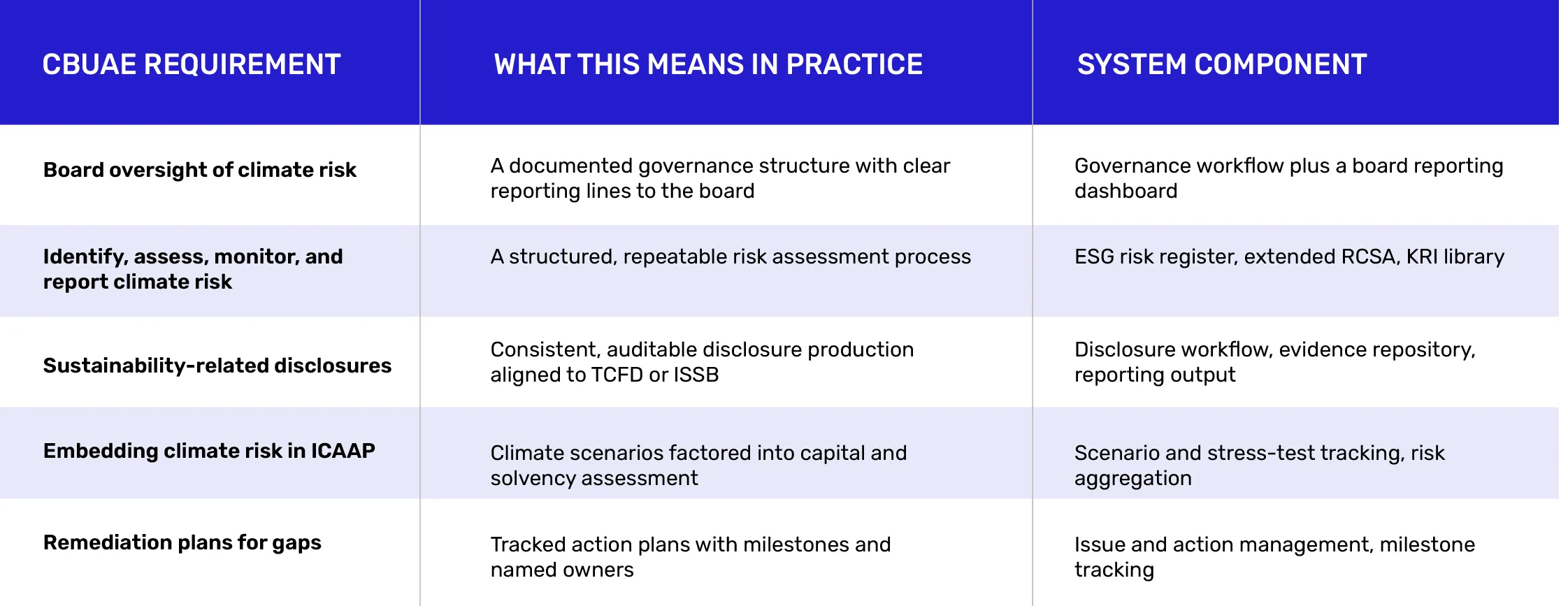
This is really the whole exercise in one table. Every regulatory line item has a home inside a system that most banks already run.
What a GRC Platform Can Actually Do
Once governance and taxonomy decisions are made, a GRC platform can be configured to carry the operational weight. Six capability areas cover most of what’s needed.
- Risk register and taxonomy: Structured ESG and climate risk categories, with inherent and residual risk ratings, sitting as an extension of the existing operational risk register rather than as a separate system.
- Controls and assessments: Existing Risk and Control Self-Assessment (RCSA) templates get extended with ESG-specific questions, and control effectiveness gets tracked per risk item.
- KRIs and metrics dashboards: ESG and climate key risk indicators sit alongside operational KRIs the bank already tracks, feeding into dashboards for both management and the board.
- Questionnaires and due diligence: Vendor and client ESG questionnaires, scored and version-controlled, feed directly into third-party risk assessments.
- Obligations and disclosure tracking: A library of regulatory obligations, each with an assigned owner, supporting evidence, and a workflow for producing disclosures.
- Issues, actions, and remediation: Findings from audits or gap assessments get tracked as action plans with milestones, the same way any other regulatory finding would be handled.
Why a Platform Beats Spreadsheets
Some banks are tempted to handle this with spreadsheets and shared folders, especially in the early stages when the scope feels manageable. That approach tends to break down once disclosure cycles become regular and data volume grows. Here’s a side-by-side comparison of what each approach actually looks like in practice.
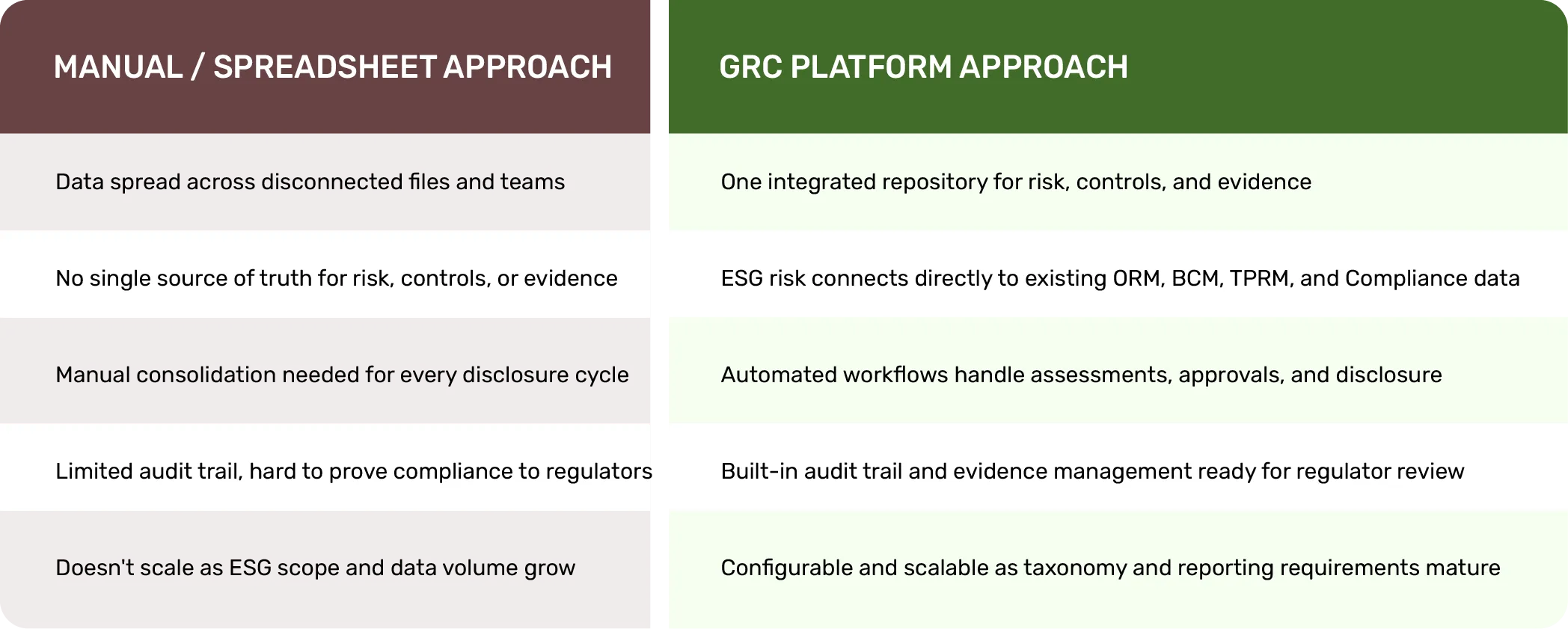
The core argument here isn’t that spreadsheets can’t technically hold the data. It’s that a spreadsheet-based process falls apart under repeated audit scrutiny and under growing volume, exactly the two conditions that ESG reporting is heading toward as CBUAE’s rules mature.
You Probably Already Have the Foundation
A common assumption is that ESG compliance calls for a brand new system. That’s usually not true for banks that already run a GRC platform in production. If ORM, BCM, Governance & Compliance, and TPRM modules are already live, ESG work is mostly a matter of extension rather than a fresh build.
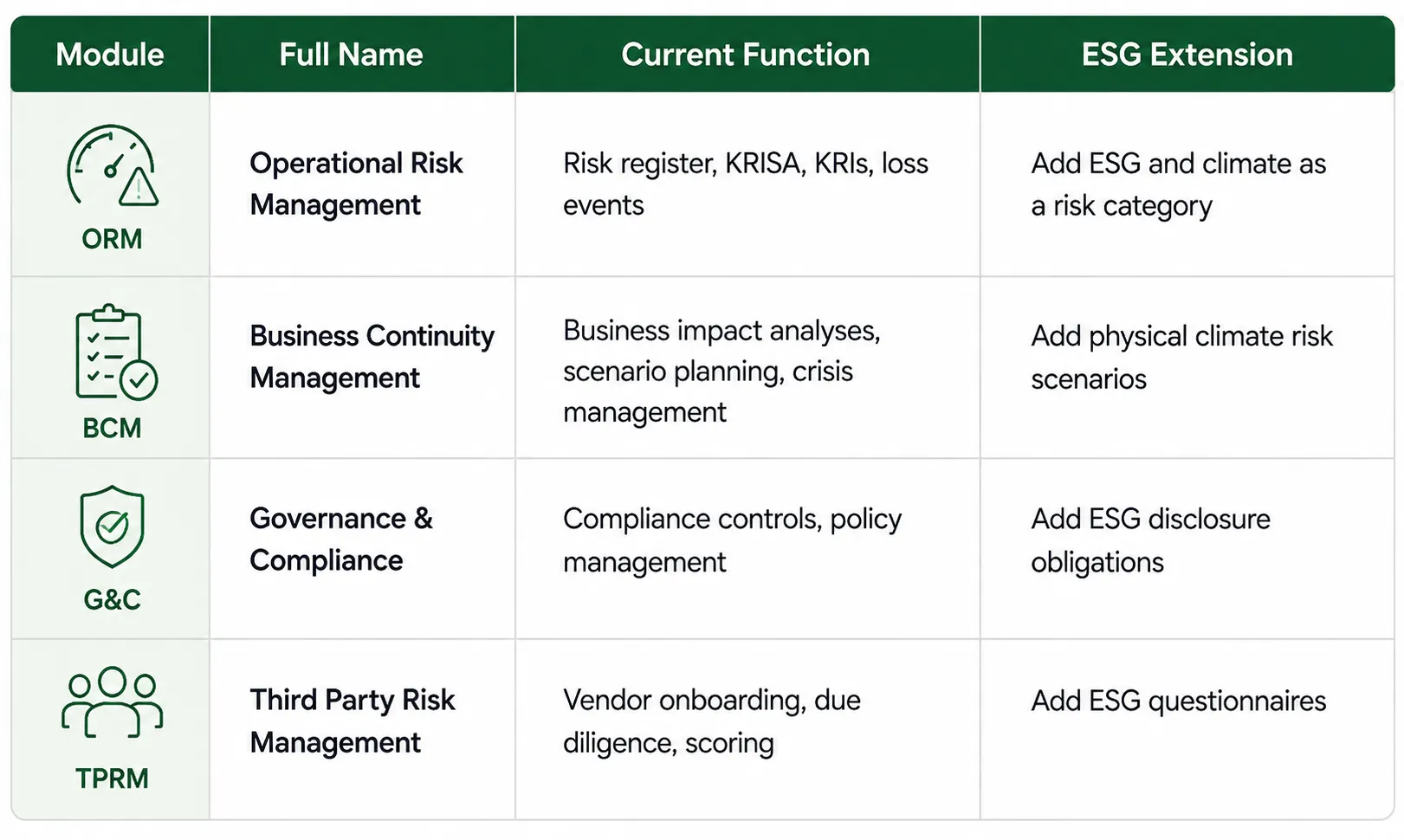
Let’s look at each of these in a bit more detail, since the configuration work differs module by module.
Extending Operational Risk Management (ORM)
ESG and climate risk become a proper risk category inside the existing ORM framework rather than a side project. The configuration work includes adding ESG and climate as a new taxonomy node covering transition risk, physical risk, social risk, and governance risk. RCSA templates get extended with ESG-specific questions tied to each business line. New KRIs specific to ESG get built into the existing KRI library and linked to loss event data. The module also needs to support climate scenario analysis across short, medium, and long time horizons, and every ESG risk entry needs an inherent and residual rating along with a control effectiveness score.
On the data side, this work depends on sector or client carbon-intensity classification, an emissions data feed covering Scope 1, 2, and 3 where the data exists, climate hazard and exposure data by geography, and the bank’s existing loss event and incident data structure.
Extending Business Continuity Management (BCM)
Here, physical climate risk becomes part of continuity planning and resilience testing rather than a separate exercise. Configuration work includes folding physical climate scenarios such as flooding or extreme heat into the Business Impact Analysis, assessing how exposed critical facilities and data centers are to climate hazards, extending crisis management plans to cover climate-driven disruption, and reviewing whether third-party and vendor continuity arrangements can hold up under climate stress. BCM findings also need to link back into the central ESG risk register so reporting stays consolidated rather than siloed.
Data needs here include site-level climate hazard mapping, facility and data center location data, vendor dependency data pulled from TPRM, and the existing BIA refresh cycle and testing calendar.
Extending Third-Party Risk Management (TPRM)
Vendor ESG performance becomes a tracked part of overall vendor risk. This means adding an ESG due-diligence questionnaire into the vendor onboarding workflow, building a scoring field that feeds into the overall vendor risk score, flagging ESG-related contractual clauses or covenants for critical vendors, and setting periodic ESG reassessment triggers based on vendor risk tier. Vendor ESG scores then surface into the enterprise-wide ESG risk register.
This depends on existing vendor tiering and criticality data, ESG questionnaire responses and supporting evidence, vendor certifications such as ISO 14001 or ISO 27001, and a contract repository that can track ESG covenants over time.
Extending Governance & Compliance (G&C)
CBUAE’s ESG obligations get tracked, owned, and evidenced the same way any other regulatory obligation would be. That means loading CBUAE ESG and climate obligations into the regulatory obligations library, mapping each obligation to an owner along with the controls and evidence needed to demonstrate compliance, building a disclosure production calendar with a sign-off workflow, and adding a greenwashing review checkpoint into product and marketing approval processes. Remediation plans and milestones for any regulatory gaps get tracked here too.
The data dependencies include the CBUAE Rulebook text covering both the principles documents and the binding regulation, the bank’s chosen disclosure framework, the product approval and marketing review process, and internal audit findings with their remediation tracking.
A Phased Path from Design to Steady State
Trying to configure everything at once is a recipe for confusion. A phased rollout keeps the sequence sane, and the sequence matters: governance and taxonomy decisions have to come before any configuration work, not the other way around.
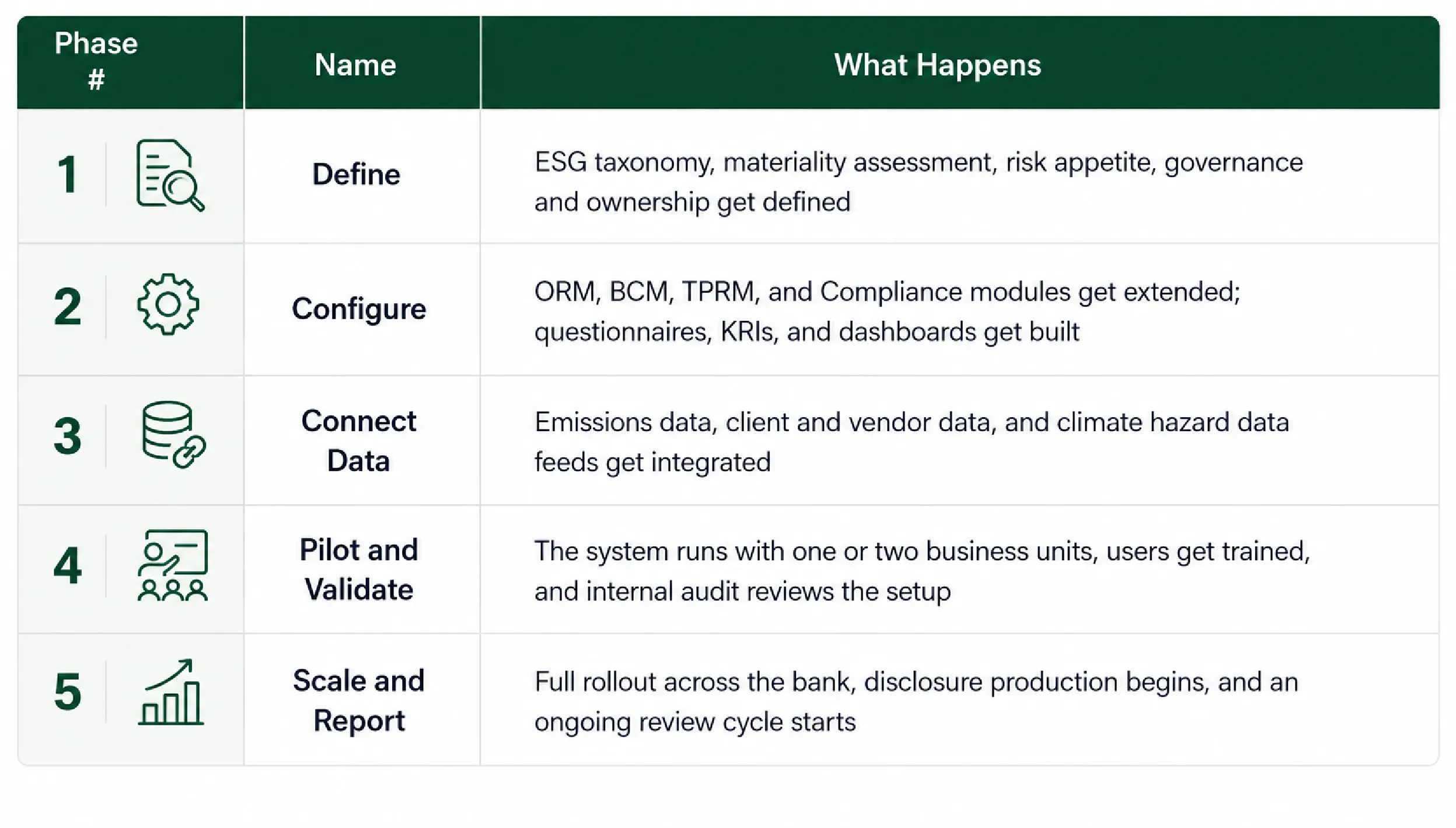
Each phase depends on the one before it. Skipping ahead to configuration before the taxonomy and governance decisions are locked in usually means rework later, once someone realizes the risk categories don’t match what the board actually agreed to.
The Main Point to Take Away
CBUAE’s path for banks is simple even if the details are involved: govern climate risk properly, assess and monitor it, disclose it clearly, and embed it into ICAAP and capital planning. Every one of these requirements maps to something a GRC platform can be configured to do, which means banks don’t need a separate ESG system running alongside everything else they already manage.
For banks running Archer or a similar platform, the existing ORM, BCM, TPRM, and Compliance modules are the fastest realistic route to a compliant ESG framework. Success mostly comes down to sequencing correctly: get governance and taxonomy defined first, then configure the platform around those decisions, not before them.
If there’s one next step worth taking immediately, it’s this: align on the ESG taxonomy and materiality assessment. That single decision is what phase one of the roadmap depends on, and everything downstream, from RCSA extensions to disclosure workflows, waits on it.
ABOUT AUTHOR


Protect your online assets from cyber threats with Paramount
Comprehensive cyber security solutions for individuals and businesses
Significantly reduce the risk of cyber threats and ensure a safer digital environment.
