
Blog
Data Privacy in the GCC: Laws, Principles & Compliance Strategy

Data Privacy in the GCC: Laws, Principles & Compliance Strategy
Nowadays, data is the lifeblood of organizations, whether it’s customer information, employee records, or sensitive business data. Companies across sectors rely heavily on data to drive decision-making, improve customer service, and gain a competitive edge. However, with the increasing volume and complexity of data comes the responsibility to protect it. Privacy laws around the globe are evolving rapidly to safeguard personal information, placing organizations under greater scrutiny. This is particularly true in the GCC (Gulf Cooperation Council), where governments are ramping up efforts to enforce stringent data privacy regulations.
This blog explores the trends, challenges, and practical strategies organizations operating in the GCC can implement to ensure data privacy compliance.
What is Data Privacy?
At its core, data privacy is about agency and control. While it is often discussed in the context of legal frameworks and technical jargon, it is fundamentally a human right. It’s the idea that individuals should have the power to decide how their personal information, their names, locations, health records, and even their digital habits, are collected, used, and shared.
In the professional world, we often distinguish between data security and data privacy. If security is the “lock on the door” that keeps hackers out, privacy is the “agreement” on who is allowed to enter and what they are permitted to do once they are inside.
For a modern enterprise, data privacy isn’t just about avoiding a fine; it’s about stewardship. It involves:
- Transparency: Being honest and clear about why you are collecting data and what you intend to do with it.
- Purpose Limitation: Only using that information for the specific reason it was gathered, rather than repurposing it for something the user never agreed to.
- Minimalism: Adopting the “less is more” philosophy, collecting only what is absolutely necessary to provide a service.
- Individual Rights: Respecting that the data still belongs to the person it describes, which includes their right to access it, correct it, or ask for it to be deleted.
Why Data Privacy Matters for GCC Enterprises?
In the GCC, we are witnessing a massive shift in how organizations view information. Data privacy is no longer just a “legal checkbox” handled by the compliance team in the basement; it has moved into the boardroom as a core strategic priority. As the region races toward a digital-first future, privacy has become the bridge between innovation and integrity.
Here is why data privacy is a non-negotiable factor for modern enterprises in the Gulf:
- Building a Foundation of Digital Trust: As banking, government, and commercial services continue to move online, customer trust has become a critical business asset. Organizations that prioritize data privacy demonstrate their commitment to protecting personal information, strengthening customer confidence and long-term loyalty.
- Alignment with National Digital Visions: Regional initiatives such as Saudi Arabia’s Vision 2030, the UAE Centennial 2071, and Qatar National Vision rely on secure digital transformation. By adopting strong data privacy practices, enterprises contribute to national goals while supporting a resilient and trusted digital economy.
- Reducing the Impact of Data Breaches: Privacy-focused strategies such as data minimization, encryption, and strict access controls reduce the amount of sensitive information exposed during a cyberattack. This limits potential damage and simplifies incident response and recovery.
- Avoiding Regulatory Penalties: Data protection authorities across the GCC are actively enforcing privacy regulations. Maintaining compliance helps organizations avoid substantial financial penalties, operational disruptions, and reputational damage resulting from non-compliance.
- Creating a Competitive Advantage: Strong privacy practices enhance credibility with international clients, partners, and investors. Organizations that comply with global and regional data protection standards are better positioned to expand into new markets and participate in cross-border business opportunities.
- Fostering a Privacy-First Culture: Building a culture of privacy awareness empowers employees to handle sensitive information responsibly. Regular training and clear policies help reduce human error, prevent accidental data exposure, and strengthen the organization’s overall security posture.
Data Privacy Principles
If you think of a data privacy law as a set of rules, then the principles are the “spirit” behind those rules. They are the ethical North Star that guides how a company should behave, even when a specific scenario isn’t explicitly written in the law. In the GCC, whether you are looking at the UAE’s Federal Law or Saudi Arabia’s PDPL, these data privacy principles are almost identical because they are built on a foundation of respect for the individual.
Adopting these isn’t just about avoiding a legal headache; it’s about shifting your mindset from “we own this data” to “we are the temporary caretakers of this information.”
The following table breaks down the core pillars that every modern GCC enterprise should build its data strategy upon:
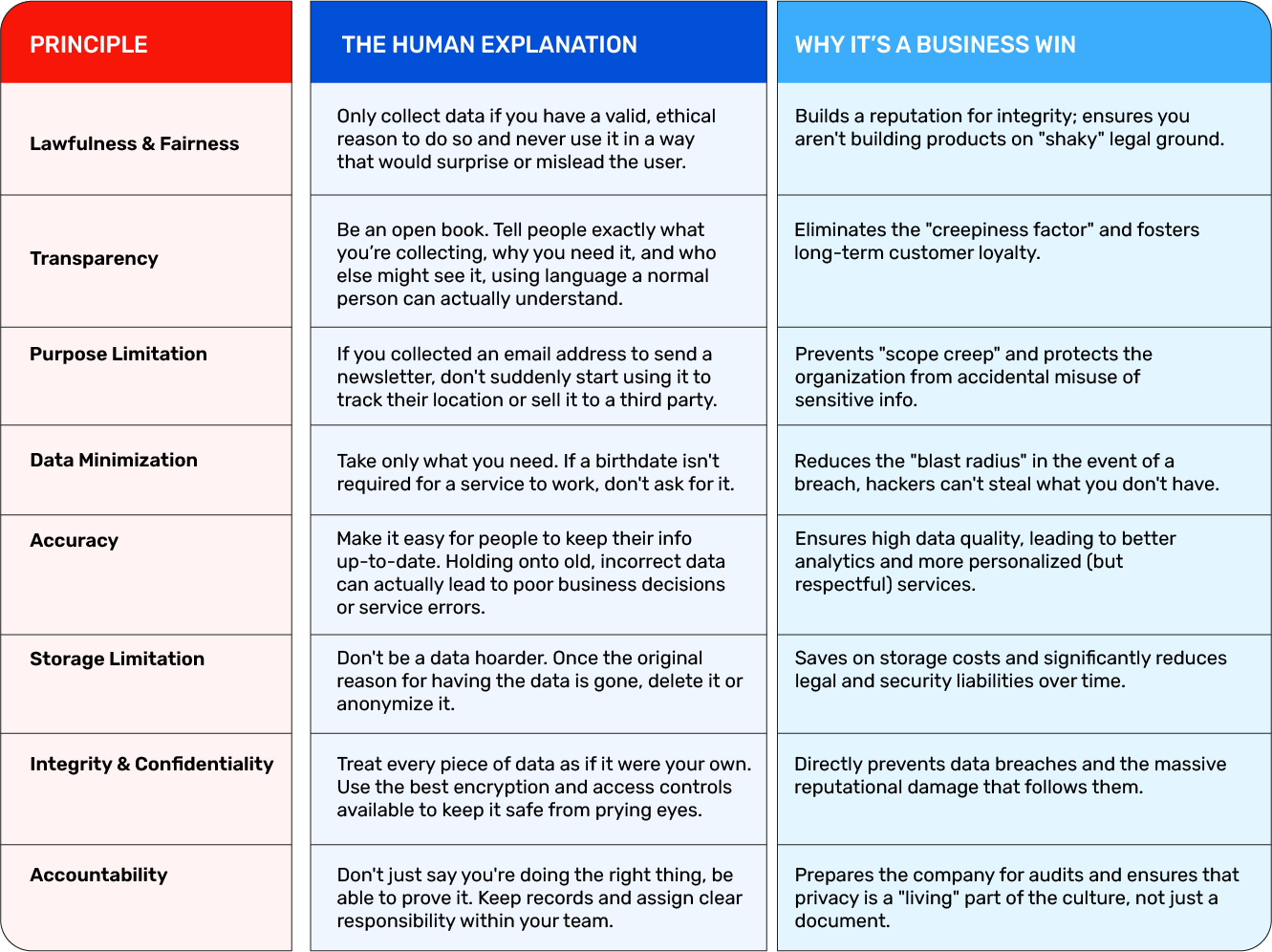
When these data privacy principles are woven into the fabric of your daily operations, compliance stops being a chore and starts being a competitive advantage. You aren’t just following a law; you’re building a brand that people feel safe with.
Data Privacy Landscape in the GCC
The Gulf region is not exempt from the global movement towards data privacy protection. The GCC has witnessed a surge in implementing robust privacy laws across its member states. The region is committed to aligning with global privacy standards from Saudi Arabia’s Personal Data Protection Law (PDPL) to Oman and Kuwait’s data privacy frameworks.
-
Saudi Arabia’s Personal Data Protection Law (PDPL)
Saudi Arabia’s PDPL is a significant milestone for the Kingdom. It regulates personal data collection, processing, and sharing. Private and public organizations must comply with the PDPL’s stringent requirements or face penalties. The law was introduced in 2022 with a one-year grace period for organizations to ensure compliance. As the deadline approaches, businesses must demonstrate their readiness, including implementing policies and practices that protect personal data per the law.
-
Qatar’s Pioneering Privacy Law
Qatar was one of the first GCC countries to introduce a data privacy law back in 2016. Over the past few years, the country’s Data Protection Authority (NDPO) has become more proactive in enforcing the law. Companies are now regularly audited to ensure they comply with privacy requirements. This development serves as a wake-up call for other GCC countries, emphasizing that privacy laws are no longer theoretical but actively enforced.
-
Other GCC Countries
The UAE, Oman, and Kuwait have also implemented their privacy laws, with varying degrees of enforcement. Oman and Kuwait’s laws were introduced recently, and compliance is already required. The UAE, which implemented its privacy regulations in 2021, is awaiting the release of executive regulations to begin full enforcement.
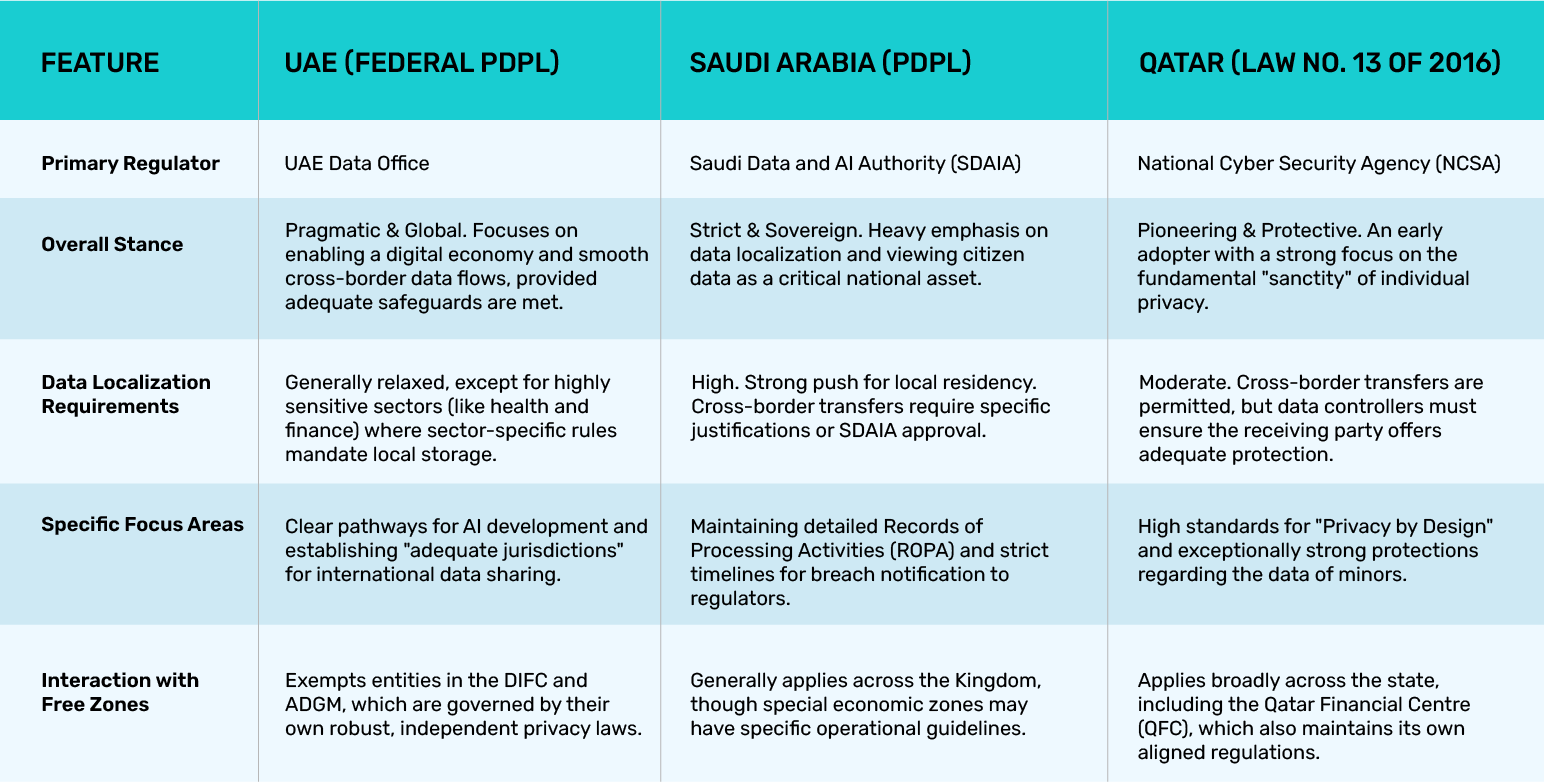
UAE Data Privacy Laws Explained
The UAE has undergone a significant legislative transformation to match its status as a global digital leader. While there are several sector-specific rules, the landscape is primarily defined by a federal standard that aligns the nation with international benchmarks like the GDPR.
Understanding the UAE’s approach requires looking at the “Onshore” federal law and the specialized “Offshore” jurisdictions.
The Federal Decree-Law No. 45 of 2021 (PDPL)
This is the “main” law that applies to the processing of personal data for anyone living or working in the UAE. It also has extraterritorial reach, meaning if a company outside the UAE processes the data of people inside the UAE, they are still expected to follow these rules.
Key highlights of the PDPL include:
- Consent by Default: Organizations must generally obtain clear consent before processing data, though there are exceptions for “public interest” or “legal necessity.”
- The UAE Data Office: A dedicated federal regulator has been established to oversee compliance, handle complaints, and issue further executive regulations.
- Data Protection Officers (DPOs): Many companies are now required to appoint a DPO to act as the internal “privacy champion” and the primary point of contact for the regulator.
The Financial Free Zones (DIFC and ADGM)
If your business operates within the Dubai International Financial Centre (DIFC) or the Abu Dhabi Global Market (ADGM), you fall under their specific, world-class privacy frameworks:
- DIFC Data Protection Law (2020): Often considered one of the most advanced in the region, it is designed to be “adequate” with European standards to facilitate easy data flow between Dubai and the West.
- ADGM Data Protection Regulations (2021): Similarly rigorous, these regulations ensure that the capital’s financial hub remains a trusted environment for global investors and tech firms.
Sector-Specific Regulations
Beyond the general laws, specific industries have their own layers of protection:
- Healthcare: The “ICT in Healthcare” law (often called the UAE Health Data Law) strictly governs how patient records are stored and prohibits the transfer of health data outside the UAE without specialized approval.
- Banking: The Central Bank of the UAE has established a Consumer Protection Regulation that mandates high standards of data confidentiality for financial institutions.
The Big Picture: For an enterprise in the UAE, the message is clear: data is no longer a free-for-all resource. It is a protected asset. Whether you are a local startup in Sharjah or a multinational in the DIFC, the law expects you to be a responsible gatekeeper of the personal information you hold.
Key Trends Shaping Data Privacy in the GCC
As privacy regulations in the GCC continue to evolve, several key trends are emerging that businesses must be aware of.
-
The Role of AI and Automation in Privacy Management
The rise of AI and automation has transformed how companies manage privacy. AI-driven tools are increasingly being used to handle complex privacy tasks such as data discovery, data mapping, breach detection, and compliance reporting. These tools allow businesses to automate repetitive and time-consuming processes, enabling more efficient data privacy operations.
-
Fluidity in Regulatory Environments
The global regulatory landscape is dynamic, with new privacy laws, guidelines, and enforcement practices regularly introduced. For example, in July 2023, the European Union adopted the AI Act, a law aimed at regulating the use of artificial intelligence. In the GCC, similar regulatory developments are expected, such as ongoing updates from Saudi Arabia’s SDAIA (Saudi Data and Artificial Intelligence Authority).
-
Consumer Expectations Are Changing
Consumers in the GCC are becoming more privacy-conscious. Research suggests that 74% of consumers are more likely to trust brands that prioritize the safe use of personal information. This growing demand for privacy is pushing companies to comply with regulations and adopt a privacy-first mindset. The idea that privacy is merely a compliance issue is giving way to the notion that privacy can be a strategic advantage.
Data Privacy Compliance Framework
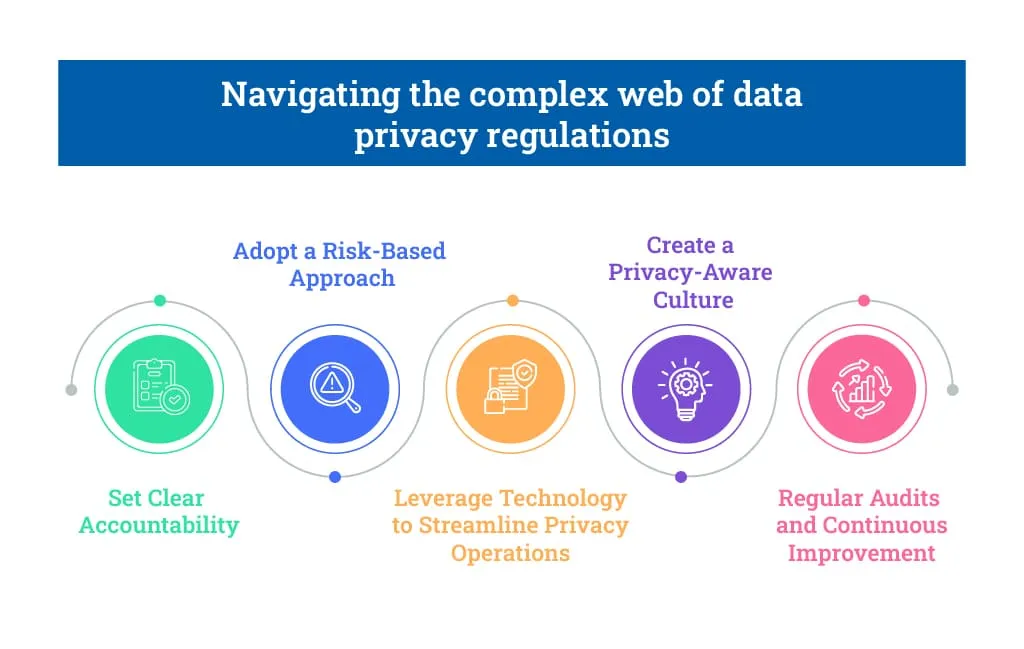
Think of a compliance framework not as a rigid set of chains, but as a roadmap. It’s the structural foundation that ensures your organization isn’t just “guessing” at privacy, but is following a repeatable, defensible process. In the GCC, where regulations are evolving quickly, having a formal framework is what separates companies that react to crises from those that build long-term resilience.
- Set Clear Accountability: One of the most critical aspects of data privacy compliance is assigning clear roles and responsibilities within the organization. Data privacy should not be a siloed function handled solely by IT or legal departments. Instead, accountability should be shared across all relevant departments, with senior management playing a key role in shaping the organization’s privacy strategy.
To this end, appointing a Data Protection Officer (DPO) or creating a Data Privacy Office that reports to senior leadership can ensure privacy remains a top priority. - Adopt a Risk-Based Approach: Given the complexities of managing vast amounts of data, businesses should adopt a risk-based approach to privacy management. Companies should focus on high-risk areas rather than attempting to tackle every possible data privacy concern. Identifying which data processing activities pose the greatest risk to personal data and consumer trust allows organizations to allocate resources more efficiently and address critical privacy gaps.
- Data mapping & classification: Think of data mapping as a “digital census.” Before you can protect your customers’ information, you have to know exactly where it lives, how it travels through your organization, and who has the keys to see it. In the GCC, where many businesses are rapidly migrating to the cloud, it’s easy for data to become scattered across different departments and platforms. By mapping this data, you’re creating a “Record of Processing Activities” (ROPA), essentially a clear story of your data’s journey. Once you see the big picture, you can then classify it. This means distinguishing between “standard” information (like a business email) and “sensitive” data (like biometrics, health records, or financial details).
- Policy & governance: If mapping is about understanding your data, governance is about setting the house rules. A robust privacy policy shouldn’t just be a wall of “legalese” designed to protect the company; it should be a clear, human-centric promise to your users about how you will respect their boundaries. In the modern GCC enterprise, this starts with appointing a Data Protection Officer (DPO), someone who acts as the “conscience” of the organization. Governance is also about creating a culture where every employee, from marketing to IT, understands that data privacy is part of their job description. Whether you are aligning with Saudi Arabia’s PDPL or the UAE’s Federal Law, good governance ensures that privacy isn’t just a one-time project, but a core value woven into the fabric of your daily operations.
- Monitoring & audits:A compliance framework is never “finished.” As your business grows and technology evolves, new risks will naturally emerge. This is where monitoring and audits come in. Think of these not as a “police inspection,” but as a regular health check for your trust-building efforts. Continuous monitoring allows you to spot unusual patterns or potential vulnerabilities in real-time, long before they turn into a crisis. Periodic audits, on the other hand, provide a chance to step back and ask, “Are we actually doing what we said we would do?” In 2026, regulators and customers alike aren’t just looking for a “secure” system, they are looking for a transparent one.
By following this framework, compliance stops feeling like an overwhelming mountain to climb and starts feeling like a series of manageable, strategic steps. It turns privacy from a “legal problem” into a standard business operation.
Data Privacy Challenges in the GCC
- Balancing Data Localization and Innovation: Data sovereignty regulations in countries such as the UAE and Saudi Arabia require certain categories of sensitive data to remain within national borders. Organizations using global cloud platforms often face significant costs and technical challenges when redesigning infrastructure to meet these localization requirements.
- Managing Cross-Border Data Transfers: Businesses operating across multiple countries must navigate varying privacy regulations and data transfer requirements. Compliance with mechanisms such as Standard Contractual Clauses (SCCs) and transfer risk assessments adds complexity to international operations and collaboration.
- Balancing AI Innovation with Privacy: As artificial intelligence adoption accelerates, organizations must ensure AI systems comply with privacy principles such as data minimization, transparency, and responsible data usage. Achieving high-performing AI models while protecting personal information remains an ongoing challenge.
- Addressing the Privacy Skills Gap: The demand for experienced Data Protection Officers (DPOs) and privacy professionals continues to exceed supply. Organizations require experts who understand both global privacy standards and the evolving regulatory landscape across the GCC.
- Implementing Granular Consent Management: Modern privacy regulations require organizations to provide users with greater control over how their personal data is collected and used. Upgrading legacy systems to support detailed consent preferences can be technically complex and resource-intensive.
- Managing Third-Party Privacy Risks: Organizations remain responsible for protecting personal data even when it is handled by external vendors. Conducting regular assessments, audits, and compliance checks across suppliers, cloud providers, and service partners is essential to minimize third-party risks.
- Ensuring Child Digital Safety Compliance: Emerging regulations, including child digital safety requirements, require businesses to implement age verification, enhanced privacy protections, and secure data handling practices for younger users, adding new compliance and technical responsibilities.
Addressing these challenges isn’t just about avoiding a fine, it’s about proving that your organization is mature enough to handle the responsibilities of the modern digital economy. The companies that solve these hurdles first are the ones that will win the “trust race” in the region.
Data Privacy Best Practices
Achieving compliance with the GCC’s new privacy laws is a major milestone, but true leadership in this space goes beyond just ticking boxes. The goal is to move from “enforced compliance” to “embedded trust.” Here is a listicle of best practices for GCC enterprises to turn data privacy into a sustainable competitive advantage.
- Prioritize “Human-Readable” Transparency: Move away from the dense, legalistic privacy policies that no one reads. Instead, use clear, simple language (in both Arabic and English) to explain why you need data and what you’re doing with it. When people understand the value exchange, they are far more likely to trust you with their information.
- Adopt a “Less is More” Data Mindset: The most secure piece of data is the one you never collected. Practice strict data minimization: if a piece of information isn’t vital to the specific service you’re providing today, don’t ask for it. This naturally reduces your risk profile and keeps your databases lean and efficient.
- Implement “Privacy by Design”: Privacy shouldn’t be an afterthought or a “patch” applied at the end of a project. Whether you’re launching a new app in Riyadh or a marketing campaign in Dubai, bake privacy into the very first line of code and the very first draft of the strategy.
- Empower Your “Human Firewall”: Data breaches aren’t always a technical failure; they are often the result of a simple human error. Regular, engaging training ensures that every team member, from the front desk to the C-suite, understands the weight of the data they handle and feels responsible for protecting it.
- Vet Your Third-Party Partners Rigorously: In today’s connected ecosystem, your privacy is only as strong as your weakest vendor. Perform deep due diligence on every cloud provider, marketing agency, and software tool you use. Ensure their standards for data handling and cross-border transfers align with the UAE PDPL or Saudi PDPL.
- Establish a Clear “Right to be Forgotten” Workflow: Don’t wait for a customer to ask for their data to be deleted before you figure out how to do it. Have a documented, tested internal process for handling Data Subject Access Requests (DSARs). Being able to respond quickly and accurately to these requests is a massive signal of professional maturity.
- Automate Where Possible, Audit Always: In 2026, manual spreadsheets aren’t enough to manage global privacy standards. Invest in automated data discovery and governance tools that can spot sensitive data leaks in real-time. Pair this automation with regular “Trust Checks”, independent audits that verify you are actually practicing what your policy preaches.
- Localize Your Data Strategy: Given the strict residency requirements in many GCC jurisdictions, ensure your technical architecture respects national borders. Use “Sovereign Cloud” options where necessary to ensure that sensitive citizen data stays within the Kingdom or the Emirates, as required by law.
By following these practices, you aren’t just staying out of legal trouble, you are building a brand that stands for integrity in the digital age.
Recent Posts
- IT/OT convergence a way forward towards robust OT security system
- Rockwell Automation is rocked by serious Vulnerabilities: A Comprehensive Approach to Securing Industrial Control Systems
- AI with Effective Security for Organizations
- How to Manage Mobile Threats Effectively
- How to Define Policies and Usage Guidelines for Business Users
FAQs on Data Privacy
Most modern privacy laws, including the GDPR and many of the new frameworks in the GCC, are built on seven core pillars. These aren’t just legal rules; they are ethical guidelines for how a business should treat its customers:
- Lawfulness, Fairness, and Transparency: Be honest and legal about why you’re taking data.
- Purpose Limitation: Only use data for the specific reason you collected it.
- Data Minimization: Don’t be a data hoarder, collect only what is absolutely necessary.
- Accuracy: Keep the information up to date.
- Storage Limitation: Delete data once it’s no longer needed.
- Integrity and Confidentiality: Use strong security to keep data safe from prying eyes.
- Accountability: Be ready to prove that you are following these rules.
While the “7 principles” are the legal standard, many organizations simplify their internal strategy into 5 Data Pillars for easier employee training:
- Consent: Always ask before you take.
- Purpose: Know exactly why you need the information.
- Security: Treat every piece of data as a high-value asset.
- Minimalism: Less data equals less risk.
- Individual Rights: Respect that the data belongs to the person, not the company.
In 2026, the risks have shifted from simple hacks to more complex, systemic issues:
- AI-Driven Data Exposure: Using Large Language Models (LLMs) can accidentally “leak” sensitive company or customer data into public AI training sets if not managed carefully.
- Cloud Misconfigurations: As companies move to the cloud, a single “public” instead of “private” setting can expose millions of records in an instant.
- Third-Party Vulnerabilities: Your privacy is only as strong as the weakest vendor you work with. A breach at a small software supplier can lead directly into your enterprise’s “vault.”
If risks are the potential for trouble, threats are the active forces trying to cause it. The three biggest threats today are:
- Digital Blackmail (Ransomware): Attackers no longer just lock your files; they steal your sensitive data and threaten to leak it unless you pay a ransom.
- Sophisticated Social Engineering: Phishing has evolved. Attackers now use AI to mirror the exact writing style and tone of your CEO or colleagues to trick employees into handing over access.
- The Insider Threat: This isn’t always a “bad actor.” It is often a well-meaning employee who accidentally shares a sensitive file or uses an unapproved app to get their work done faster.
The short answer: Everyone. However, in a professional structure, accountability is usually split into three roles:
- The Data Controller (The Organization): The company that decides why and how data is collected is ultimately responsible for its safety.
- The Data Protection Officer (DPO): This is the internal “conscience” of the company. They oversee the strategy and act as the bridge between the business and the government regulators.
- The Individual Employee: From marketing to IT, every person who touches a customer’s information is the first line of defense. Privacy isn’t just an IT problem; it’s a daily professional responsibility.

Protect your online assets from cyber threats with Paramount
Comprehensive cyber security solutions for individuals and businesses
Significantly reduce the risk of cyber threats and ensure a safer digital environment.
