
Blog
A Step-by-Step Breakdown of the NIST AI RMF Core Functions
Reading Time: 8 Minutes

The NIST AI Risk Management Framework (AI RMF 1.0, published as NIST AI 100-1 in January 2023) is voluntary guidance for managing AI risk across an AI system’s lifecycle. It has four functions. They are Govern, Map, Measure and Manage. Govern cuts across the other three. Map, Measure and Manage run as a continuous loop. The framework is not certifiable. ISO/IEC 42001 is the certifiable counterpart and the EU AI Act is binding law with its own timeline.
What the NIST AI RMF Is, and What It Is Not
The NIST AI RMF was developed under the National AI Initiative Act of 2020. It is not a law, not an audit scheme, and not a checklist. Nobody certifies you against it. The companion Playbook holds operational detail the framework does not spell out. The Generative AI Profile (NIST AI 600-1, July 2024) is what most people mean when searching for a newer version. A framework gives structure, a standard sets requirements, a regulation creates obligations.
The Four Core Functions
1. Govern: Build the Foundation
Govern is not a phase you finish. It creates the conditions the other three functions run inside.
- Write AI policies tied to legal and regulatory obligations
- Name who signs off on a system going live
- Define risk appetite and acceptable AI risk levels
- Run workforce training on those policies
The firm output here is an AI system inventory with a named owner per system.
2. Map: Understand the Context
Map happens before deployment and is repeated when the use case changes.
- Document what the system does and what decisions it informs
- Identify who is affected, including people who are not direct users
- Assess what could go wrong and who it would harm
- Record third-party model and vendor dependencies
Most organisations are buying AI rather than building it, so vendor dependencies deserve close attention. The firm output is a context and harms assessment per system.
3. Measure: Test and Track
Measure covers pre-launch testing and ongoing monitoring. The source document uses the acronym TEVV, short for Testing, Evaluation, Verification and Validation.
- Choose metrics tied to the risks Map identified
- Test for accuracy, bias, robustness, and security before launch
- Monitor for model drift after launch (drift means behaviour shifts as data changes)
- Record what was tested, when, and by whom
The firm output is a test record someone outside the team can follow.
4. Manage: Act on What You Find
Manage feeds back into Map. New information from live systems changes the risk context and restarts the loop.
- Prioritise risks against the tolerance set in Govern
- Decide to accept, reduce, transfer, or avoid each risk
- Assign a treatment owner and a deadline to every open item
- Keep an incident response path and a route to take a system out of service
The firm output is a risk register with treatment decisions and named owners.
Where to Actually Start
Most of the programmes stop at inventory because nobody knows what AI is already running.
- List every AI system in use, including tools staff adopted informally and AI features in licensed software
- Assign a named owner to each system
- Pick the highest-risk system and run Map, Measure and Manage on that one
- Write the governance policy after that first pass, not before
How the AI RMF Relates to ISO 42001 and the EU AI Act
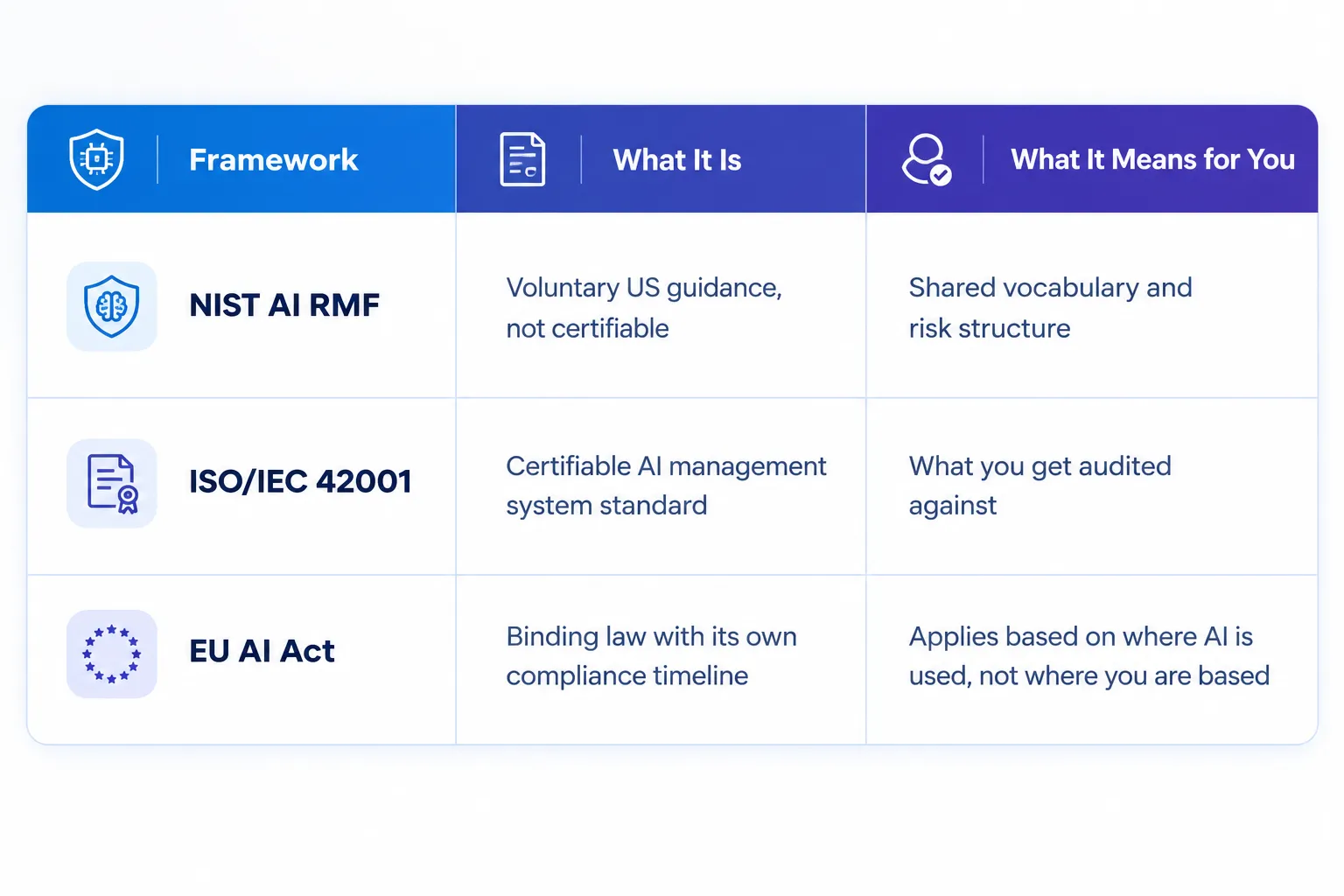
The UAE and Saudi Arabia have national AI strategies and ethics guidance rather than a binding AI law equivalent to the EU AI Act. For guidance on how these frameworks apply to your organisation, check out Paramount’s Compliance and Regulatory Consulting services.
Recent Posts
- Best Practices for Implementing Robust OT Security
- Effective Data Security Strategies: A Comprehensive Guide for Middle Eastern Businesses
- What Is Deep Packet Inspection (DPI) and How Does It Work?
- Generative AI adoption risks you should address to safeguard your enterprise
- 3 Reasons Your Cybersecurity Strategy Isn’t Working—And How to Fix It
Frequently Asked Questions
No. It is voluntary guidance. Customers, insurers, and procurement teams increasingly ask about it anyway.
No. There is no audit scheme. ISO/IEC 42001 is the certifiable counterpart.
Govern, Map, Measure and Manage. Govern runs across the other three rather than sitting first in a queue.
Not as a finalised document. NIST AI 600-1, the Generative AI Profile published July 2024, is what most people mean.
No fixed timeline exists. A practical first milestone is completing an inventory and assigning owners within weeks, then running one system through all four functions within a quarter.
Talk to our AI governance team to assess what AI is already in use, establish ownership, and plan the first 90 days of an AI RMF-aligned programme.

Protect your online assets from cyber threats with Paramount
Comprehensive cyber security solutions for individuals and businesses
Significantly reduce the risk of cyber threats and ensure a safer digital environment.
