
Blog
Vulnerability Assessment vs Penetration Testing: Which Do You Need?
Reading Time: 8 Minutes

A vulnerability assessment is an automated, broad scan that lists known weaknesses; a penetration test is a manual, expert-led simulated attack that proves which of those weaknesses can actually be exploited. An assessment covers systems broadly and can run continuously, while a test examines a defined scope in depth at set intervals. Most organisations need both, in that order, particularly where PCI DSS, ISO 27001, UAE NESA/IA Standards or Saudi NCA ECC requirements apply.
What a vulnerability assessment does
Automated scanning tools check networks, servers, applications and endpoints for known weaknesses. Findings are matched against public vulnerability records, then prioritised for remediation.
- CVE: a public catalogue of known software flaws.
- CVSS: a 1–10 score used to describe vulnerability severity.
- Produces a prioritised list for the patching team.
- Can run continuously or on a monthly or quarterly cycle.
A vulnerability assessment identifies potential weaknesses. It does not attempt to exploit them.
What a penetration test does
A penetration test takes the next step. An authorised tester manually tries to gain access using techniques associated with real attackers and records what actually works.
- Testers can chain several weaknesses into an attack path, the route from an initial flaw to a target.
- Manual work can expose business-logic problems and misconfigurations scanners miss.
- Findings are validated to separate genuine exposures from false positives.
- The report provides evidence and a narrative showing how access was gained.
Testing may use black-box, grey-box or white-box scope models. It is also a form of ethical hacking, meaning authorised security testing performed within agreed boundaries.
Penetration testing vs vulnerability assessment: the key differences
The difference is clearer when the two activities are compared directly.
Side-by-side comparison table
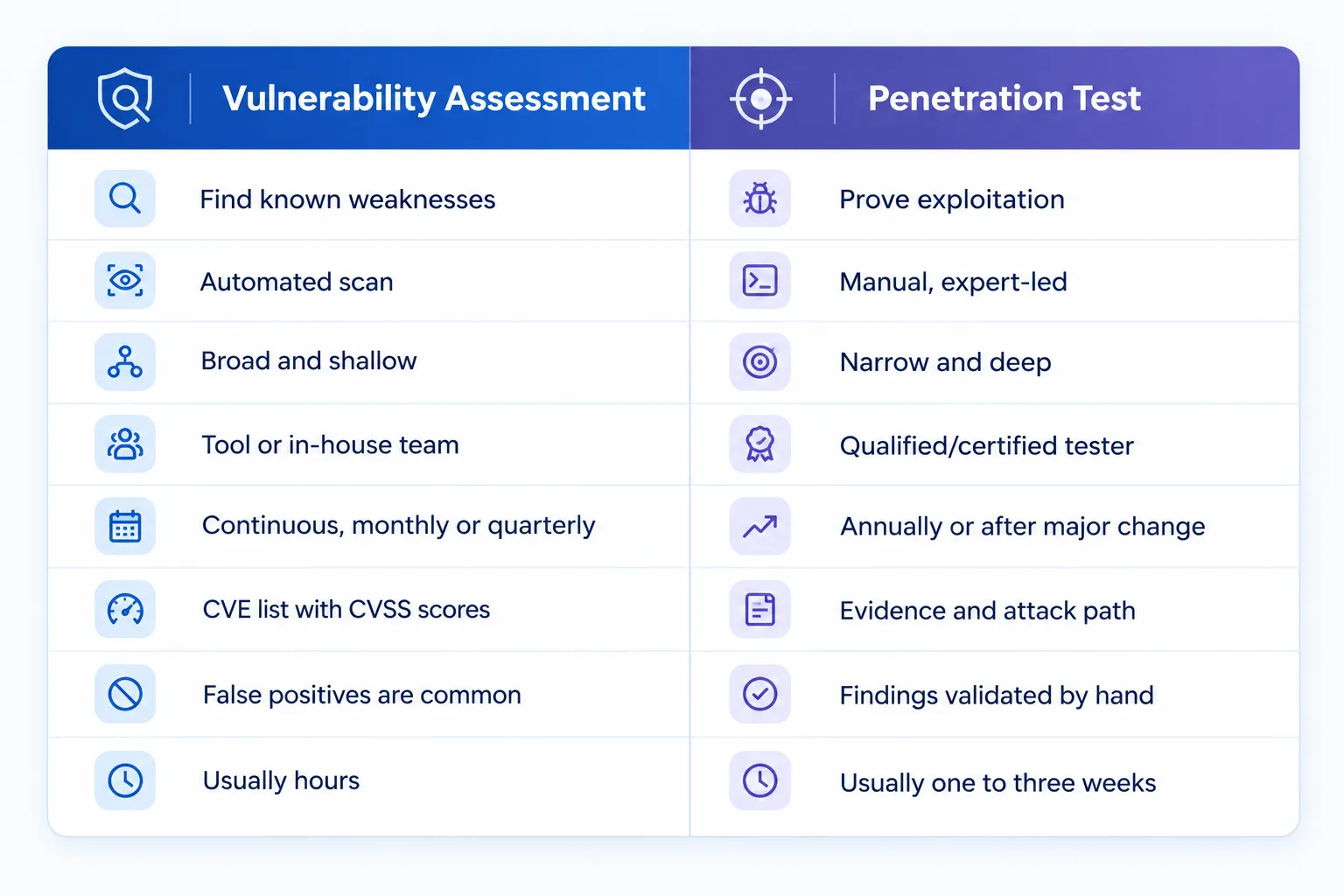
What these differences mean in practice
- A scan may return hundreds of medium-severity findings without showing which one an attacker would actually use.
- A scanner will not normally chain a weak password policy with an unpatched server to reach a finance system. A tester can attempt that route.
- A clean scan report shows that known weaknesses were not detected. It does not prove that security controls withstand a targeted attack.
Which one do you need?
- Scenario A: Start with a vulnerability assessment. Choose this route when current visibility is poor, the asset inventory is uncertain, or patching has no regular cycle.
- Scenario B: Go for a penetration test. This fits organisations that already scan and patch, are launching a new application, or need to validate existing controls.
- Scenario C: Use both. This is relevant where a regulator or customer requires testing, or where payment, health or government data is involved.
They are sequential rather than competing activities: scan to find, patch to fix, test to prove.
How often should you run each?
- Vulnerability assessments: Run continuously or at minimum quarterly to maintain ongoing visibility into known security flaws. (PCI Perspectives)
- Penetration testing: Conduct at least annually and whenever significant infrastructure or application changes occur.
- ISO 27001: Requires regular technical compliance reviews and vulnerability management as part of routine ISMS maintenance.
- Regional frameworks: UAE IA Standards/NESA and Saudi NCA ECC specify periodic assessments based on organizational risk profiles and applicable controls.
Governance alignment: Testing schedules should align with regional compliance requirements to ensure continuous audit readiness.
What to check before you commission either
- Tester credentials: Check OSCP, CREST or CEH credentials, and confirm who will perform the testing.
- Written scope: Define included assets and explicit exclusions.
- Retesting: Check whether remediation retesting is part of the fee.
- Deliverable: A raw scanner export is not a penetration test report.
- Rules of engagement: Agree on testing limits and an escalation contact before work starts.
Recent Posts
Frequently Asked Questions
No. VAPT is a bundled service covering vulnerability assessment and penetration testing. Penetration testing is one part of VAPT.
No. A scan tells you what might be exploitable. A penetration test verifies what can actually be exploited within scope.
Typically one to three weeks, plus reporting time. The scope and complexity of the environment determine the actual duration.
For applicable PCI DSS requirements, yes. PCI DSS v4.0.1 includes recurring vulnerability scanning and penetration-testing requirements, with the exact obligations depending on the organisation’s scope. (PCI Security Standards Council)
A penetration test looks for exploitable weaknesses within a defined scope. A red team exercise simulates a specific adversary end-to-end and can also test detection and response.

Protect your online assets from cyber threats with Paramount
Comprehensive cyber security solutions for individuals and businesses
Significantly reduce the risk of cyber threats and ensure a safer digital environment.
