
Blog
AI Governance in Practice: Why Speed Needs Guardrails, Not Hype

AI is now part of daily work in many companies. People use it for writing, summaries, code, search, support, and even decisions. That makes AI useful, but it also makes it different from older systems such as databases, servers, or standard software. A database gives a predictable result when you feed it data. AI does not always do that. It can give the wrong answer, change its behaviour after deployment, or sound confident while being wrong. That is why AI governance is not just another policy layer. It is a practical way to control how AI is used, where it is used, and how much risk an organisation is willing to accept.
Everyone wants the speed, productivity, and competitive advantage AI promises, but very few organisations are fully prepared for the risks that come with it. That exact tension became the centre of a detailed discussion between AI and security leaders Prabh Nair and Pradeep Menon during a podcast session focused on AI adoption and governance. Their conversation was not just all theory; they also focused on practical concerns businesses are already facing, including reckless AI adoption, hallucination risks, shadow AI, accountability, security responsibilities, and the growing pressure on CISOs to balance innovation with control.
What Does AI Governance Really Mean?
A strong point made in the discussion was that AI governance is not about filling out a huge spreadsheet or creating a fancy checklist for the sake of it. It is about a set of operating rules that control AI so it supports the business instead of creating chaos. In simple terms, AI governance covers strategy, policy, controls, risk management, and the practical guardrails that tell people when to use AI and when not to use it. It also has to stay separate from older forms of governance, because AI can hallucinate and can change behaviour in ways that static systems usually do not.
One useful example from the conversation was everyday use. If someone uploads health reports into a chatbot or asks it to act like a doctor, that is not smart use, even if the tool is impressive. The example showed that governance starts at home, with basic awareness about what should never be entered into AI tools. That is why policy and user guidance matter as much as technical controls.
Why is AI Harder to Govern Than Older Technology?
The key challenge is unpredictability. Traditional IT systems usually behave in a fixed way. AI does not. It can produce different results for similar inputs, and it may still look correct while being wrong. That is the source of both value and risk. The discussion also pointed out that AI is already involved in decision-making, which raises the stakes. This is why AI governance has to be stronger than older governance models copied straight from IT or standard GRC practice.
The podcast also pushed back against the idea that governance always slows innovation. The better view was that governance should be a road enabler, not a roadblock. That matters because many teams rush into AI due to fear of missing out or pressure from senior leaders, rather than because they have a clear business case. In the discussion, this was described as “panic spending without a strategy”. That kind of speed may look productive at first, but it often creates weak controls, weak adoption, and weak results later.
Why Do Some AI Projects Stay Stuck in Pilot?
A major theme was that enthusiasm for AI often sits at the top of the organisation, while the middle layers remain less convinced because the tools are not fully built into workflows. Many companies still treat AI like a chat box or a side experiment rather than something that improves day-to-day work. That is why so many projects stay in pilot and never become production systems. The problem is not only technology. It is also a weak process design and unclear ownership.
The conversation gave a strong example of this gap. A chief executive sees AI at a conference, comes back excited, and tells the team to adopt it without a plan, controls, or use case. That kind of decision creates adoption pressure, but not business value. The better approach is to ask why AI is needed, where it fits, and what level of control is required before it is introduced.
Risk Tolerance Is Not the Same in Every Use Case
One of the clearest ideas from the discussion was that AI risk should match the business context. A content team using AI for drafts is not the same as a sales team using AI for invoices or a hospital using AI for diagnostics. The content use case may carry a lower risk, while the invoice or diagnostic use case can touch sensitive data, money, or patient safety. A single blanket rule does not work well because the harm from failure is different in each case.
This was explained through a healthcare example. AI used for patient token generation can carry a higher risk tolerance because a human can still check the outcome. AI used for diagnosis should have a much lower tolerance because the consequences are more serious. That distinction matters. It shows that governance is not just about saying yes or no. It is about deciding how much human review is needed, how sensitive the task is, and what level of error the business can live with.
Hallucination is a business risk, not just a technical quirk
The discussion spent a lot of time on hallucination. The point was not that every hallucinating system is useless. The point was that every organisation must decide whether the risk is acceptable. If a model gives a wrong answer, the company has to ask whether that error will damage reputation, security, safety, or trust. That is why risk tolerance matters. Some companies may accept mild hallucination in low-stakes use cases. Others cannot accept it at all.
There was also a useful reminder that sales teams have always made claims, and buyers have always had to judge those claims carefully. The example showed that people often blame the tool when a purchase fails, but the real issue is whether the buyer had the right expectations and controls. AI works the same way. A model should not be sold as perfect. Quantified claims, such as measured accuracy or known limits, are more credible than vague promises like “100 percent protection”.
Shadow AI, prompt injection, and model leakage
Another major risk discussed was shadow AI. This happens when people use AI tools on their own, outside approved systems, and without proper oversight. The conversation gave examples such as doctors using public tools on mobile devices, or teams requesting API access and data access without a full review. That kind of activity creates exposure because no one has defined what data can be used, how it should be protected, or who owns the risk.
The discussion also raised prompt injection, model inversion, and supply chain risk. These are not theory-only concerns. A third-party model can bring hidden weaknesses, and a badly handled prompt can expose sensitive information. The point was simple: AI risk is not just an infosec issue or just an AI issue. It is a combined business, IT, security, and data issue. If one layer fails, the full system can fail.
What should the CISO do?
The podcast made a strong distinction between being a roadblock and being an enabler. The CISO should not merely regulate AI use. The CISO should help create secure AI systems, advise on controls, understand where AI is being used, and decide how much monitoring is needed. The CISO is accountable for security around the AI system, especially from the outside, such as infrastructure, architecture, and controls. But inside the AI use case, accountability must also sit with data owners, AI owners, and system owners.
This is where role clarity matters. If HR uses AI for hiring data, HR and the relevant data owner cannot step away from responsibility. If IT runs the platform, IT owns its side of the risk. If security sets the control layer, security owns that part. The message was that AI accountability should be shared across the business, not dumped on one person.
Safe AI and secure AI are not the same thing
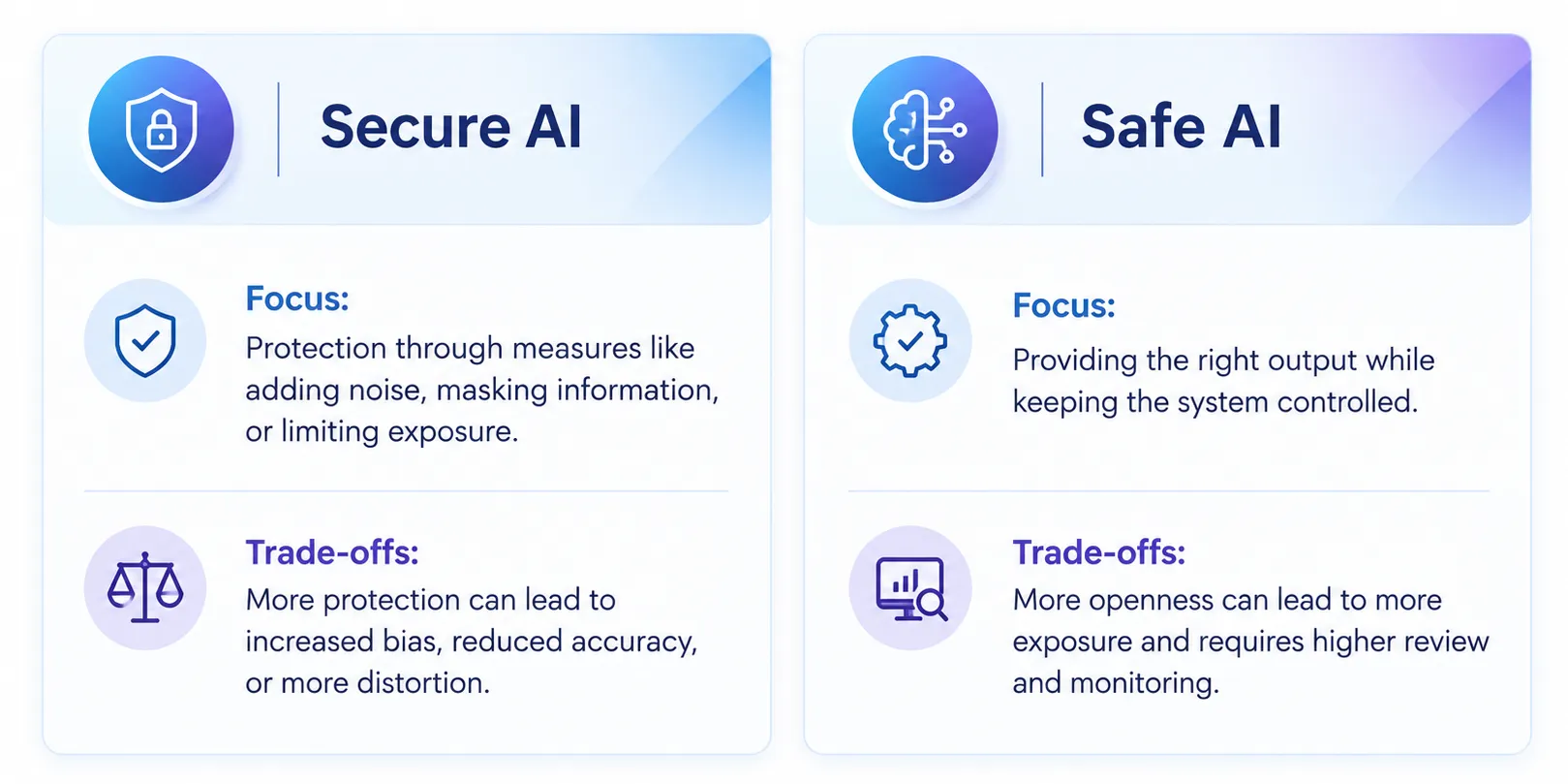
A useful distinction in the conversation was between safe AI and secure AI. Secure AI focuses on protection. It may add noise, mask information, or limit exposure. That can help security, but it can also increase bias or reduce accuracy. Safe AI, on the other hand, aims to provide the right output while still keeping the system controlled. The trade-off is clear: more protection can mean more distortion, while more openness can mean more exposure. The right answer depends on the use case.
This is exactly why governance should start with the business context. A customer-facing system, a medical use case, and a back-office experiment should not have the same controls. The more sensitive the use case, the more review, monitoring, and human oversight it needs.
What a good AI governance framework looks like
A good AI governance framework was described as one that controls people, process, and technology together. It should also be built through collaboration between legal, privacy, security, IT, and ethics. If those five groups are not working together, the framework will be weak, no matter how polished the documents look. Management approval and funding are also essential, because governance without support becomes a paper exercise.
The discussion also stated that the best starting point is responsible AI principles. Those principles include privacy, fairness, transparency, explainability, accountability, and controlled autonomy. Once those are in place, the organisation can build controls around them and then update the framework when new regulations arrive. That way, the framework is not tied to one law or one region. It is built to absorb change.
How often should AI be reviewed and audited?
The advice given was practical. Critical AI systems should be reviewed every three months. Non-critical systems can be reviewed every six months. Waiting a full year for high-risk systems was not recommended because AI changes too quickly. This is different from many older systems, where annual review cycles may still work. AI needs a faster rhythm of monitoring, testing, and auditing.
Another piece of advice given in the same conversation was that companies should not wait for regulation before acting. A better approach is to begin with a strong framework based on responsible AI, then do gap assessments when new rules appear. That keeps the governance model current without starting from scratch each time the law changes.
Certifications and learning paths
The discussion closed with guidance on learning and certification. The recommendation was to begin with ISO 42001 because it gives a foundation in AI governance, policy, controls, and the Plan-Do-Check Act cycle. After that, the next step depends on the learner’s goal. Someone who’s focused on governance can move toward AIGP. Someone focused on security can study AI security architecture and then look at AISM. Someone interested in audit can study AIA. The overall message was that understanding the framework matters more than collecting badges.
The same idea came up again when the speaker described a framework that combines ISO 42001, the EU AI Act, and NIST-style thinking. The point was not that one standard replaces all others. The point was that a company can build a strong base from the main responsible AI principles, then map new controls to that base as needed.
Final thoughts
The most important lesson from the podcast is simple. AI should be used with intention, not panic. It can improve speed, productivity, and quality, but only when the organisation knows why it is using AI, what data it is feeding, where the risk sits, and who is responsible when something goes wrong. Fast adoption without controls may look impressive for a while. Strong governance makes AI useful for the long term.
Recent Posts
- Top 5 Cyber Security Risks in 2026: What GCC and Saudi Leaders Need to Watch Closely
- Everything You Need to Know About Quishing: The QR Code Scam You Can’t Ignore!
- Why is choosing the Right Security Operations Center Necessary?
- Spot & Stop Phishing
- Rockwell Automation is rocked by serious Vulnerabilities: A Comprehensive Approach to Securing Industrial Control Systems

Protect your online assets from cyber threats with Paramount
Comprehensive cyber security solutions for individuals and businesses
Significantly reduce the risk of cyber threats and ensure a safer digital environment.
