
Blog
Cloud Migration Strategy for Middle East Enterprises: A Complete Guide

Cloud Migration Strategy for Middle East Enterprises: A Complete Guide
Your compliance lead flags a recent cloud deployment for violating local data residency rules. The project lead insists it passed all internal checks. Meanwhile, your audit deadline looms, and your cloud partner is asking for exemptions that don’t exist.
Middle Eastern enterprises are accelerating cloud adoption. This is evident from the fact that the global cloud market is expected to reach US$1,266.4bn by 2028 (source).
This adoption, however, is often pursued without a baseline cloud migration strategy. Migrations are approached as isolated infrastructure projects, not phased business transformations. This leads to misaligned workloads, rework during audits, and missed SLAs, especially in sectors bound by NCA, NESA, or QCB mandates.
This guide offers a practical, business-aligned approach to Azure cloud migration for Middle Eastern enterprises. Whether you’re in banking, telecom, or government, this roadmap is designed to support compliance, optimize performance, and minimize disruption while avoiding the most common pitfalls.
What is Cloud Migration Strategy?
A cloud migration strategy is more than a technical blueprint for moving data and applications; it is a phased business transformation. It is a high-level plan that guides an organization’s transition from on-premise infrastructure to a cloud environment. The strategy must go beyond isolated infrastructure projects to ensure workloads are properly aligned, avoid rework during audits, and prevent missed SLAs, particularly in highly regulated sectors bound by mandates such as NCA, NESA, or QCB. For enterprises in the Middle East, a compliant design based on the regulatory context is the essential foundation for any scalable and secure migration plan.
Why Cloud Migration is Critical for Middle East Enterprises?
For Middle East enterprises, transitioning to the cloud has evolved from a technical choice to a vital business move. It’s no longer just about upgrading systems; it’s about staying resilient, keeping pace with regional progress, and ensuring that your data remains both secure and fully compliant with local laws.
Here’s why cloud migration is critical for Middle East enterprises:
- Driving National Digital Transformation Agendas – Cloud adoption is a cornerstone of national vision programs across the GCC, such as Saudi Arabia’s Vision 2030 and the UAE’s National Innovation Strategy. Enterprises are mandated to digitize public-facing services and internal operations to align with these goals, which are designed to diversify economies away from reliance on oil and gas. Cloud infrastructure provides the necessary scalability and resilience to host large-scale e-government, smart city, and national ID projects, making migration a strategic imperative, not just an IT choice.
- Mandates for Regulatory Compliance and Data Sovereignty – The Middle East operates under some of the world’s strictest data residency and sovereignty laws, enforced by bodies like the National Cyber Authority (NCA) in Saudi Arabia, the National Electronic Security Authority (NESA) in the UAE, and the Qatar Central Bank (QCB). Cloud migration is critical because modern cloud platforms offer sophisticated, verifiable controls for data localization, encryption, and access management that aging on-premise infrastructure often cannot meet. Failing to migrate to a compliant cloud environment exposes enterprises to severe penalties, failed audits, and operational shutdowns.
- Accelerating Agility and Innovation – In competitive regional markets like financial services and telecom, time-to-market is crucial. Cloud platforms enable rapid deployment of new services through DevOps and containerization. This agility allows Middle East enterprises to quickly adapt to geopolitical shifts, rapidly provision resources for seasonal demand (e.g., during Ramadan or major events), and stay ahead of global competitors who are aggressively adopting cloud-native approaches.
- Optimizing Cost and Operational Efficiency – While initial migration costs can be significant, the long-term operational expense model of the cloud (pay-as-you-go) offers superior efficiency. By shifting from CapEx (buying and maintaining physical servers) to OpEx, enterprises free up capital for core business innovation. This is particularly relevant in a region where energy costs for large data centers can fluctuate, and real estate for on-premise infrastructure is at a premium. Cloud services allow dynamic scaling, ensuring resources are not over-provisioned, thereby managing costs more effectively than static on-prem environments.
Unique Cloud Migration Realities in the Middle East
Migration frameworks designed for the US or EU markets do not hold up in the Middle East. Enterprises in the region operate under layered regulations, NCA in Saudi Arabia, NESA in the UAE, and QCB in Qatar. These aren’t recommendations; they’re legally enforceable. Data residency, encrypted storage, approved vendors, and in-country backups are non-negotiable.
While global hyperscalers are expanding regional zones, many critical workloads still fail compliance for cloud migration in the Middle East. The issue often starts upstream with architectural decisions that ignore local hosting rules or encryption standards. These missteps require expensive retrofits during audits or trigger full project resets.
In this region, cloud migration cannot begin with tooling or infrastructure. It must start with the regulatory context. A compliant design is the only viable foundation for any scalable, secure migration plan.
What Makes a Strong Cloud Migration Strategy?
A cloud migration strategy is far more than a checklist of servers to move; it is the strategic blueprint for realizing your organization’s future potential. A truly robust strategy aligns every technical decision with overarching business goals, ensuring the journey to the cloud generates real competitive advantage, enhances resilience, and, critically for the Middle East, guarantees compliance from day one.
The success of your migration rests on five interdependent pillars, transforming a complex technical project into a predictable business outcome:
- Business-Driven Portfolio Assessment (The ‘Why’): A strong strategy begins with rigorously defining the business value of moving each application. Instead of migrating everything, prioritize workloads that unlock the highest ROI, reduce immediate risk, or are critical for national digital mandates. This involves classifying applications using the 6Rs framework (Rehost, Refactor, etc.) and focusing resources where they deliver the maximum business impact.
- Regulatory Context as the Foundation (The ‘How-to-Comply’): In the GCC, compliance is not a post-migration afterthought; it is the non-negotiable starting point. A strong strategy mandates an early mapping of all workloads against regional standards like NCA, NESA, and QCB. This ensures that the chosen cloud regions, encryption methods, data residency rules, and access controls are baked into the architecture, preventing costly retrofits or audit failures later on.
- The Landing Zone (A Secure and Governed Home): Before a single application is moved, a mature strategy establishes a well-governed landing zone. This zone is the secure, pre-configured environment in the cloud that enforces security and compliance policies automatically. Key elements include centralized identity and access management (IAM), automated cost monitoring and tagging, and a network topology that supports regional compliance for data flow and isolation.
- Skills and Operating Model Readiness (The ‘Who’): Migrating to the cloud fundamentally changes how IT operates. A strong strategy includes a clear plan for upskilling internal teams in cloud architecture, DevOps, and FinOps (cloud financial management). This ensures that once the applications are migrated, your organization can efficiently manage, optimize, and innovate with the new cloud resources, maximizing the long-term benefit of the investment.
- Optimization as a Continuous Cycle: Many organizations view migration as the end goal, but a strong strategy recognizes it as the beginning. It establishes a continuous loop of performance tuning, cost management, and security posture improvement. Post-cutover activities should be defined to ensure tag hygiene is enforced, resources are appropriately scaled (avoiding costly over-provisioning), and new cloud-native services are adopted to drive ongoing efficiency.
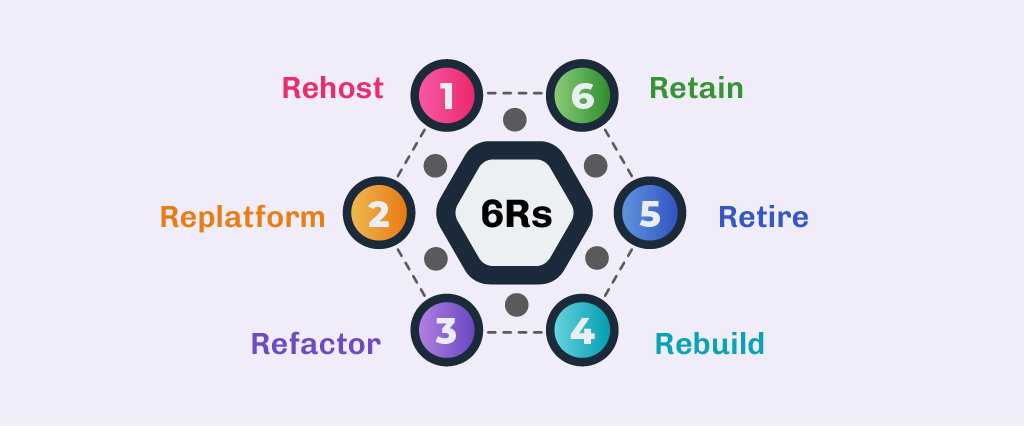
Types of Cloud Migration Strategies (6Rs)
Every workload should be evaluated before migration. The 6Rs framework helps classify applications based on complexity, business value, and regulatory exposure. Without this discipline, enterprises either overspend on unnecessary reengineering or face compliance issues due to shallow refactoring.
Below are the six cloud migration strategies, adapted for regional realities:
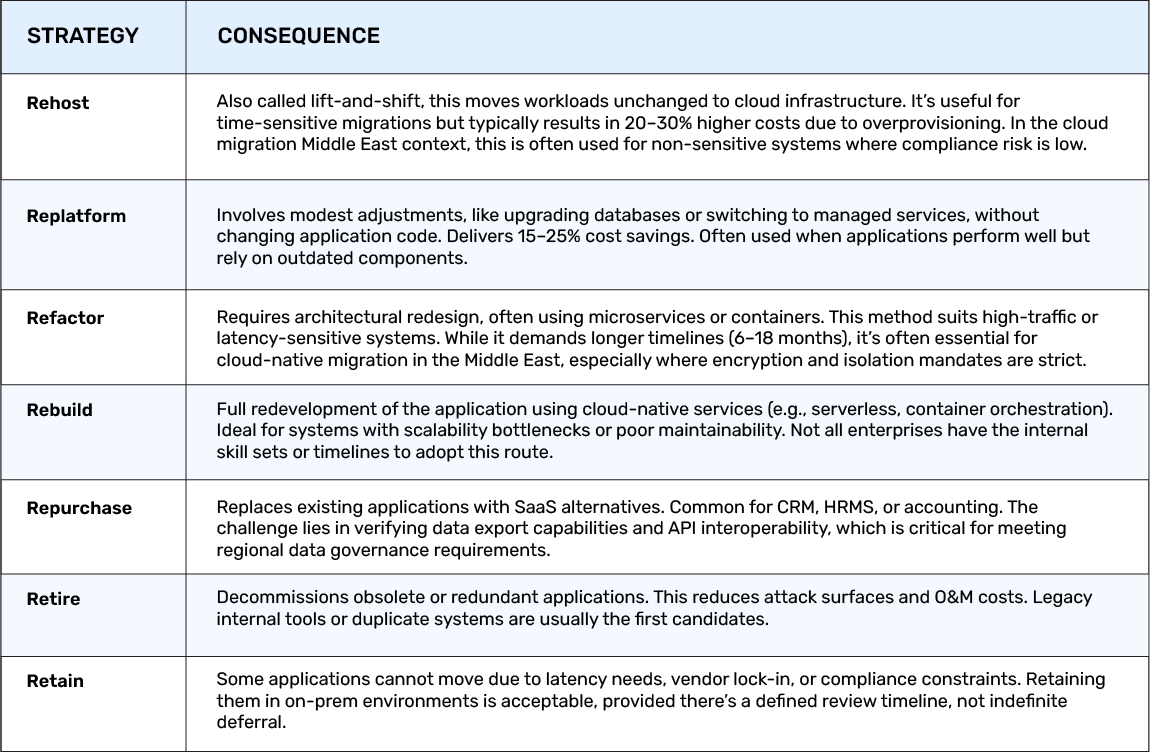
The 6Rs framework brings clarity to migration decisions. In regulated sectors, each path must be validated not just for technical feasibility but for alignment with compliance for cloud migration in the Middle East.
Azure Cloud Migration Strategy for Enterprises
When global enterprises look to the cloud for digital transformation, Microsoft Azure often emerges as a preferred platform, particularly in highly regulated markets like the Middle East. A systematic Azure cloud migration strategy, guided by the Cloud Adoption Framework (CAF), focuses intensely on governance, security, and achieving local compliance mandates.
A successful Azure cloud migration hinges on leveraging its integrated tools and regional infrastructure to meet specific business and regulatory needs. This strategy is structured around key pillars that ensure a transformation is not only technically sound but also audit-ready from the start:
- The Microsoft Cloud Adoption Framework (CAF) as a Roadmap: Azure’s recommended cloud migration path centers on the CAF, providing detailed guidance across strategy, planning, and governing the new state. For Middle Eastern entities, CAF’s emphasis on governance and compliance mapping is paramount for aligning with requirements set by authorities like NCA, NESA, and QCB.
- Foundation (Azure Landing Zone (ALZ) for Governance): The crucial first step is deploying a well-architected Azure Landing Zone. This acts as the pre-configured, scalable environment that applies baseline security policies, networking controls, and identity management. For the GCC region, the ALZ must enforce data residency rules by selecting in-country Azure regions and using private networking for secure connectivity.
- Assessment & Planning with Azure Migrate: The technical discovery phase leverages Azure Migrate to perform a comprehensive portfolio assessment. This tool identifies server dependencies, estimates costs, and recommends the optimal 6Rs strategy (Rehost, Refactor, etc.) for each application. This is vital for avoiding scheduling issues caused by legacy systems with hardcoded IPs or unsupported protocols.
- Governance and FinOps Integration: Azure offers tools like Azure Policy and Azure Cost Management. A strong strategy mandates using these to enforce tag hygiene for cost allocation and to set guardrails that prevent non-compliant resource deployments. This maintains control over operational spend (OpEx) and ensures continuous efficiency post-migration.
- Security and Regional Sovereignty: Meeting stringent data sovereignty laws requires leveraging Azure’s compliance certifications and specific services:
- Data Residency: Utilizing local Azure regions and Azure Storage services configured for in-region data persistence.
- Key Management: Implementing Azure Key Vault to centralize and manage encryption keys, ensuring the enterprise retains control over its data security perimeter.
- Identity: Integrating on-premise identity with Microsoft Entra ID (formerly Azure AD) to enforce least-privilege access models across the cloud estate.
The Cloud Migration Phases – An Executable Roadmap
A successful migration is not one large move. It’s a phased execution with defined checkpoints, risk controls, and compliance overlays, especially in regulated Middle Eastern environments.
Here’s a five-phase roadmap tailored to cloud migration for Middle Eastern enterprises:
Phase 1: Discovery and Assessment
Begin by identifying what applications exist, their interdependencies, and their readiness for the cloud. This is where most teams underestimate the complexity. Legacy systems with hardcoded IPs, unsupported OS versions, or outdated auth protocols routinely derail schedules.
Use Azure’s cloud migration readiness tools like Azure Migrate, AWS Migration Evaluator, or Turbonomic to automate discovery and generate dependency maps. Don’t move forward without validating:
- Application dependencies and shared infrastructure
- Data classification and compliance for cloud migration in the Middle East
- Licensing and vendor restrictions
Phase 2: Strategy and Planning
This is where architectural decisions lock in downstream risk. Define which workloads will be rehosted, refactored, or replaced based on the 6Rs. Establish your landing zone, which includes network architecture, IAM policies, encryption controls, and logging standards.
Key planning requirements include:
- Selecting a compliant cloud model and in-region availability zones
- Establishing rollback paths and cutover windows
- Mapping business priorities against technical readiness
Phase 3: Landing Zone and Control Implementation
Before migrating any data, implement your cloud security posture. Regional regulatory mandates require you to configure:
- In-region storage zones
- Encrypted backups and key management
- Identity federation and least-privilege access models.
This phase also includes policy enforcement, defining logging, cost monitoring, and guardrails for workload segmentation. Failure here often leads to failed audits and retroactive remediation.
Phase 4: Migration Execution
Use practices such as:
- Pilot migrations for tool validation
- Blue-green or parallel cutovers for critical workloads
- Stakeholder alerts and helpdesk readiness before each move.
Each cutover must be followed by a validation checklist: Did the application come online? Were security controls carried over? Did performance baselines hold?
Migration tools such as CloudEndure, AWS Application Migration Service, and Carbonite can accelerate this phase while reducing risk.
Phase 5: Stabilization and Optimization
Cutover is not the end. This is where most cloud migration Middle East efforts succeed or unravel.
Key activities post-migration:
- Validate encryption and IAM policies
- Check tag hygiene and cost thresholds
- Tune workloads for performance and scaling
- Align optimization with Middle East cloud migration optimization best practices
This is also the time to schedule compliance audits and finalize documentation for regulators.
Cloud Migration Best Practices
Moving to the cloud is a major strategic commitment, not just a technical task. To ensure your migration delivers lasting value, from better security to lower operating costs, it’s essential to follow proven methods. These best practices help transform your plan into a successful, compliant, and optimized cloud environment.
- Prioritize a Business-First Assessment: Start by clearly defining the business outcome for every application you plan to move. Instead of lift-and-shift everything, use the 6Rs framework to strategically categorize workloads. Focus resources on applications that provide the highest return on investment (ROI) or are critical for national digital transformation initiatives.
- Establish a Strong Regulatory Foundation: Especially in the Middle East, compliance is the non-negotiable starting point. Before any migration begins, ensure your cloud architecture is mapped against local mandates like NCA, NESA, and QCB. This includes pre-selecting in-region data centers and baking in required encryption and data sovereignty controls from the initial design phase.
- Build a Secure Cloud Landing Zone First: The landing zone is your governed home in the cloud. It must be built and configured before moving any applications. This zone enforces crucial policies automatically, such as centralized Identity and Access Management (IAM), mandatory security logging, and network segregation, ensuring all future workloads land in a compliant environment.
- Treat FinOps as a Daily Practice: Cloud financial management (FinOps) is key to controlling costs. Implement tools for continuous cost monitoring and set strict guardrails. Regularly review resource usage, enforce tag hygiene (labeling resources for cost tracking), and decommission unused resources to maximize the long-term operational savings of the cloud model.
- Invest in Team Readiness and Upskilling: Cloud operations require new skills in areas like DevOps, security engineering, and cloud architecture. A critical best practice is to invest in upskilling your internal IT and development teams. This ensures that after the cutover, the team can effectively manage, secure, and innovate using the new cloud tools, rather than relying indefinitely on external consultants.
- Automate Everything Possible (Infrastructure as Code): Use tools like Terraform or Azure Resource Manager (ARM) to define your infrastructure through code. This eliminates manual errors, ensures environments are consistently deployed, and speeds up recovery from issues. Automation is essential for maintaining scale and consistency in large-scale enterprise migrations.
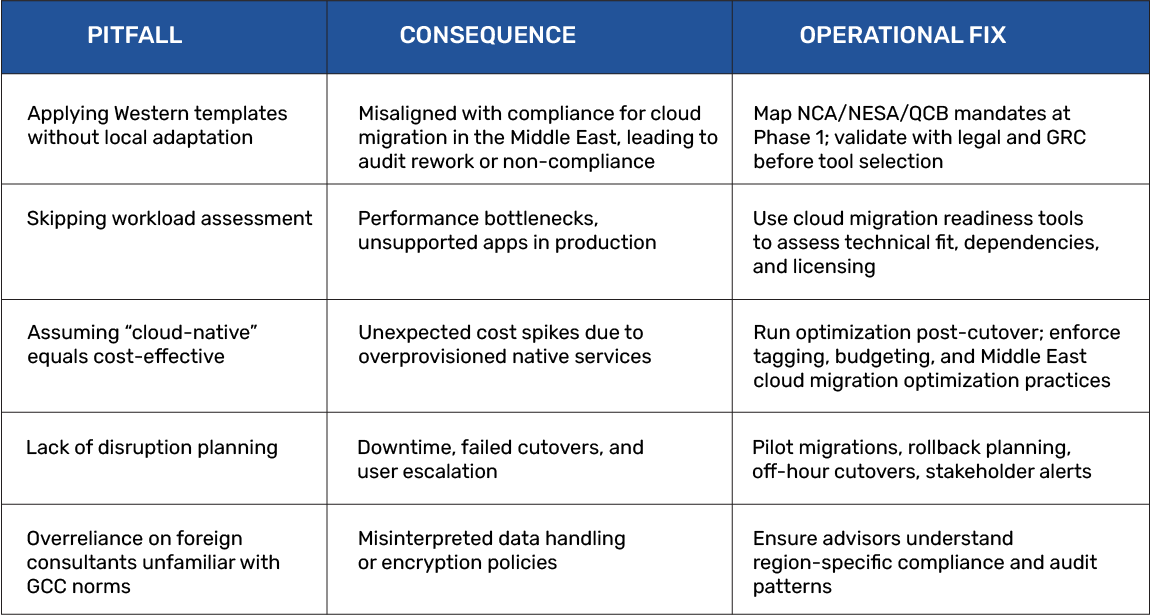
Common Pitfalls to Avoid During Cloud Migration in the Middle East
Even with a sound plan, cloud migration in the Middle East fails when regional complexity is underestimated. Below are common failure points and how to address them.
Benefits of Cloud Migration
Moving to the cloud is more than just a tech upgrade; it’s a strategic business decision that unlocks significant value. Below is a look at the major benefits you can expect from a successful cloud migration.
- Financial Efficiency and Cost Control: The switch from buying and maintaining physical servers (CapEx) to a pay-as-you-go subscription model (OpEx) is a major financial advantage. You only pay for the computing resources you actually use, which prevents costly over-provisioning. This flexibility helps businesses, especially those growing quickly, manage budgets more effectively and free up capital for strategic initiatives.
- Unmatched Scalability and Agility: Cloud services provide the unique ability to instantly scale resources, such as storage and processing power, up or down based on fluctuating business demand. This flexibility ensures that you can handle sudden traffic surges (like during seasonal events) without performance bottlenecks, allowing your business to adapt swiftly to market changes and stay agile.
- Enhanced Security and Compliance Posture: Cloud providers dedicate massive resources to security, often implementing more robust measures than individual organizations can afford. This includes advanced features like encryption, multi-factor authentication, and constant network monitoring to protect sensitive data. By leveraging these built-in controls, you can simplify adherence to strict regional and global regulatory standards.
- Superior Business Resilience and Disaster Recovery: With data stored redundantly across multiple secure locations, the cloud inherently offers a strong defense against data loss or service disruption. Cloud providers offer comprehensive disaster recovery services that enable swift data recovery following a cyber-attack or a physical disaster, ensuring business continuity with minimal downtime.
- Focus on Core Innovation: By outsourcing the heavy lifting of IT maintenance, like patching, managing security hardware, and updating infrastructure, to the cloud provider, your internal IT teams are freed up. This allows your talent and capital to be redirected toward creating new business value, developing innovative services, and focusing on core business goals.
Partner with Paramount for Cloud Migration Success
A single misstep, wrong region selection, unenforced encryption, or incomplete dependency mapping, can cause audits to fail or workloads to be rolled back at scale. For regulated industries, this isn’t just a delay. It’s risk exposure.
That’s where Paramount comes in. Our consultants don’t just support technical migrations. They help you operationalize a compliant, business-aligned cloud migration strategy from the ground up.
We work with enterprises across the GCC to:
- Map cloud workloads to regulatory mandates (NCA, NESA, QCB) before tooling is selected.
- Design and enforce landing zone controls, covering identity, encryption, and cost containment.
- Drive post-migration optimization across tagging, access, and region-specific tuning.
Whether you’re modernising legacy systems or scaling out new services, Paramount ensures your cloud migration delivers audit-ready outcomes, not just uptime.
Recent Posts
- Cloud cost optimization strategies for the Middle East| Paramount
- Data Classification for GCC Enterprises: A Strategic Guide to Policy, DLP & Governance
- Let’s root for each other and watch each other grow
- SAP Security for UAE IA Standards & Saudi NCA ECC
- What Is DNS? A Complete Guide to the Domain Name System
FAQs
Enterprises must comply with mandates from the National Cyber Authority (NCA) in Saudi Arabia, the National Electronic Security Authority (NESA) in the UAE, and the Qatar Central Bank (QCB). These are legally enforceable and cover data residency and sovereignty.
The 6Rs framework (Rehost, Replatform, Refactor, Rebuild, Repurchase, and Retire/Retain) helps classify applications based on their complexity, business value, and regulatory exposure to determine the best migration path.
A Landing Zone is a secure, pre-configured environment in the cloud that enforces security and compliance policies automatically, such as identity management (IAM) and network topology, before applications are moved.
FinOps, or cloud financial management, is a practice used to control costs, enforce tag hygiene for cost allocation, and prevent over-provisioning, ensuring the long-term efficiency of the OpEx cloud model.
The roadmap includes: (1) Discovery and Assessment, (2) Strategy and Planning, (3) Landing Zone and Control Implementation, (4) Migration Execution, and (5) Stabilization and Optimization.
While Rehosting is useful for time-sensitive moves, it can result in 20–30% higher costs due to over-provisioning and is best suited for non-sensitive systems where compliance risk is low.
These laws require that specific data remain within the country. Strategies must include selecting in-region availability zones and using local storage services to ensure legal compliance.
Teams identify existing applications, their technical interdependencies, data classification, and readiness for the cloud to avoid delays caused by legacy systems.
Yes, the “Retain” strategy allows applications to stay on-premise due to latency needs or compliance constraints, provided there is a defined timeline for future review.
Automation, through Infrastructure as Code (IaC) tools like Terraform, eliminates manual errors, ensures consistent environment deployment, and speeds up recovery from technical issues.

Protect your online assets from cyber threats with Paramount
Comprehensive cyber security solutions for individuals and businesses
Significantly reduce the risk of cyber threats and ensure a safer digital environment.
