
Blog
Next-Generation Firewall (NGFW) vs Traditional Firewall: How They Differ
Reading Time: 9 Minutes
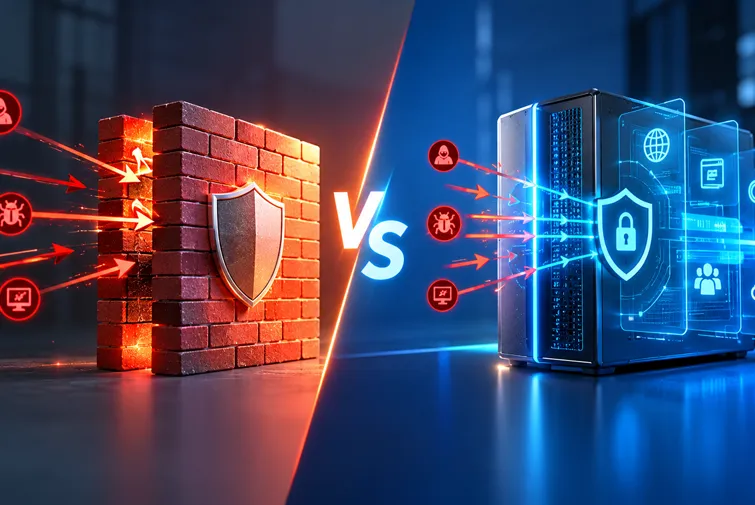
A traditional firewall allows or blocks traffic using IP address, port and protocol, mainly at OSI Layers 3 and 4. A next-generation firewall (NGFW) does the same basic job, then inspects applications, users and traffic content up to Layer 7. Application control, integrated intrusion prevention, encrypted traffic inspection and user identity awareness are central NGFW capabilities. Most organisations do not need both at the perimeter. An NGFW generally replaces the traditional firewall there.
What a traditional firewall does
A packet is a small unit of network data, while a port identifies a service or communication endpoint. A traditional firewall checks these details against its rules. With stateful inspection, the firewall remembers the connection that a packet belongs to.
- Filters traffic using source and destination IP, port and protocol.
- Works mainly at OSI Layers 3 and 4.
- Can be stateless or stateful, depending on whether it tracks connections.
- Often includes basic VPN support.
What a next-generation firewall (NGFW) does
An NGFW includes the functions of a traditional firewall and adds deeper traffic inspection and security controls. Gartner’s current network firewall material describes stateful traffic inspection as a core firewall function, while Gartner Peer Insights descriptions of NGFW products show the wider combination of application control and intrusion prevention.
- Application awareness and control: Identifies applications and applies rules to them.
- Integrated IPS: Detects and blocks suspicious network activity within the firewall.
- Deep packet inspection: Reads the content inside traffic, rather than checking only its address label.
- User and identity awareness: Links traffic to named users or directory groups.
- TLS/SSL inspection: Decrypts and inspects encrypted traffic where policy permits.
- Live threat intelligence: Uses current threat information when making security decisions.
For organisations reviewing their next-generation firewall deployment, these controls bring application-level visibility into the security policy.
NGFW vs traditional firewall: the key differences
The ngfw vs traditional firewall comparison is easier to assess when each capability is placed beside its equivalent.
Side-by-side comparison table
What these differences mean day-to-day
- A traditional firewall may permit all traffic on port 443, so approved SaaS and an unsanctioned file-sharing service can appear identical at that level.
- It cannot inspect the contents of encrypted traffic without an additional capability, leaving less visibility into what that traffic contains.
- IP-based rules do not identify a person consistently when the same employee moves between devices.
Where traditional firewalls fall short today
- Encrypted traffic: A traditional firewall can see where encrypted traffic is going, but not what sits inside it.
- Cloud and SaaS: Applications may communicate directly with users without crossing the old office perimeter.
- Remote and hybrid users: People working away from the office sit outside that original network edge.
- Separate security products: IPS, web filtering and antivirus may operate as separate products, making policy coordination harder.
Do you need both? Generally, no. An NGFW is designed to replace the traditional firewall at the perimeter.
When to move to an NGFW
An upgrade deserves consideration when:
- The current firewall is approaching end of support.
- Security teams cannot see which applications staff are using.
- Separate IPS or web-filtering appliances are still being maintained.
- Compliance requirements call for application-level controls or stronger logging. Depending on the environment, UAE IA Standards, Saudi NCA ECC and PCI DSS may be relevant.
- Remote users or cloud workloads have grown substantially since the firewall was installed.
For organisations operating across the Gulf, the decision should follow the actual network design, traffic requirements and compliance scope.
What to check before you choose an NGFW
The headline throughput figure is not enough. Check what happens when security inspection is switched on.
- Throughput with inspection enabled: Throughput is how much traffic the firewall can handle before network performance suffers.
- TLS inspection: Confirm that encrypted-traffic inspection can handle the organisation’s expected volume.
- Multi-site policy management: Check how security policies are managed across different locations.
- SIEM and monitoring integration: Verify how events and logs connect with existing monitoring tools.
- Licensing model: Understand which security features require subscriptions and how costs change as usage grows.
A firewall that performs well with inspection disabled can produce a very different result once its security features are active.
Recent Posts
Frequently Asked Questions
No. An NGFW includes traditional firewall functions and adds application, user and content inspection.
An NGFW works across Layers 3 to 7, compared with Layers 3 to 4 for a traditional firewall. Layer 7 is where application-level traffic is understood.
It can see connection details and the destination, but not the content inside encrypted traffic. An NGFW can decrypt and inspect it where policy permits.
Yes. An NGFW protects traffic crossing the network, whereas endpoint protection protects the device itself. The two controls address different points.
They overlap. UTM generally combines several security functions in one appliance and is often associated with smaller organisations. NGFW centres on application-layer control and integrated IPS for enterprise environments.

Protect your online assets from cyber threats with Paramount
Comprehensive cyber security solutions for individuals and businesses
Significantly reduce the risk of cyber threats and ensure a safer digital environment.
