
Blog
Identity and Access Management in the GCC: What CISOs Need to Get Right
Author:
Yanish Sahu | Shiju Chandroth
Reading Time: 8 Minutes

A latest industry report found that infostealer malware exposed over 300,000 ChatGPT credentials in 2025, consistently corresponding to infostealer infections and leaked credentials collections observed in 2024 and earlier.
Credential theft is still scaling rather than slowing down.
That shift changes more than the threat model. It changes the control point. When an attacker enters with a legitimate account, the breach is no longer defined by a firewall failure or an unpatched endpoint. It is defined by a failure to verify identity, limit access, or detect misuse fast enough.
That is why Identity and Access Management (IAM) matters more now, especially in the GCC. Identity and Access Management decides who gets access, how they prove they are authorized, and what they are allowed to do once inside.
Since the Middle East is tightening cybersecurity and compliance expectations, those decisions now affect audit readiness as much as breach exposure.
What Is Identity and Access Management (IAM)?
Identity and Access Management is the system that controls how identities are created, verified, and granted access across an organisation’s digital environment. Identity management controls digital identities across systems.
It answers three enforcement questions:
- Who is requesting access
- How their identity is verified
- What they are allowed to do once access is granted
That sounds straightforward. Execution is not.
Every organization operates with multiple identity types. Employees, contractors, vendors, service accounts, and customer-facing identities all interact with different systems. Each identity carries a different risk profile. Treating them uniformly creates exposure.
Identity management handles the lifecycle. It defines how identities are created, updated, and removed. Failures here lead to orphaned accounts and lingering access long after a user has left the organization.
Access management controls permissions. It defines what each identity can access and under what conditions. Failures here lead to over-permissioned users, which remain one of the most common causes of internal and external breaches.
A functional identity access management system connects both layers. It ensures that access is not just assigned correctly at the start but continuously validated over time.
This is where most implementations break. Access is granted once and rarely revisited. Roles expand, responsibilities shift, and temporary access becomes permanent. Over time, access reflects history, not current need.
Modern IAM implementations address this through:
- Role-based or attribute-based access models
- Continuous authentication and session validation
- Periodic access reviews tied to business ownership
- Integration with security monitoring systems
None of these are optional in regulated environments. They are expected controls.
In the GCC, Identity and Access Management is defined by how well identity lifecycle, authentication, and access enforcement map to regulatory requirements and operational risk.
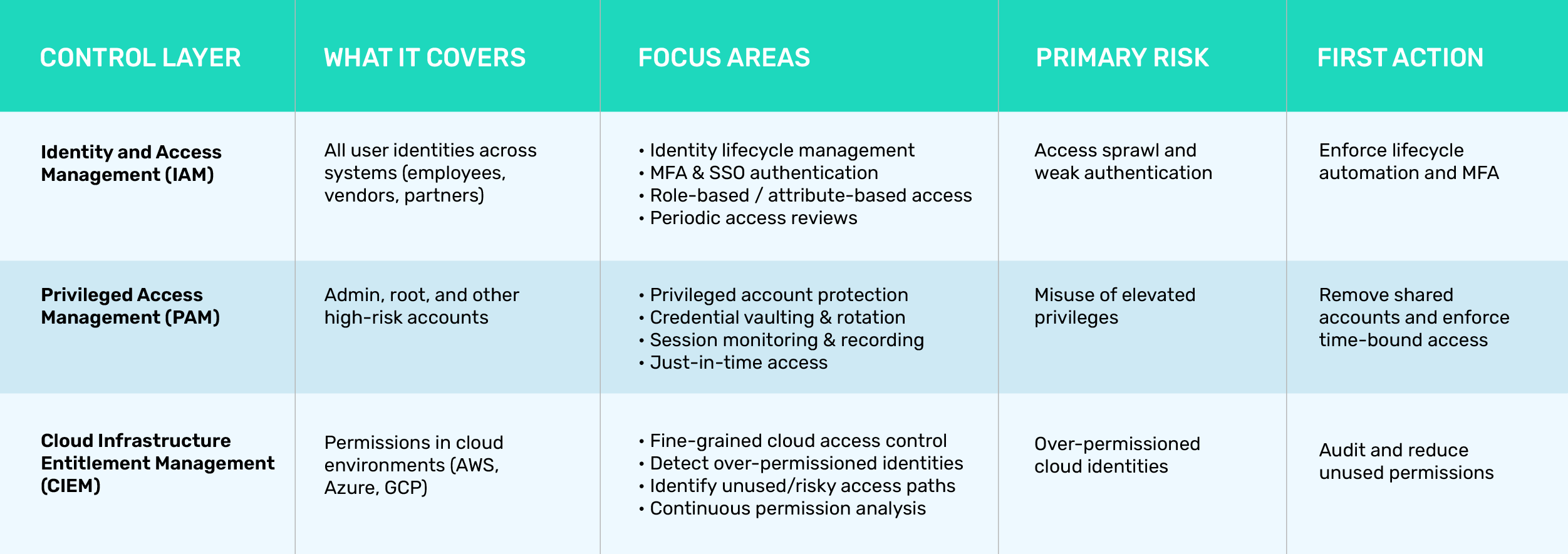
IAM vs. PAM vs. CIEM: What Each Control Layer Actually Does
Security teams often group these terms together. That creates overlap in tooling and gaps in control. Each exists to solve a different access problem. Treating them as interchangeable leads to incomplete coverage.
What is the difference between IAM, PAM, and CIEM?
The difference comes down to scope and risk level. Each system controls a different type of access.
How GCC Regulations Are Driving IAM Investment
In many GCC organizations, IAM adoption is strongly shaped by audit and compliance requirements, even as security and digital transformation needs continue to grow.
Regulators particularly in Saudi Arabia and the UAE have moved from broad cybersecurity guidance to enforceable controls. Identity is where most of those controls land.
This changes how organizations treat Identity and Access Management in three ways.
1. IAM moves from IT ownership to audit ownership
Controls under NCA ECC-2:2024 and UAE cybersecurity frameworks are not optional. They are assessed. Access control, authentication, and identity governance are now a part of audit scope.
This forces organizations to formalize identity management policies. Informal access approvals or undocumented exceptions no longer pass review.
2. Access decisions need evidence, not intent
Regulations require proof. It is not enough to say least privilege is enforced. Organizations need to show:
- Who has access
- Why they have it
- When it was last reviewed
This drives investment in access management systems that can produce audit trails on demand.
3. Manual processes fail at scale
Joiner-mover-leaver workflows, periodic access reviews, and privileged access controls cannot be handled manually once audit frequency increases.
This is where identity access management platforms become necessary. Automation replaces email-based approvals and spreadsheet tracking.
4. Non-compliance creates operational risk, not just penalties
Failure to meet identity-related controls does not stop at fines. It leads to:
- delayed certifications and approvals
- Restrictions on working with government or regulated sectors
- Increased scrutiny during incident response
For many organizations, this becomes a revenue risk. That is why IAM investment is accelerating, because organizations can no longer operate without them.
What Are the Key IAM Best Practices for Organizations in the GCC?
The most effective Identity and Access Management practices in the GCC are those that map directly to regulatory controls while reducing real access risk.
Anchor identity lifecycle to HR and vendor systems – Identity management must be tied to authoritative sources such as HRMS and contractor systems. In GCC audits, orphaned accounts are one of the most common findings. Automate joiner-mover-leaver workflows so access is created and revoked based on verified status, not manual requests.
Enforce MFA based on risk, not just access type – Regulations in Saudi Arabia and the UAE require strong authentication, but enforcement often stops at VPN or email. That leaves cloud consoles and internal systems exposed. Apply MFA across all critical systems, with stricter enforcement for privileged and remote access.
Replace static roles with context-aware access: Traditional role-based access often leads to over permissioning, especially in large enterprises common in the GCC. Move toward attribute-based access, factoring role, location, device, and session context.
Make access reviews business-owned and auditable: Many organizations run access certifications as IT exercises. That fails during audits because ownership is unclear. Assign access ownership to business units. Ensure every review produces a record that can be audited.
Separate and control privileged access aggressively: Shared admin accounts and standing privileges still exist across many organizations in the region. These fail both security and compliance checks. Use identity access management with PAM integration to enforce time-bound privileged access and eliminate shared credentials.
Align cloud access with CIEM principles early: Cloud adoption in the GCC is accelerating, especially driven by Saudi Vision 2030 and UAE digital initiatives. Permissions often scale faster than governance. Audit cloud identities regularly. Remove unused permissions and monitor privilege escalation paths.
Integrate IAM with detection and response systems: Identity signals are often isolated from SOC operations. That delays response to compromised accounts. Feed IAM logs into SIEM and SOC workflows to detect anomalous behaviour, not just failed logins.
Map every IAM control to a regulatory requirement: IAM implementations often fail audits because controls are deployed without clear mapping to frameworks like NCA ECC-2:2024. Document how each Identity and Access Management control satisfies specific regulatory clauses.
Each of these aligns directly with GCC regulatory expectations. None of them require advanced tooling to start. Most failures come from poor execution, not lack of technology.
Aligning Zero Trust IAM to NCA ECC-2:2024 and UAE Cybersecurity Law
Zero Trust is a set of enforceable identity controls based on the principle of: never trust, always verify.
Mapping that to GCC requirements involves:
- Continuous authentication: ECC requires strong authentication. Zero Trust extends this to session-level validation.
- Least privilege enforcement: Both Saudi and UAE frameworks require access restriction. Zero Trust enforces this dynamically.
- Device and context-based access: Access decisions should factor location, device health, and behaviour.
- Audit and visibility: Regulatory frameworks require logging. Zero Trust depends on it.
A Zero Trust IAM model satisfies compliance by design. It does not require separate compliance layers.
How to Build an IAM Roadmap
Most IAM programs fail because they start with tools. An effective IAM roadmap starts with identity visibility, then builds enforcement layers aligned to risk and regulation. Starting with tools leads to fragmentation. Starting with identity structure leads to control.
Step 1: Map identities and access flows
Start by identifying every type of identity interacting with your environment. Employees are only one category. Contractors, vendors, service accounts, and customer identities often carry equal or higher risk.
Focus on where identities originate and how access is granted today. In most GCC organizations, HR systems define employee identities, while vendor access is managed informally. That gap creates unmanaged entry points.
If identity creation is not tied to a single source of truth, access control will remain inconsistent.
Step 2: Identify high-risk access points
Admin accounts, cloud consoles, remote access systems, and integrations with external partners create the highest exposure.
List where elevated permissions exist and how they are used. In many cases, privileged access is broader than required and rarely time bound.
Reducing risk at this stage is more effective than trying to fix it after scale.
Step 3: Define access policies
Access models often evolve through exceptions. Over time, those exceptions become the norm.
Define how access should be granted based on role or attributes. Then remove one-off permissions that do not follow that logic. If access cannot be explained in one sentence, it should not exist.
Step 4: Implement foundational controls
Multi-factor authentication, lifecycle automation, and access reviews are often implemented partially. That creates blind spots.
Apply MFA across all critical systems, not just external access points. Automate joiner-mover-leaver processes so access reflects current roles, not historical ones. Ensure access reviews are completed and recorded, not just scheduled.
Step 5: Extend to privileged and cloud access
Privileged access and cloud permissions require separate attention. They do not behave like standard user access.
Admin rights should be temporary and traceable. Cloud roles should reflect actual usage, not default configurations. In most environments, unused permissions accumulate faster than they are removed.
This is where identity access management needs to extend into PAM and CIEM controls.
Step 6: Integrate monitoring and response
In the GCC, IAM is measured through compliance. Controls need to map directly to frameworks such as NCA ECC-2:2024.
Track how users behave after authentication, not just whether they logged in successfully. Sudden changes in access patterns often signal compromise before traditional alerts trigger. Document how identity lifecycle, authentication, and access governance satisfy specific clauses. If a control cannot be mapped, it will not hold during audit.
Building Audit-Ready IAM with Paramount
Paramount helps organizations operationalize IAM as a control layer by aligning identity governance with regulatory requirements, automating lifecycle and access controls, and strengthening visibility across users and systems.
This approach is supported by:
- Consistent policy enforcement across on-prem and cloud environments, ensuring access decisions are not fragmented across systems
- Automation of joiner–mover–leaver processes, reducing manual effort and minimizing delays or errors in provisioning and deprovisioning
- Business-aligned access reviews, with clear ownership and accountability tied to roles and functions
- Continuous monitoring of access posture, enabling early detection of anomalies, over-provisioned accounts, and policy violations
- Reduced reliance on manual controls, helping teams scale governance without increasing operational overhead
The focus is not just on passing audits, but on reducing identity-driven risk in a measurable, repeatable way.

ABOUT AUTHOR


Recent Posts
- Types of Phishing Scams: How Cybercriminals Trick Their Victims
- Everything You Need to Know About IGA Light
- The End of the Password Era: What Passwordless Authentication Means for Dubai’s Digital Future
- The Most Critical Cyber Threats Middle East Businesses Face
- Essentials To Achieve Information Security Compliance
FAQ
Identity and Access Management (IAM) is a framework of policies, processes, and technologies that enables organizations to manage digital identities and control user access to critical information and systems. It ensures that the right individuals have access to the right resources at the right time, for the right reasons, and prevents unauthorized access. Key functions include authentication (verifying identity) and authorization (determining access rights).
IAM is fundamental to minimize the risk of data breaches and cyberattacks, meet various compliance mandates (e.g., GDPR, HIPAA, PCI DSS), streamline user provisioning, de-provisioning, and access request, simplify access for users, and safeguard sensitive data and intellectual property from internal and external threats.
IAM holds heightened importance in the Gulf Cooperation Council (GCC) due to several unique factors:
Rapid Digital Transformation: GCC nations are aggressively pursuing digital transformation, smart city initiatives, and economic diversification (e.g., Saudi Vision 2030, UAE Vision 2021). This rapid digitalization increases the attack surface and the need for robust security.
Critical Infrastructure & Energy Sector: The region is home to vital oil, gas, and financial infrastructure, making it a prime target for sophisticated cyber threats. Protecting these assets requires stringent access controls.
Evolving Regulatory Landscape: GCC countries are developing and enforcing stricter data residency, sovereignty, and privacy laws (e.g., UAE’s Federal Data Protection Law, KSA’s National Data Governance Policy), making comprehensive IAM essential for compliance.
Diverse and Dynamic Workforce: The region often has a diverse, transient workforce, requiring efficient and secure management of identities and access for employees, contractors, and partners across various nationalities and roles.
Increased Cyber Threat Landscape: The GCC faces a growing volume and sophistication of cyberattacks, necessitating advanced IAM strategies to defend against identity-based threats.
A comprehensive IAM strategy typically includes several core components:
- Single Sign-On (SSO): Allows users to log in once and access multiple applications without re-authenticating.
- Multi-Factor Authentication (MFA): Requires users to provide two or more verification factors to gain access, significantly enhancing security.
- Privileged Access Management (PAM): Manages, monitors, and secures privileged accounts (e.g., administrators, root users) that have elevated access rights.
- Identity Governance and Administration (IGA): Focuses on managing the lifecycle of digital identities and access rights, ensuring compliance and auditing.
- Access Management (AM): Defines and enforces policies for who can access what, under what conditions.
- Customer Identity and Access Management (CIAM): Manages external customer identities, focusing on user experience, scalability, and security for consumer-facing applications.
Organizations in the GCC might encounter challenges such as, legacy systems integration, talent shortage, budget constraints, regulatory complexity and resistance to change.

Protect your online assets from cyber threats with Paramount
Comprehensive cyber security solutions for individuals and businesses
Significantly reduce the risk of cyber threats and ensure a safer digital environment.
