
Blog
What Is Deep Packet Inspection (DPI) and How Does It Work?
Reading Time: 8 Minutes

Deep packet inspection (DPI) is a filtering method that checks both the header and payload of a data packet, much like checking the address on an envelope and the letter inside it. It operates up to Layer 7 of the OSI model, allowing it to identify applications, protocols and content that basic filtering sees only as an IP address and port. DPI runs in next-generation firewalls, intrusion prevention systems, data loss prevention tools and SASE platforms to block malware, prevent data from leaving an organisation, and enforce traffic policies.
What deep packet inspection is
Every piece of data moving across a network is divided into packets. Each packet contains a header, which identifies where it came from and where it is going, and a payload, which carries the actual data.
Basic packet filtering reads the header. DPI deep packet inspection reads both.
DPI is a technique rather than a standalone product. It can be built into several network security and traffic management tools.
- Header: network information such as source and destination addresses.
- Payload: the actual content carried by the packet.
- DPI: inspection of both to understand what the traffic contains.
How deep packet inspection works
The process moves from capturing traffic to deciding what should happen to it.
The process, step by step
- Capture: Traffic is intercepted at an inspection point, usually a firewall, IPS or gateway.
- Decrypt where required: Encrypted traffic is decrypted for inspection under policy and then re-encrypted.
- Reassemble: Packets are put back into their original order so the complete content can be examined.
- Analyse: The payload is checked against signatures, protocol rules and behavioural patterns.
- Act: Traffic is allowed, blocked, rerouted, throttled or logged.
The three inspection techniques
- Signature matching: Compares payloads with a database of known threats. Its weakness is that it depends on current threat signatures and may miss threats that are not yet catalogued.
- Protocol anomaly detection: Flags traffic that does not behave as the protocol expects. Its weakness is that unusual but legitimate traffic can be blocked.
- Heuristic and behavioural analysis: Looks for suspicious patterns rather than exact matches, which can help identify previously unseen threats. Its weakness is a higher risk of false positives.
DPI vs standard packet filtering
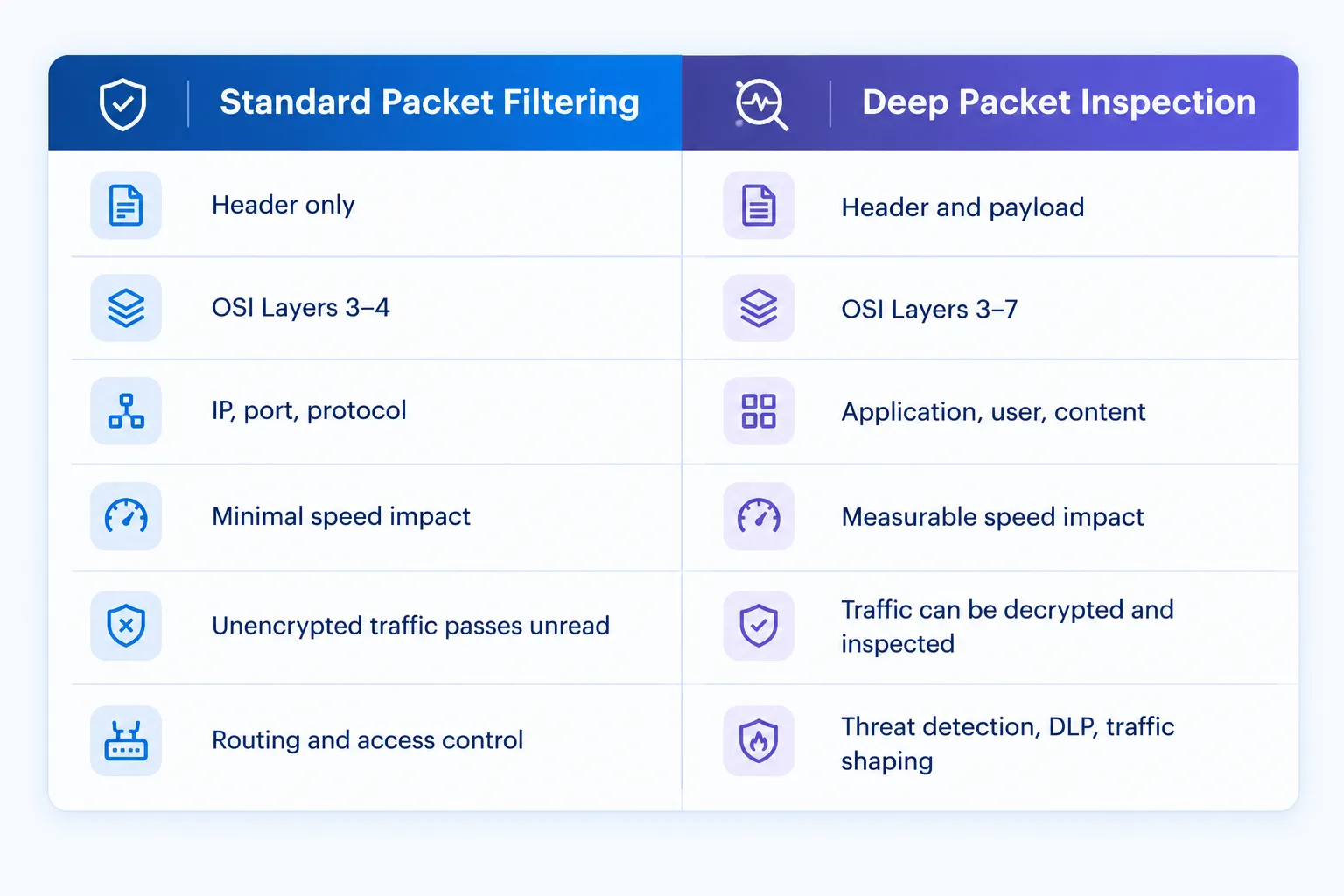
Where deep packet inspection is used
DPI has applications beyond basic threat detection:
- Signature matching: Compares payloads with a database of known threats. Its weakness is that it depends on current threat signatures and may miss threats that are not yet catalogued.
- Protocol anomaly detection: Flags traffic that does not behave as the protocol expects. Its weakness is that unusual but legitimate traffic can be blocked.
- Heuristic and behavioural analysis: Looks for suspicious patterns rather than exact matches, which can help identify previously unseen threats. Its weakness is a higher risk of false positives.
For organisations concerned about sensitive information leaving their environment, DPI can form part of a wider data security approach.
What DPI cannot do, and what it costs you
DPI has practical limits, and those matter when designing a network security architecture.
- Performance overhead: Inspection requires processing power and can create bottlenecks. Vendor throughput figures are often quoted with inspection disabled.
- Encryption: TLS 1.3 encrypts most of the TLS handshake, while Encrypted Client Hello (ECH) can protect SNI and other ClientHello information. This reduces what can be observed without decryption.
- Complexity: Rules and signatures require ongoing maintenance.
- False positives: Aggressive protocol rules can block legitimate traffic.
DPI is therefore not a complete defence on its own. It works as one capability within a broader network security architecture.
Privacy, consent and lawful use
Because DPI can inspect the contents of communications, its use can fall within data protection and privacy requirements. Organisations should establish clear policies and provide appropriate notification where required. Service-provider use is subject to the relevant telecom and regulatory framework.
In the Middle East, relevant frameworks include the UAE Federal Decree-Law No. 45 of 2021 on Personal Data Protection and Saudi Arabia’s Personal Data Protection Law (PDPL). The GDPR may also apply where an organisation processes personal data within its scope.
Frequently Asked Questions
Generally, an organisation can inspect traffic on its own network, subject to applicable data protection requirements, policies and notification obligations. Service-provider use can be governed by separate telecom rules.
Yes. DPI is processing-heavy and can create measurable overhead. Published throughput figures should therefore be checked to see whether inspection was enabled during testing.
Only after the traffic is decrypted for inspection under an applicable TLS inspection policy. TLS 1.3 and ECH reduce the information visible without decryption.
A VPN can hide the contents of traffic, but it does not necessarily hide the fact that VPN traffic is being used. DPI can identify and block VPN traffic based on protocol characteristics.
No. DPI is an inspection technique. A firewall is one type of security tool that can use DPI, alongside IPS, DLP and SASE platforms.

Protect your online assets from cyber threats with Paramount
Comprehensive cyber security solutions for individuals and businesses
Significantly reduce the risk of cyber threats and ensure a safer digital environment.
